
Sand mixers specified for telecom-enclosure foundries are typically rotor-style intensive mixers with batch capacities between 100 kg and 600 kg, drive power in the 20-75 kW band, and cycle times of 90-120 s per batch, matching the thinner section work and tighter dimensional window of indoor/outdoor telecom housings [S2][S5].
Telecom enclosures cast in aluminium or thin-wall grey iron tolerate low scrap rates only when mulling energy is consistent: a continuous foundry at 5-10 t/h needs a muller or rotor unit sized at 10-15 kW per ton of compacted sand per hour, with peak short-cycle high-intensity duty trending toward 20 kW/t [S2].
Why Rotor Geometry Wins for Telecom-Enclosure Work
Horizontal-shaft rotor mixers running tip speeds above 20 m/s are the preferred geometry for chemically bonded systems because activation energy must be injected in under 60 s, and that envelope suits the short-cycle moulding typical of thin-wall enclosure production [S2]. The rotor pattern combines a low-speed scraper that lifts material into the basin with two symmetrically driven rotors whose blades impact, cut and scrape the moulding sand; the combined action accelerates sand mixing while keeping the sand-bed temperature stable for binder activation [S1].
For a 20 t/h green-sand or shell line feeding enclosure moulds, the spec band is a 1,000-1,500 kg/cycle muller at 1.5-2.5 m/s wheel tip speed, paired with a 75-160 kW drive; the smaller 5-10 t/h envelope used by most telecom-enclosure foundries is comfortably served by intensive rotor units in the 300-600 kg/batch class at 40-75 kW, with cycle time locked to 90-120 s including charge, dry mulling, binder add, wet mulling and discharge [S2][S5].
Capacity, Drive Power and the kW-per-Ton Rule
Batch capacity is set by the highest hourly tonnage the moulding line will demand divided by realistic cycle time, and a 30 cycles/h floor for high-pressure green sand or 20 cycles/h for furan shell keeps the muller discharge window at 110-160 s including all recipe steps [S2]. Kelsons documents a clean ladder of intensive-mixer models: KIM-300-20 at 20 HP with 300 kg batch and 9 t/h mixing rate, KIM-500-40 at 40 HP / 500 kg / 18 t/h, KIM-600-75 at 75 HP / 600 kg / 21 t/h, KIM-750-100 at 100 HP / 750 kg / 22.5 t/h, and KIM-1900-150 at 150 HP / 1,000 kg / 30 t/h, with 90-120 s cycle and 36 batches/h at the upper end [S5].
Wheel tip speed governs the shear rate at the sand-wheel interface, and 1.5-2.5 m/s is the bentonite-activation band; pushing past 3.0 m/s wastes power as heat and shortens lining life without delivering proportional tensile-strength gain, which matters for enclosure castings where surface finish and pressure-tightness on machined faces drive scrap cost [S2]. Wheel loading is the complementary figure: high-pressure moulding lines want 800-1,200 kg of wheel mass per kW of motor input, while job-shop green-sand work sits comfortably at 1,500-2,000 kg/kW [S2].
Lining, Scraper and Discharge Trade-offs
Ni-Hard cast iron at approximately 550 HBW is the foundry default for abrasive green-sand duty, with a typical service life of 18-36 months in two-shift iron work, and foundry-grade replacement Ni-Hard wheels run USD 3,500-7,500 per set as the rate-limiting sub-assembly on the maintenance budget [S2]. Stainless-steel liners (commonly 304/316) are specified when sodium silicate or phenolic-urethane binders attack the ferrous lining, and polyurethane panels are used in resin-sand units where binder pickup on metal drives recurring clean-down cost [S2]. Ceramic bottom lining plates paired with optimised scraper and blade angles are a documented alternative that delivers smaller scraper clearance and more even sand mixing, and tungsten-carbide surfacing on scraper edges is a common wear-life upgrade [S1].
Side-unloading doors that shake sand out cleanly, spring-pressure regulating mixing mechanisms, diabase cast stone liners, and centralised forced lubrication on the main transmission are the design refinements that distinguish newer rotor units from older roller mills; the sand mixer reference on SourceBySpec lines these features against the corresponding failure modes for buyers cross-shopping older inventories. Discharge configuration also matters: a side door for high-tonnage continuous lines versus a manual or pneumatic bottom gate for the smaller 50-500 kg batch drum mixers used in jobbing foundries [S1][S4].
Binder Path: Furan, Phenolic-Urethane and Bentonite
Binder chemistry dictates both muller geometry and PLC recipe structure: furan acid-cured systems use a high-speed rotor with a 10-25 s binder add window and sand temperature held at 25-35 °C, while phenolic-urethane no-bake and shell processes follow different activation profiles that still favour rotor geometry for the short residence-time window [S2]. Green bentonite systems are the default for high-tonnage iron-enclosure work, with the mulling residence time typically 90-180 s before tensile strength rolls off, so the recipe must keep wet-mulling inside that envelope regardless of which mixer class is selected [S2].
Resin-sand lines and shell-sand lines for thin-wall telecom hardware have their own agitator sizing and binder-sand ratio, and the resin sand line reference on SourceBySpec walks through that matching. For high-speed rotor units running alongside a muller, a power mixer primer on impeller-class geometry is the supporting reading; buyers specifying shell-coating or chemically bonded enclosure work should also read the adjacent sand cooler page for downstream thermal envelope, because muller discharge temperature and the cooler inlet are the two interfaces that have to be sized together [S2].
Small-Batch and Job-Shop Mixers Below 600 kg
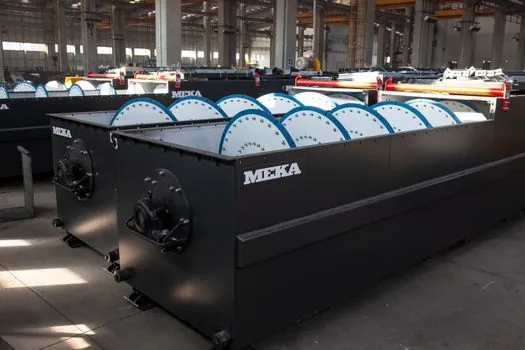
Smaller foundries and prototype enclosure work commonly use drum mixers and Counter-Current Intensive Mixers (CCIM) in the 50-500 kg batch range at 2-15 HP, with manual or pneumatic bottom discharge; cycle time runs 2-5 minutes per batch, and the mild-steel body with abrasion-resistant lining is the standard build [S4][S7]. Indian-built CCIM units cite 150 kg vessel capacity, 750 mm to 2.5 ft pan diameter, 24-28 RPM muller speed, and 2 HP motor at the lower end, with motor power scaling up to 7.5 HP for the 300-500 kg class [S7].
Vermac-style rotary drum mixers at 5-15 HP and 50-500 kg/batch are typical for jobbing foundries running mixed sand chemistries, and the gearbox-driven horizontal-shaft configuration gives consistent blending with minimal unmixed pockets at the 2-5 minute cycle window [S4]. For higher-tonnage work, the CE/ISO intensive sand mixer class built to the S14 series specification uses self-adjusting roller wheel height to bottom plate, anti-abrasion plates on both roller wheel outer race and bottom plate, and a grinding-and-abrasion action that suits medium-volume iron enclosure production [S3].
Standards, Sourcing and Audit Signals
The mechanical-design reference for rotor sand mixers in China is JB/T 7457-96, and the broader clay-sand-mixer reference is JB/T 505-96; outside China, equipment is generally built to OEM internal standards with the CE/ISO Intensive Sand Mixer designation for export markets, and the Kelsons intensive mixer line is explicitly positioned as equivalent to German standards [S1][S3][S5]. Ni-Hard wheel and liner supply is the rate-limiting sub-assembly in a procurement cycle, and the next realistic plant-side signal is the foundry's binder-system audit under IATF 16949, which is the point at which any kW-per-ton or recipe-handling gap surfaces in writing [S2].
For telecom-enclosure foundries the practical check is to align the foundry's hourly tonnage, the binder chemistry, and the discharge temperature window with the muller or rotor class above, and to budget the USD 3,500-7,500 per-set Ni-Hard wheel replacement as part of the total installed cost; the related Sand mixer selection for electronics housings: binder-first spec map and Sand Mixer Selection for Automotive Parts: 2026 Foundry Spec Map articles cover adjacent binder-first and high-pressure-moulding workflows that overlap this spec band [S2].