Aerospace foundries pouring nickel and cobalt superalloys, titanium, and premium aluminum alloys need sand reclamation units that preserve grain refractoriness above 1700°C, hold AFS-GFN within ±3 points across cycles, and keep iron and chromite contamination below 50 ppm on the face-sand fraction.
The 2026 procurement picture is shaped by three documented technical references: zircon sand (ZrSiO₄) with 65% minimum ZrO₂ and a 2550°C melting point for face-sand duty [S1]; V-Process casting's 95-98% reclamation rate on unbonded dry silica using 50-100 kPa vacuum [S2]; and bentonite-bonded greensand systems that reuse 20-30% of new sand per cycle when binder quality is held to specification [S3].
Aerospace Sand Reclamation: Scope and Definition
A sand reclamation unit in an aerospace foundry is the integrated train of shakeout, attrition, magnetic separation, screening, thermal or pneumatic classification, and dust collection that returns used molding media to a reusable state. Scope covers shell sand, nobake resin-bonded, greensand, and V-Process (vacuum) loops, each with different binder-burnout, dust-load, and grain-strength requirements. [S2]
Aerospace components raise the bar: investment-cast wax-pattern tooling, single-crystal turbine blade cores, and aluminum structural housings all require surface finishes in the Ra 6.3-12.5 µm band that V-Process can deliver on first pour [S2], with reclamation efficiency high enough to keep virgin sand makeup under 5% per campaign. The unit's classification step (typically 75-125 µm cut points with AFS-GFN 50-70 for face sand) is the deciding factor between aerospace-grade and commercial-grade output.
Selection Criteria: The Four Engineering Gates
Gate 1, binder chemistry, dictates whether the unit needs a calciner or a fluidized-bed thermal reactor. Resin-bonded nobake sand for aerospace cores requires 700-900°C burnout to destroy phenolic/urethane residues, while V-Process silica needs only mechanical attrition and dedusting because no binder is present [S2]. Greensand loops regenerate bentonite in situ and need a sand cooler plus mulling, not a calciner.
Gate 2, refractory preservation, matters most on zircon-faced molds. Zircon's 7-12 W/m·K thermal conductivity and 4.5-4.7 g/cm³ density [S1] mean reclamation must use gentle attrition (below 1.5 kW per ton of sand) to keep the angular particle shape that drives surface finish; over-aggressive mechanical scrubbing rounds the grains and degrades face-sand performance. Gate 3, contamination control, requires magnetic drums pulling ferrous tramp below 50 ppm and density separators rejecting chromite carry-over above 0.5%. Gate 4, throughput, scales the unit: a 5 t/h attrition module fits a Tier-2 aerospace job shop, while integrated 20-40 t/h thermal-plus-mechanical lines serve high-volume aluminum airframe casting.
Who It Is For, and Where It Fails
Thermal reclamation units are for foundries pouring nickel superalloys, cobalt alloys, and large titanium aerospace housings where binder burnout cannot be skipped; capital cost is 2-4× higher than mechanical-only systems, but the closed-loop thermal stage removes phenolic residue to below 0.3% LOI, the threshold above which core defects reappear. Mechanical reclamation is for V-Process and greensand shops where the binder is already designed for low-temperature reactivation [S3].
For sandblasting-room and surface-prep applications, the equipment class diverges entirely, with portable blast cabinets and wet-blast systems sized by nozzle orifice and cfm rather than tonnage [S4].
Comparison: Three Reclamation Routes on Five Decision Criteria
The three principal reclamation routes for aerospace work line up against the criteria that drive spec sheets: (1) V-Process mechanical attrition on dry unbonded silica delivers 95-98% recovery, 50-100 kPa vacuum integrity, Ra 6.3-12.5 µm finish, ±0.2-0.5 mm/25 mm tolerance, near-zero binder residue [S2]; (2) greensand bentonite-bonded loops with mulling and cooling hit 70-80% mass reuse per cycle, depend on bentonite's 1300°C thermal ceiling [S3], tolerate 20-30% new-sand makeup, and carry 2-5% moisture plus 5-11% bentonite mass fractions; (3) thermal reclamation for resin-bonded nobake cores runs at 700-900°C with multi-stage quench, drives LOI below 0.3%, and consumes 80-120 kWh/t on fluidized-bed units.
On capital cost, mechanical-only systems price lowest and thermal-recalciner systems price highest (often 2-4× the mechanical baseline). On surface finish, V-Process leads because the plastic film prevents direct metal-sand contact [S2]; greensand ranks second and resin-bonded core sand ranks third unless a zircon face coat is applied. On aerospace alloy compatibility, all three handle aluminum airframes, but only V-Process and thermal-recalciner systems cleanly process nickel superalloy pours where iron contamination must stay below 50 ppm on the face-sand side.
Process Linkage to Upstream and Downstream Equipment
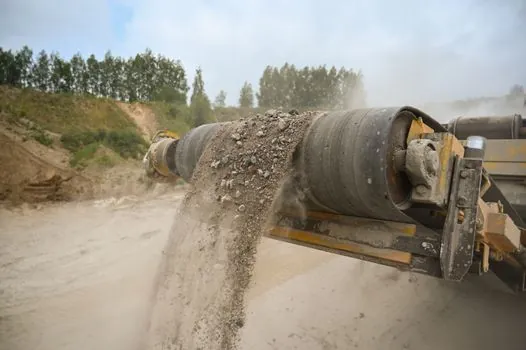
Reclamation performance is coupled to the upstream sand cooler on greensand and V-Process lines, because return-sand temperature above 120°C kills bentonite rehydration and cracks vacuum-film molds. On thermal lines, the cooler sits after the calciner quench and is sized to drop sand from 700-900°C to below 50°C before the classification screen. [S2]
Downstream, the hydraulic power unit driving the shakeout and attrition heads needs 15-25 kW per t/h on mechanical loops and 40-60 kW per t/h on integrated thermal lines. The coolant distribution unit is not part of a sand loop, but on adjacent machining cells feeding the same aerospace line, coolant cleanliness above NAS 8 keeps post-cast machining from recontaminating the surface finish the reclamation line is protecting. For environmental compliance, the FRL unit on the pneumatic conveying side of the reclamation train must hold 0.1-1.0 µm oil aerosol below 0.5 mg/m³ to keep oil from poisoning bentonite rehydration and clogging dust-collection filters.
Real Aerospace Use Cases and Operating Limits
Case A, aluminum airframe V-Process cell: 5-10 t/h throughput, unbonded silica, vacuum hold at -80 kPa, Ra 8-12 µm first-pass, 95-98% sand reuse, plastic film at 0.05-0.2 mm gauge [S2]. The reclamation unit here is mostly mechanical: shakeout, lump breaker, vibratory attrition, magnetic drum, and 2-stage dedusting. Case B, nickel superalloy investment-cored nobake line: 3-6 t/h, phenolic-urethane binder, thermal calciner at 800°C, fluidized-bed quench, magnetic separation, and density separator; LOI target 0.2-0.3%, ferrous below 30 ppm.
Operating limits: attrition energy capped at 1.5 kW/t to preserve angular zircon particle shape, dedusting air-to-cloth ratio 1.5:1 minimum, and return-sand temperature under 120°C before re-mulling.
Sourcing, Standards, and Trackable Signals
Procurement should anchor on three verifiable numbers: reclamation rate (95-98% V-Process [S2], 70-80% greensand [S3]), binder LOI after thermal stage (target ≤ 0.3% for resin-bonded loops), and AFS-GFN stability (within ±3 points over 50 cycles). Standards touching this equipment include ISO 9001 for OEM QA on the unit itself, plus regional foundry-emission rules (EU Industrial Emissions Directive as cited for bentonite-grade foundries [S3]) and ASTM E11 / ISO 3310-1 test sieves for classification cut-point verification.
Trackable signals through the rest of 2026: the V-Process reclamation band will likely widen below 95% as foundries push tolerance to ±0.15 mm/25 mm; thermal-calciner LOI targets are tightening from 0.5% to 0.3% on aerospace superalloy cores, and bentonite-grade foundries are extending reuse cycles toward 60-70% mass recovery on greensand lines [S3]. For adjacent cell design, see a related casting mold selection map for rail components where greensand and resin-bonded trade-offs are matched to a different operating envelope, and a zirconia ceramic selection guide for the rail industry where ZrO₂ content drives the same face-sand physics covered here.