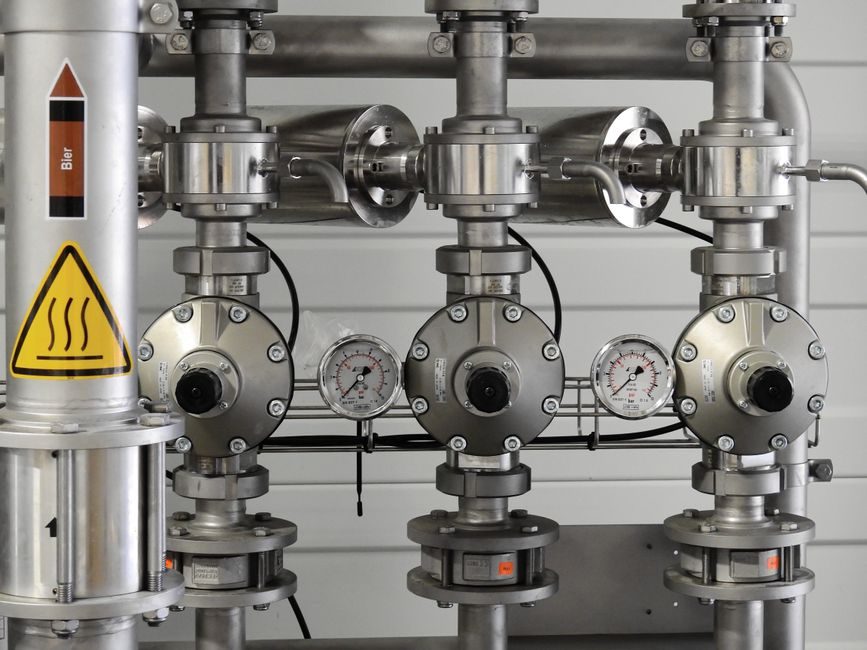
A centrifugal pump entering a sanitary process line must clear seven certification gates before it touches product contact: material pedigree, surface finish, mechanical seal scope, electrical area classification, performance verification, hygienic connection geometry, and documentation traceability [S3].
Specifying engineers should treat the certificate stack as a single deliverable — a 304 SS liquid end alone, for example, satisfies only the material gate; a separate elastomer and seal scope still has to be evidenced before a 100 °C CIP loop is signed off [S3]. For background on how a centrifugal pump is built into a sanitary skid, the process-engineer reference starts at the impeller and works outward.
Gate 1 — Material traceability and wetted-parts pedigree
Mill certificates with heat numbers, ASTM/EN grade calls, and full traceability from the casting house to the wetted component are the first audit ask; a Masterflex high-head pump lists its liquid end as 304 SS for the pump head and impeller plus an SS shaft, with that triple of grades visible on the nameplate and on the cert dossier [S3].
Cast-iron volutes and ductile-iron casings are common in industrial ISO 5199 lines but do not enter sanitary service — the ISW80-160 horizontal pipeline pump from Chinese OEM catalogues is offered in either cast iron or stainless steel, and only the SS build passes a hygienic audit [S2]. Multi-stage stainless CDLF4-120 designs, by contrast, ship as standard in stainless steel and are the safer default where audit tolerance is low [S2].
Gate 2 — Surface finish and cleanability
Product-contact Ra values in sanitary process lines are routinely specified at ≤ 0.8 µm for mechanical polish and ≤ 0.5 µm for electropolish; the Masterflex datasheet calls out stainless liquid-end components for corrosion resistance but does not publish an Ra number, so that value has to be demanded on the certificate rather than read off the brochure [S3].
Back-pullout construction — the design that lets the impeller and seal be overhauled without breaking the suction and discharge piping — is a cleanability feature because it keeps the pipe-work sterile boundary intact during seal changes [S3]. For an overview of how the back-pullout architecture slots into a broader molding line or hygienic skid, the disassembly sequence is identical regardless of whether the line is filling vials or moving resin.
Gate 3 — Mechanical seal and elastomer scope
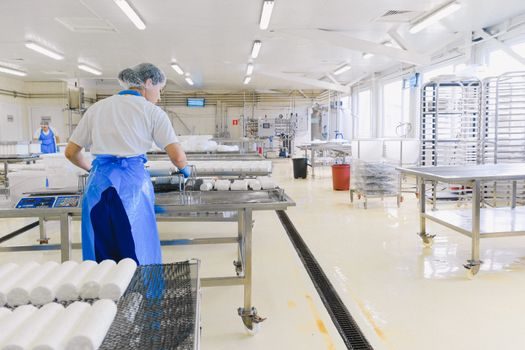
Type 21 mechanical seals with carbon versus ceramic/Viton faces and Viton O-rings are the named scope on the Masterflex 380 GPM build, with a maximum liquid temperature of 100 °C and maximum viscosity of 352 cP bracketing the operating envelope [S3]. Above 100 °C, EPDM or PTFE seals take over, and a 304 SS liquid end alone is no longer the controlling variable.
For hydraulic power units running parallel to the sanitary line, the mechanical seal certification checklist walks the same API 682 / ISO 21049 categories; a pump in a CIP return loop has to clear both checklists if the seal faces share a flush plan. Elastomer selection is covered separately in an O-ring certification checklist for corrosive fluid lines, which lists the seven chemical families that disqualify nitrile and butyl seals at room temperature.
Gate 4 — Electrical area classification and motor cert
TEFC motors at 208-230/460 VAC, 60 Hz, drawing 40.0-37.0/18.5 A and producing 15 hp at 3450 rpm are the drive spec on the Masterflex build, with the conduit box listed as a hard-wiring accessory [S3]. For Zone 1 / Class I Div 1 sanitary rooms the motor has to be upgraded to an explosion-proof or IECEx-certified frame, and the pump certificate stack has to be re-issued to include the motor nameplate and the certification body's Ex marking.
Voltage and frequency tolerance bands (typically ±10 % on 460 VAC, ±5 % on Hz) are not always printed on a Chinese OEM's product page, so a U.S. or EU specifier has to ask for a nameplate photo before purchase order release; the CDLF4-120 listing confirms material and use case but does not publish electrical tolerance [S2].
Gate 5 — Performance verification and CFD evidence

CFD simulation reports are now treated by most European EPCs as a partial substitute for the factory witness test, provided the mesh, turbulence model, and operating window are documented; a representative centrifugal-pump run on water at 1770 rpm, four components, 1.57 M total cells, k-omega SST turbulence, and second-order numerics produced a best-efficiency point of 82.45 % at 0.156 m³/s with 27.55 m of head and 50.99 kW of shaft power [S1].
The same dataset shows head rising from 23.27 m at 0.186 m³/s to 30.38 m at 0.126 m³/s, radial force dropping from 413.4 N to as low as 45.5 N, and axial thrust shifting from -8586 N at high flow to -9863 N near shut-off — the kind of curves a hydraulic engineer needs to size the thrust bearing before purchase order release [S1]. A second test point at 0.166 m³/s delivered 26.42 m of head at 82.43 % efficiency, confirming a flat efficiency curve between 0.146 and 0.166 m³/s [S1].
Gate 6 — Hygienic connection geometry and pipe-load behaviour
Sanitary pumps terminate in flanges or tri-clamp ferrules sized to the line; the Masterflex build ships with a 2.5" inlet flange and 1.5" outlet flange and a top-centerline discharge plus foot support under the casing, which is the geometry that keeps the pump self-venting and limits misalignment from pipe loads [S3].
The self-venting layout matters during CIP: air pockets at the discharge flange cold-spot the seal and shorten face life, and the only way to evidence the geometry is to demand a general-arrangement drawing with the centreline dimensioned. For engineers who are also reviewing mould-side flow on a molding line, the same centreline-discipline rule applies to the sprue/runner balance.
Gate 7 — Documentation, traceability, and re-certification cadence
The cert dossier has to include the mill cert, the Ra-measurement log, the seal and elastomer batch numbers, the motor nameplate, the witness-test or CFD report, the GA drawing, and a signed declaration of conformity to the relevant directive (e.g. EU Machinery Directive 2006/42/EC, FDA 21 CFR for contact materials, or 3-A Sanitary Standards for North American dairies). The Masterflex product page is updated as of 2026-07-26 with the most recent spec sheet and price snapshot, which is the cadence a specifier should expect from any vendor asking for sanitary release [S3].
Re-certification on a used pump is triggered by any seal change, any wetted-parts replacement, or any change in the product being pumped; the back-pullout design of the Masterflex build is the enabler because it lets the seal and impeller be removed without breaking the suction and discharge pipe welds [S3]. For ancillary process-line hardware such as V-process line tooling or conveyor sorting line controls, the documentation cadence is identical even though the standards stack is not.
Track the next evidence node by monitoring ISO 5199 revision activity and 3-A Sanitary Standards updates for centrifugal pumps, and request a 1.57 M-cell k-omega SST CFD report from any vendor offering to skip the factory witness test.