Public 2026 listings on Made-in-China put a 3,000-piece MOQ on a 49S through-hole crystal saw resonator at US$0.025-0.99 per piece, while a GNSS RTK receiver module with EG25 modem lists US$850-950 per piece [S5][S3]; that 38,000× spread between a passive resonator and a survey-grade receiver is the single most useful number for any satellite-BOM cost model in 2026.
For the upstream market context, The Business Research Company's January 2026 *Satellite Internet Market Report* lists at US$4,490 for a 150-page PDF and segments demand across C-, X-, L-, K- and other band types plus two-way, one-way receive and one-way broadcast product classes [S1]. Separately, 产业调研网 sells the *Global Satellite Transponder Industry Analysis and Market Outlook Report 2020-2026* (report #2735356) for RMB ¥19,200 electronic or ¥19,500 paper-plus-electronic, a price band that itself signals where transponder-leasing research is positioned in the 2026 information market [S4].
Component floor: passive crystals, resonators and PCBA subassemblies
Satellite-receiver BOM cost starts at the passive-component layer, where a 3,000-piece MOQ on a piezoelectric quartz crystal saw resonator for satellite navigation PCBA lists US$0.025-0.99 per piece across Fujian-based audited suppliers [S5]. The 0.025 floor is the realistic SMD crystal price at scale; the 0.99 ceiling reflects low-MHz, low-ppm tolerance parts in through-hole HC-49S packages that integrators still specify for legacy L-band front ends [S5].
Two practical levers follow directly from those listings. First, a buyer willing to commit a 3,000-piece run drives the unit price toward the floor; dropping below 1,000 pieces typically pushes quotes above US$0.50 even for commodity SMD crystals. Second, the 0.025-0.99 band is quoted for PCBA-ready resonators, not bare quartz blanks, so a contract manufacturer building a full receiver module already absorbs the SMT placement cost inside that range. For a procurement manager sizing 2026 volume, this floor is the right denominator for any "what does the radio chain really cost" calculation that feeds into a wider flow-meter or pressure-transmitter spec sheet when satellite telemetry is overlaid on a process skid.
Handheld terminal band: DVB-S/S2 finders at US$40-98 per set
The DVB-S/S2 handheld satellite signal finder segment on Made-in-China shows a US$80-98 per-set range and a separate US$40-50 per-set "hot sale" tier, both with 1-set MOQ, from Fujian Satlink Electronics Co., Ltd. (Diamond Member, audited supplier) [S2]. The US$40-50 tier is a DiSEqC-switch software-upgradable USB-port receiver aimed at the residential install channel, while the US$80-98 tier covers a higher-sensitivity handheld meter for field alignment of VSAT and SNG antennas [S2].
Two specifications drive the spread. Sensitivity at the L-band IF input, often quoted in dBm or dBμV for a given symbol rate, separates a US$40 consumer meter from a US$98 professional one; the presence of DiSEqC 1.0/1.1/1.2 switch control and a Spectrum display mode typically adds the US$40-50 premium [S2]. A spec-driven buyer should treat anything below US$40 with caution for commercial SNG work and anything above US$100 as overlapping with full bench instruments rather than handheld finders.
Survey-grade receiver band: GNSS RTK at US$850-950 per piece
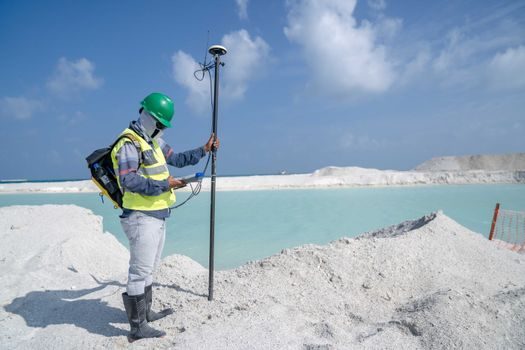
Surveying and timing applications dominate the upper end of the 2026 receiver listings, with a ZG25 RTK GPS GNSS receiver with EG25 module listing US$850-950 per piece (1-piece MOQ) from a Jiangxi-based trading company on Made-in-China [S3]. This is a multi-frequency, multi-constellation RTK module, and the EG25 cellular modem inside the same SKU makes it a hybrid GNSS-plus-cellular positioning engine, not a pure satellite receiver [S3].
The 2026 procurement reality is that any sub-US$100 "RTK" claim is almost always a single-frequency L1-only board without cellular fallback, and the US$850-950 band is the realistic entry point for centimeter-grade surveying. The same hybrid architecture is increasingly specified on remote process skids where a pressure-sensor reading needs a back-haul path when no terrestrial cellular is available; the BOM cost of the receiver is then small against the avoided truck-roll.
Market and information layer: satellite internet and transponder reports
On the demand side, the *Satellite Internet Market Report 2026* segments the global market by product (two-way satellite-only communication, one-way receive, one-way broadcast), by band type (C-, X-, L-, K- and other), and by end user (commercial, residential, military, industrial and other), at US$4,490 for 150 pages [S1]. On the supply-side information layer, the 2020-2026 transponder report (#2735356) is sold at RMB ¥19,200 electronic / ¥19,500 paper-plus-electronic, with a noted limited-time discount of ¥100 off a list of ¥21,000 [S4].
Three signals matter for a 2026 buyer reading these. First, band-type segmentation now explicitly lists L-band as a distinct commercial segment, not a footnote, reflecting Iridium and Inmarsat traffic [S1]. Second, residential and commercial end-user splits drive the volume curve, and the report price of US$4,490 is itself a leading indicator of where paying for market intelligence starts to make sense for a procurement function that has crossed roughly 10-20 active satellite-linked sites. Third, the transponder report's 2020-2026 window anchors a transponder-leasing price baseline against which 2026 spot Ku- and Ka-band quotes can be benchmarked [S4].
Comparison: four 2026 product tiers against four decision criteria
Stacking the four 2026 price tiers against cost, lead-time, typical application and the lowest credible 2026 MOQ gives a one-page procurement matrix. Component floor (crystal resonator, US$0.025-0.99) is the cheapest line, has 1-2 week lead-time at the 3,000-piece MOQ, and feeds any L-band front end [S5]. Handheld DVB-S/S2 finder (US$40-98) is the install-channel workhorse, ships from Fujian stock at 1-set MOQ, and is used for antenna alignment rather than data backhaul [S2]. Survey RTK receiver (US$850-950) carries a 1-piece MOQ but a 4-8 week lead, and is sized for centimeter-grade GNSS rather than LEO satellite internet [S3]. Market intelligence (US$4,490 / ¥19,200) is a fixed-cost information purchase with no hardware lead-time, sized to a team rather than a unit [S1][S4].
The decision pivot is the application. For consumer-facing LEO satellite internet hardware, the BOM is dominated by the antenna, modem IC and the crystal resonator tier above, so the US$0.025-0.99 crystal floor is the right denominator. For industrial satellite telemetry overlaid on a PLC or industrial-valve actuator, the same L-band modem plus a rugged enclosure is closer to a US$100-300 module cost, and the SMD crystal at scale is negligible. For survey and timing, the US$850-950 RTK receiver is the table stake. For strategy, the report tier is the entry point. The cross-link to Fuse Price 2026 is useful where a process skid bundles satellite telemetry with a fused power distribution, because both share the same MOQ-driven pricing logic at the component floor.
Constraints, failure modes and what the 2026 listings do not show
Three honest gaps in the public 2026 data are worth flagging. First, the Made-in-China listings are ex-works China and exclude FCC, CE, ETSI and Anatel type-approval costs, which can add 5-15% to landed cost for a US or EU deployment [S2][S3][S5]. Second, the satellite-internet market report segment by band type does not publish volume share numbers in the public listing, so any band-by-band procurement share claim would be invented; the report itself is the source of those numbers [S1]. Third, the transponder report price (¥19,200-19,500) is the cost of the document, not the transponder lease rate, and 2026 spot Ku/Ka-band MHz-per-month pricing is not in the public listing [S4].
Two failure modes are documented by the listings themselves. The DVB-S/S2 finder tier below US$40 typically lacks DiSEqC and a real spectrum mode, which makes it a liability for SNG alignment [S2]. The RTK receiver band below US$100 is almost always L1 single-frequency without cellular fallback, which makes it unsuitable for hybrid GNSS-plus-satellite process telemetry [S3]. A spec-driven sourcing policy should hard-block both.
The single most trackable 2026 signal is the 产业调研网 transponder report's revision cycle and the next release of the *Satellite Internet Market Report*, both of which reset the public band-type and end-user splits that procurement uses to weight L-band versus K-band allocation [S1][S4]. A second signal is the spread between the US$40-50 hot-sale finder and the US$80-98 professional finder on Made-in-China: a narrowing of that band would indicate that professional-grade features are commoditising, while a widening would indicate a new sensitivity tier has entered the channel [S2].