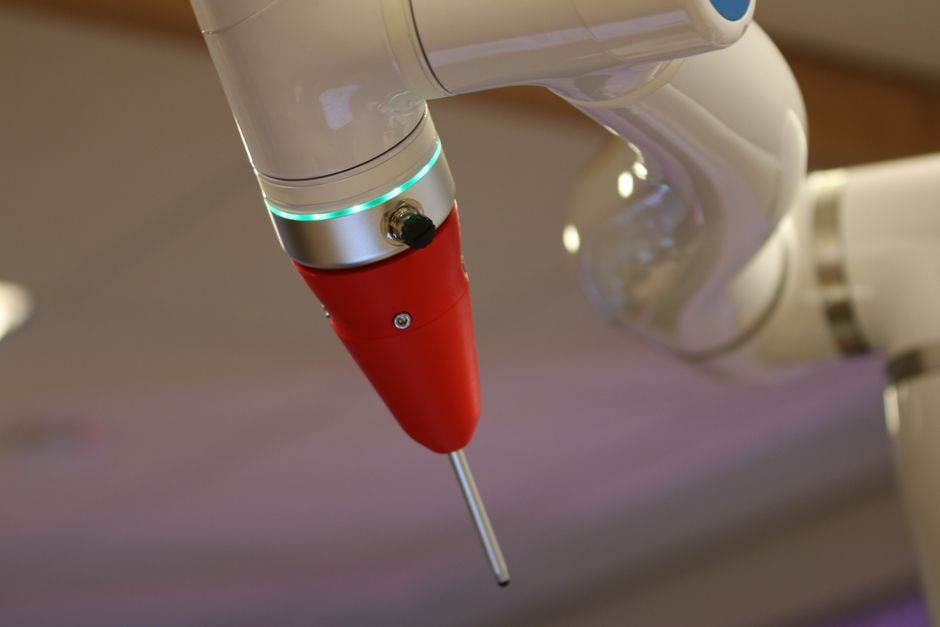
A 4-axis SCARA robot with 620 mm reach, 8.4 kg payload, ±0.01 mm repeatability and an ESD-safe coating targets electronics assembly lines where static-sensitive components are handled, per Stäubli's TS2-60 ESD datasheet [S4].
Mainstream Chinese SCARAs from suppliers such as TURIN Robotics ship with ≤±0.05 mm repeatability and ≤±0.15 mm path accuracy on the same envelope, with over 42,000 cumulative units delivered since 2007 [S5]. The buying decision in 2026 is dominated by four hard numbers — repeatability, reach, payload, cycle time — plus the question of cleanroom or ESD certification, not by brand prestige.
What "SCARA" Actually Means in a 2026 RFQ
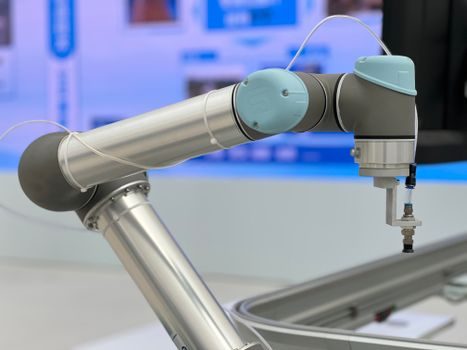
SCARA stands for Selective Compliance Assembly Robot Arm: two parallel rotary joints in the horizontal plane give compliance in X-Y, while a vertical prismatic joint handles Z insertion force. A fourth rotary axis (θ) orients the end-effector, making it a 4-axis architecture suited to pick-and-place, screw driving, and adhesive dispense [S4].
For a procurement engineer, the practical consequence is rigidity in the vertical axis — useful for press-fit and screw insertion — and compliance in the horizontal plane, which absorbs minor positional error from upstream articulated robot fixtures or vision-guided belt registration. Spec sheets in 2026 still quote reach in millimetres (220-1000 mm common), payload in kilograms (1-20 kg), and repeatability in millimetres, and these three numbers will shorten your shortlist faster than any marketing slide.
The Four Hard Specs That Decide the Shortlist
Reach, payload, repeatability, and cycle time form a coupled envelope — a 1000 mm arm is rarely paired with 20 kg payload, and a 1 kg high-speed unit rarely quotes tighter than ±0.02 mm. Premium 4-axis units such as the Stäubli TS2-60 ESD sit at 620 mm reach, 8.4 kg payload, ±0.01 mm repeatability, and are designed for floor, ceiling, or wall mounting in electronics lines [S4].
Chinese mainstream units such as the TURIN SCARA line quote ≤±0.05 mm repeatability and ≤±0.15 mm trajectory accuracy with cumulative deliveries above 42,000 units across roughly 2,600 application recipes [S5]. For most SMT, lithium-cell sorting, and consumer-electronics assembly, ±0.05 mm repeatability is the practical spec floor; ±0.01 mm is only required when the downstream process (e.g. connector insertion, micro-screw driving) has no mechanical float.
ESD, Cleanroom, and Food-Grade Variants
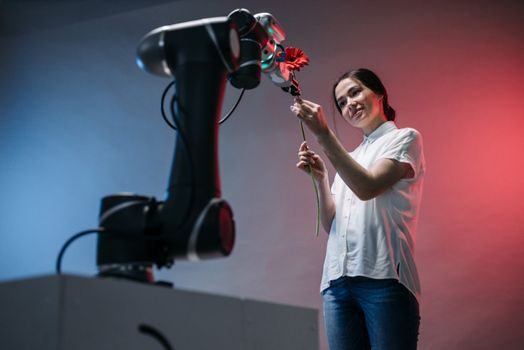
ESD-certified SCARAs carry a static-dissipative coating tested for surface resistivity, residual-charge decay rate, and cross-section conductivity, with the Stäubli TS2-60 ESD validating all three parameters across ten test points covering every reachable arm element [S4].
For SMT lines handling bare PCBs, LED dies, or camera modules, an ESD rating is non-negotiable: a single 100 V discharge can latch-up a CMOS sensor. Pharma and semiconductor fabs additionally require ISO Class 5-7 cleanroom ratings with low outgassing materials, and food/beverage lines need IP65+ housings with food-grade grease. Spec sheets should call out the standard (e.g. ISO 14644-1 class, IEC 61340-5-1 for ESD) — if the vendor can't name it, walk away.
Integration Footprint: Controller, Vision, and Conveyor Hand-off
SCARAs almost always ship as a 4-axis arm plus a separate controller cabinet, with fieldbus options typically including EtherCAT, PROFINET, and CC-Link. Vision-guided belt tracking is the standard upgrade path, and the controller must accept a trigger-to-pick latency under one vision cycle — roughly 30-50 ms for 2D line-scan cameras. [S1]
Conveyor hand-off tolerance is usually ±2-5 mm before a vision system is mandatory. If your line already runs an AGV or AMR for material delivery, check that the SCARA controller speaks the same VDA 5050 or fleet-manager protocol, or you'll bolt on a PLC just to translate. Cylinder-driven end-effectors and vacuum grippers are typical; for high-mix lines, electric grippers with force feedback shorten changeover.
When SCARA Is the Wrong Tool
SCARAs struggle above 20 kg payload — for palletising, heavy machine tending, or large-panel handling, a 6-axis articulated robot is the correct geometry. They also cannot reach around obstacles in a work cell; if fixtures block the direct top-down path, a 6-axis arm's extra DOF saves re-engineering the cell. [S2]
Long-reach horizontal transfer (over 1 m of pure X-Y travel with no Z) is better served by a linear guide gantry or a Cartesian X-Y-Z stage — SCARAs lose rigidity and speed past ~1000 mm reach. For ultra-high-speed top-load SMT placement (chips >50,000 cph), a dedicated pick-and-place machine still beats a SCARA on throughput-per-dollar.
Total Cost of Ownership in 2026
A mainstream Chinese 4-axis SCARA in the 400-600 mm reach band lands in the US$8,000-15,000 range for the arm alone, with controller and software adding 30-50%; a premium Japanese or European unit in the same envelope runs 2-3× that figure. Add integration (vision, conveyor, guarding, training) and the turnkey cell is typically 2-3× the bare-arm price. [S3]
Energy draw for a SCARA cycle is 0.3-0.8 kWh per hour under typical loading, dominated by the two horizontal servo axes. Lubrication intervals on Chinese mainstream units are quoted at 6,000-10,000 hours for grease points; premium European units extend this to 20,000+ hours with sealed-for-life joints. Plan a 5-year service budget of 8-12% of the turnkey capex if you run two-shift production — the robot itself rarely fails; the belt, grease, and encoder batteries do. For a deeper dive on how upstream materials like steel and cable feed into robot pricing, see the 2026 steel export-band analysis.
Open-Source SCARA: A Note Before You Spec It
Public GitHub repositories for SCARA kinematics — Jacobian derivations, trajectory planners, MATLAB simulations — are useful reference implementations for engineering students and controls engineers prototyping custom motion paths, but they are not a buying shortlist [S1][S2][S3].
Treat them the same way you'd treat a textbook chapter: cite the math, do not buy the machine. If a vendor's "open-source" SCARA has no published cycle time, no MTBF figure, and no factory acceptance test protocol, the total cost of ownership is unquantifiable, and unquantifiable TCO is the most expensive kind. Stick to vendors who publish IEC 60204-1 or ISO 10218-1 conformance certificates and a real warranty in years, not months.
Trackable signals for the next buying cycle: (1) whether mainstream Chinese brands reach ±0.02 mm repeatability on production units by Q4 2026 — that would compress the premium-tier price band; (2) whether ESD-certified SCARAs become a default option rather than a SKU suffix, following the Stäubli ESD-series precedent [S4].