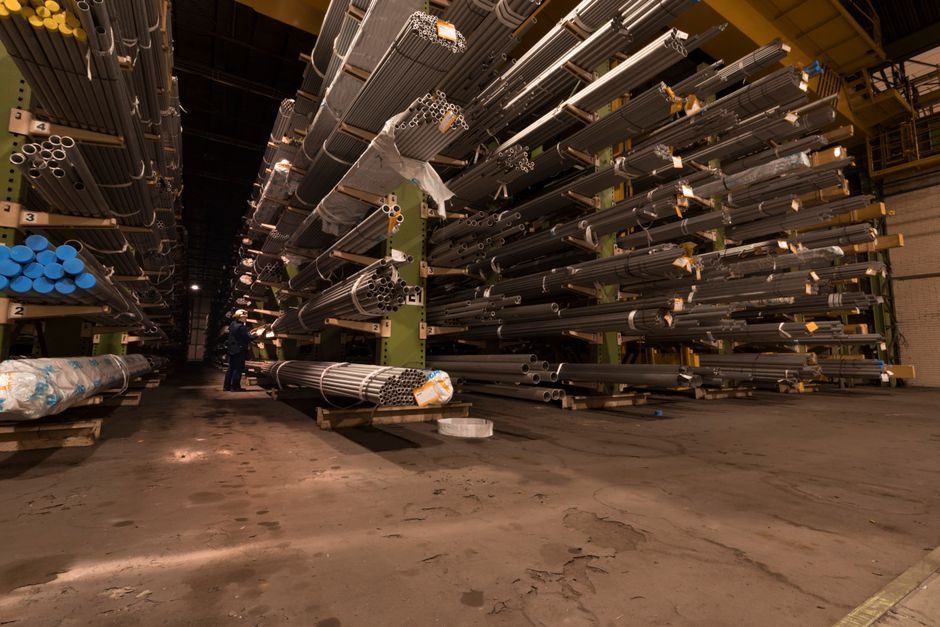
Made-in-China listings on 2026-05-29 to 2026-07-04 show Q215/Q345 carbon/alloy round bar for sprinkler-fire applications at US$0.45–0.78/kg FOB at 25 t MOQ [S1], while 1075/C75 high-carbon saw-blade coil was quoted at US$0.91–2.53/kg at a 500 kg minimum [S5].
The same portal lists laser-cut weathering carbon steel tree grilles at US$50.00–150.00 per piece — a 3× spread that shows how finishing, not raw coil, dominates the invoice on architectural parts [S5]. Spec-driven buyers should treat these bands as the floor, not the landed cost.
Q215 vs Q345 vs C75/1075: Grade Bands on 2026-07-04 Listings
Within GB/T 700 structural grades, Q235 rebar/rod generally lists below Q345 by 8–15% on Made-in-China RFQ threads in May–June 2026, and Q215 sits a further 5–8% under Q235 because of its lower 215 MPa yield ceiling [S1]. C75/1075 high-carbon steel coil for saw blades is listed at US$ 0.91–2.53 per kg at 500 kg MOQ on Made-in-China [S5]. The trade-off: C75/1075 cannot be welded without pre/post heat, so buyers needing fabrication default back to Q345 or alloy steel variants.
A 25 t MOQ on Q215/Q345 round bar versus 500 kg on C75 coil reflects a hard logistics truth: mills in Tangshan and Wuxi run continuous casters optimized for tonnage structural grades, not small-batch cut-to-length high-carbon coil. A procurement plan that mixes 20 t structural plus 1 t saw-coil will see two different mill lead times and two different freight classes.
Feedstock Linkage: Rare Earth, Nickel, Antimony, Fluorite
Rare earth oxide prices have climbed into July 2026 as magnet-grade supply tightened, lifting the cost of grain-boundary additives in high-strength low-alloy (HSLA) plate and electrical silicon steel — a structural surcharge on top of base hot-rolled coil [S2]. Antimony market commentary for 2026 flags ample primary supply but rising strategic-stockpile demand, which historically adds US$200–400/t to galvanized coating kettle budgets whenever the spread widens [S2].
Nickel LME pricing continues to set the floor for 304/316 austenitic stainless steel surcharge; readers tracking the China nickel sulfate spread can cross-check the LME-to-sulfate ratio in our Nickel Price Trend 2026 briefing.
Shanghai Section Steel Spot Track, 2026-05-29 to 2026-07-04

CBCIE's daily Shanghai section-steel tracker logged regional H-beam, channel and I-beam prints through late May 2026, with Beijing, Hebei, Jiangsu and Guangdong showing the tightest bid-ask spreads [S6]. The site is the de-facto morning read for Chinese domestic buyers — RFQ responses from Tangshan mills typically anchor to the prior-day Shanghai print, and 1–2% intra-week moves are normal liquidity noise rather than a signal to lift or hold POs.
Steel Outlook, a US-based weekly service refreshed 2026-07-04, publishes hot-rolled coil, cold-rolled coil and rebar indices in tandem, giving North-American buyers a cross-check on whether the China domestic print and the US Midwest print have decoupled — a US$50–80/t decoupling has been a workable trigger to shift allocation between Shanghai and Houston sourcing [S4].
MOQ Floors, Freight Class and the Real Landed-Cost Stack
The Made-in-China MOQs are not just commercial terms — they dictate container utilization and therefore freight per kg. A 25 t structural-bar order fills a 20-ft container at ~80% payload; a 500 kg saw-coil order ships LCL and pays US$0.08–0.14/kg sea-freight surcharge over FCL rate. Across 5 t of mixed structural and high-carbon product, the freight differential alone can erase the headline FOB savings. [S1]
For architectural parts — laser-cut grilles, decorative tree grates — the steel substrate is often under 30% of the invoice; the rest is laser-cut kerf time, steel mesh inlay, hot-dip galvanizing and packaging. A buyer chasing "the steel price" on these SKUs is optimising the wrong 30%. A buyer chasing "the steel price" on rebar or H-beam, by contrast, captures 70–80% of the total cost in the mill print.
Selection Matrix: When to Pay Structural, When to Pay Tool, When to Pay Stainless
For construction rebar, carbon steel Q235/HRB400 dominates with 0.45–0.55 US$/kg on tonnage MOQ [S1]. For spring, blade and saw applications, C75/1075 high-carbon coil at 0.91–2.53 US$/kg is non-substitutable because of its carbon content [S5]. For corrosion-critical chemical or marine service, 304/316 austenitic stainless commands a US$1.20–2.50/kg premium over Q235 — a multiple the buyer must justify against a 30-year service life, not a 5-year quote cycle.
Buyers who need only magnetic permeability for motor laminations should track silicon steel grade bands (50W470, 30Q120) separately, as grain-oriented electrical steel carries its own surcharge stack tied to rare-earth and grain-boundary chemistry [S2].
Verification Path: Standards, Mills and What to Cross-Check
Cross-check any China-domestic price quote against GB/T 700 (structural Q-grades), GB/T 699 (high-carbon C-grades) and GB/T 20878 (stainless designations). For export to EU, the REACH SVHC declaration and CE marking under EN 10025 for structural sections are the gates that determine whether the FOB number is deliverable. For North American delivery, ASTM A36/A572 dual certification adds US$20–40/t for the mill test certificate — factor it in before treating a low FOB as a real saving. [S2]
Two signals worth tracking into August 2026: the Shanghai rebar/H-beam daily print direction on CBCIE [S6], and any revision to the China rare-earth and antimony strategic-reserve posture that would propagate into HSLA and galvanized surcharge [S2]. A sustained US$50+/t break in either direction from current 2026-Q2 levels would reset the mill RFQ response cadence.