
For refrigerated and frozen-product lines operating from roughly -25 °C down to cryogenic -196 °C LNG, the working spec is a horizontal or shallow-incline (≤20°) U-trough screw conveyor in 304 or 316 stainless, with a shafted helicoid or sectional flight, food-grade contact-surface finish, and a trough sized so the recommended fill factor stays at or below 30% for slurry-ice or wet product [S2][S4].
Cold-chain duty is dominated by particle-size limits, bulk density, and corrosion from brine/condensate, not by throughput alone; bulk densities in cold-chain solids typically span 35-65 lb/ft³ (560-1040 kg/m³) for frozen vegetable or seafood cuts, which dictates screw diameter and RPM before motor sizing [S3][S4].
Selection Criteria That Drive the Cold-Chain Spec
Four inputs lock the geometry: material type and condition (maximum lump size, bulk density, moisture), capacity in lb/hr or t/hr, conveying distance and incline, and design conditions (materials of construction, inlet feed, operating temperature) — these are the primary considerations a CEMA-style engineering guide lists for every screw conveyor [S4].
For cold-chain service the temperature input is decisive: jacket or insulation must be specified when product enters at -20 °C or below, and any gearbox oil reservoir should use low-temperature synthetic lubricant to keep viscosity in the 32-68 cSt at 40 °C window [S2][S5]. A 12" conveyor at 120 RPM with No. 12 gauge steel trough and standard helicoid screw is a typical indoor duty point, but that baseline is for ambient dry material and must be re-rated for refrigerated service [S5].
Configuration Options: Horizontal, Inclined, Vertical, Shafted vs Shaftless
Standard horizontal screw conveyors are the default in cold-chain packaging and palletizing lines because they keep product fill steady and let condensate drain to a low point; inclined units are generally used up to 30°, with proper design permitting up to 45° before a screw elevator becomes the correct choice [S2]. Vertical screw conveyors are reserved for elevator legs and are rarely used inside a chilled warehouse because of the casing height required.
Shaftless (crimped-ribbon) screws are the right answer for sticky, wet, or high-moisture frozen waste — fish offal, meat trim, sludges — because the absence of a center pipe eliminates the wrap hazard, while shafted helicoid or sectional screws remain the right answer for dry frozen pellets, diced vegetables, or IQF seafood where a clean center pipe supports CIP wash-down [S2][S9]. For the slush-ice and brine-condensate loads common in seafood lines, shaftless designs are increasingly specified.
Material of Construction and Sanitation
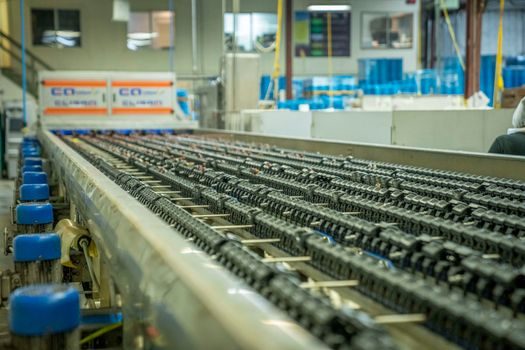
Cold-chain conveyors are commonly built in carbon steel with industrial coatings or, where hygiene and corrosion resistance require it, in 304 or 316 stainless steel, with wear parts such as flights and casings optionally upgraded to abrasion-resistant steel [S2]. For food, dairy, and pharmaceutical compliance the spec must meet UK and European hygiene laws and the ATEX directive where dust or solvent atmospheres exist, plus the Pressure Equipment Directive for closed systems [S2].
Surface finish matters as much as alloy: a No. 4 / 2B polished trough at Ra ≤ 0.8 μm on product-contact surfaces is the typical cold-chain ask, and the trough gauge should track the CEMA lump-size table so oversized frozen lumps do not stall the screw [S3][S4]. Cold-chain lines that handle wet product also benefit from a U-shaped trough geometry that exposes the screw for wash-down, a configuration that pairs naturally with chain-driven live roller takeaway conveyors on the discharge end [S1][S9].
Capacity, RPM, and Power Sizing Rules of Thumb
Capacity scales with screw diameter, RPM, and a material-specific capacity factor: a baseline 9" screw running at ~100 RPM in 35-50 lb/ft³ material delivers on the order of 1-3 ft³/min, and stepping up to 12" at the same RPM roughly doubles that throughput, with CEMA tables providing the exact factor for each lump-size class [S3][S4]. Horsepower is then computed from the formula HP = (C × L × F × Fd) / 33,000, where C is capacity in lb/hr, L is conveyor length in feet, F is the material factor, and Fd is the diameter factor.
For cold-chain service, derate the calculated HP by at least 15-20% for low-temperature grease stiffening and by another 10% if the trough is jacketed, then size the drive to a standard NEMA or IEC frame at the next available rating — for a 12" indoor conveyor, the computed 5 HP motor in the example selection falls well below the 15 HP maximum allowable, which is the design margin a process engineer should preserve [S5].
Integration With Adjacent Cold-Chain Equipment
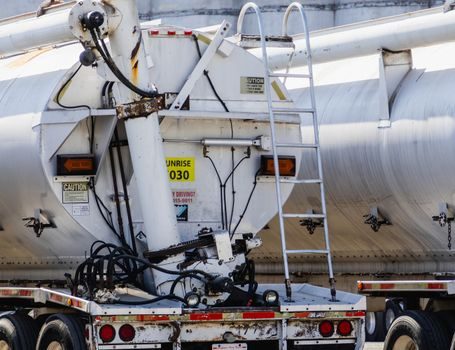
Discharge from a screw feeder or rotary valve into a screw conveyor gives a controlled, metered feed that downstream IQF tunnels, spiral freezers, and metal-detector reject conveyors can latch onto without spillage [S2]. On the drive side, a shafted screw driven through a bevel or helical-bevel gearbox lets the trough height clear the conveyor chain on the takeaway line, while a hollow-shaft mount simplifies removal for sanitation crews between shifts [S2][S5].
Where the line must elevate into a frozen storage bin, the practical limit is around 30° incline for a standard screw, and above that a Z-shape bucket elevator or pipe chain conveyor is the cleaner mechanical choice — which is why a single chain conveyor often handles both the horizontal takeaway and the lift into a cold-storage silo, with the screw limited to the infeed and dosing duties only [S1][S2].
Limits, Failure Modes, and When Not to Specify a Screw
Screw conveyors fail cold-chain duty when the product is fluid, highly abrasive, or contains lumps beyond the CEMA lump-size limit, when the incline exceeds ~45° without a custom flight, or when the trough is undersized for the frozen material's bulk density, leading to overfilling, motor overload, and shaft deflection at the hanger-bearing locations [S3][S6]. They are also the wrong choice for long distances: beyond roughly 30 m horizontal, intermediate hanger bearings start to act as a product-attrition source and a contamination trap in food-grade service.
For very long horizontal runs inside a frozen warehouse, a roller chain drag or cable conveyor is the better mechanical answer, and the spec should switch to those types before the screw is asked to do work it cannot do reliably [S2][S9]. In every other case, a correctly specified horizontal or low-incline U-trough screw in stainless steel, with the right RPM derate and a documented fill factor, will carry cold-chain duty for years between rebuilds.
Track two signals before the next purchase review: whether the spec sheet captures the operating temperature on the same line as the bulk density (cold-chain RFQs that omit °C almost always come back with the wrong gear oil and the wrong trough gauge), and whether the chosen diameter puts the fill factor in the 15-30% range the CEMA tables treat as the cold-chain sweet spot [S3][S4]. If both are clean, the conveyor is sized for the line.
For related coverage, see Hot Chamber Die Casting Machine Selection: 2026 Spec Map for Hardware Runs.