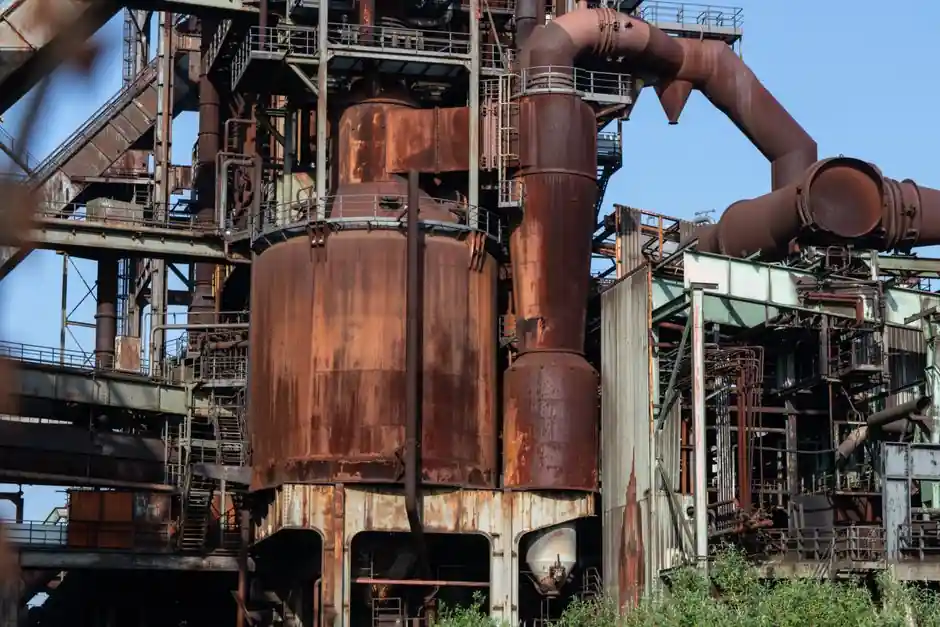
A seamless steel pipe is a hollow tube produced by piercing a solid billet, so it carries no longitudinal or spiral weld seam; this is the structural difference from ERW and LSAW products used in the same supply chains [S2][S4].
Industry groups classify seamless pipe along four axes: manufacturing process (hot-rolled, cold-rolled, cold-drawn), wall schedule (Sch 5 through XXS), material grade (carbon, alloy, stainless, nickel alloy), and dimensional standard (ASME B36.10M for carbon/alloy, ASME B36.19M for stainless) [S1][S3][S5].
Manufacturing Route: Hot-Rolled, Cold-Rolled, Cold-Drawn
Hot-rolled seamless pipe is the workhorse of the category, made by heating a round billet to roughly 1204 C / 2200 F in a rotary hearth furnace, piercing it through the center with a piercer point, then elongating it over a plug mill mandrel and sizing it to final OD and wall thickness [S4].
Cold-rolled (and cold-drawn) seamless pipe is hot-rolled pipe that has been further reduced at room temperature; the cold work tightens dimensional tolerances, improves surface finish, and raises tensile and yield strength, which is why cold-drawn products dominate high-pressure hydraulic cylinder, heat-exchanger, and bearing tube service [S2][S6].
A practical upper-size limit applies: a few mills can produce seamless pipe up to 24-in OD, and as diameter increases welded pipes (ERW, LSAW) become more economical, so most large-diameter line-pipe specifications move to longitudinal or spiral welded products [S2][S4].
Schedule, Wall Thickness, and the Barlow Relationship
Pipe schedule is a numerical shorthand for the ratio of working pressure to allowable stress, defined as SCH = (P / S) x 1000, where P is the internal design pressure and S is the allowable stress of the material [S5].
ASME B36.10M lists schedules as Standard (STD), Extra Strong (XS), Double Extra Strong (XXS), and by schedule number (5, 10, 20, 30, 40, 60, 80, 100, 120, 160, and higher), and the three numbers most frequently specified in process piping are Sch 20, Sch 40, and Sch 80 [S1][S5].
Sample calculation, useful for sanity-checking a vendor's data sheet: for OD 6.625 in, wall 0.25 in, allowable stress 20,000 psi, the Barlow pressure P = (0.25 x 20,000 x 2) / 6.625 is about 1,509 psi, which gives SCH roughly 75 and lands between Sch 60 and Sch 80 [S5].
As schedule number rises, wall thickness rises for a given nominal size, and so does mass per meter, which is why the schedule chart is also the first place a buyer should look to estimate shipping weight and pipe rack loading [S5].
Material Grades: Carbon, Alloy, Stainless, and Nickel Alloy
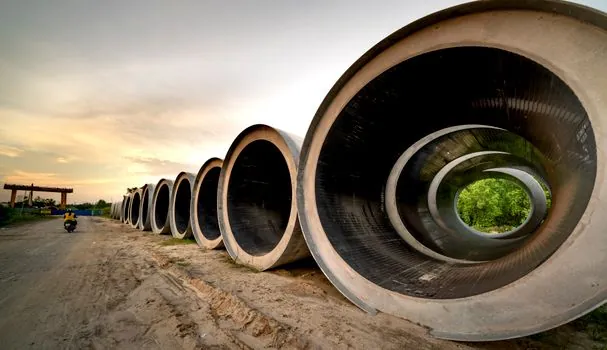
Carbon steel seamless pipe covers ASTM A53 Grade A/B for general service, ASTM A106 Grade A/B/C (Grade B is the most common specification for high-temperature refinery and power-plant service), and API 5L Grade B through X80 for line-pipe transmission [S3].
Alloy steel seamless pipe, such as ASTM A335 P11/P22/P91, is specified when service temperatures climb into the 540-620 C range typical of utility superheaters and refinery reformer outlets, where plain carbon grades lose creep strength [S2][S3].
Stainless seamless pipe, including ASTM A312 TP304/304L, TP316/316L, and duplex grades, follows the ASME B36.19M dimension table rather than B36.10M; the B36.19M schedules use the "S" suffix (5S, 10S, 40S, 80S) and the small list of differences versus B36.10M is documented in the standard itself [S1].
Nickel-alloy seamless pipe (Alloy 625, Alloy 825, C-276) enters the picture for sour service per NACE MR0175, sea-water cooling, and concentrated acid duties where standard stainless grades would suffer pitting or stress-corrosion cracking [S4].
Comparison of Pipe Types Used in Oil and Gas
For an oil and gas project, the practical decision usually comes down to seamless versus ERW versus LSAW, and the table below lines them up against the criteria that drive specification [S4].
Seamless pipe offers the highest pressure rating of the three, no weld seam to inspect, and uniform wall thickness, which makes it the default for upstream drilling, wellhead, and high-pressure hydrocarbon service; the trade-off is higher unit cost and an OD ceiling around 24 in [S2][S4].
ERW pipe is cold-formed from steel coil with one straight seam, costs the least, and is widely used for low-to-medium-pressure water, oil, and gas gathering lines, but the longitudinal weld is a documented inspection point and limits use in the most severe services [S4].
LSAW pipe is built from plate, comes in diameters from roughly 16 to 60 in, and is the workhorse of long-distance trunk lines that cross cities, rivers, or seabed; the seam can be straight or spiral, and like ERW it is rated for low-to-medium-pressure service [S4].
Dimensional Standards, NPS, and How to Order
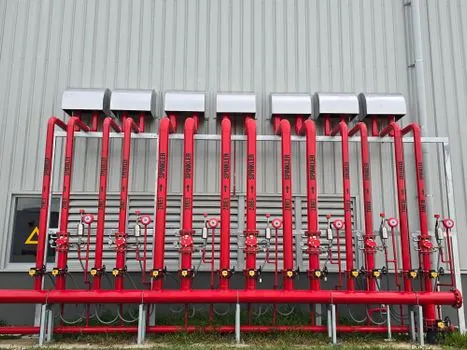
A complete pipe description has three elements, and only three: outside diameter (OD), wall thickness (WT), and length (typically 20 ft / 6 m or 40 ft / 12 m), from which the supplier derives inside diameter, weight per foot, and pressure rating [S1].
For sizes below NPS 12 (DN 300) the actual OD is larger than the nominal number, for example NPS 2 has an OD of 2.375 in; for NPS 14 and above the nominal size and OD converge, which is why purchasers must always confirm OD with a dimension chart rather than trust the nominal callout [S1].
Stainless pipe adds the "S" suffix to schedule (for example Sch 40S) and the schedule set narrows; B36.19M only specifies a few light schedules (5S, 10S, 40S, 80S) and a handful of large-diameter 10S entries, so a Sch 60 stainless callout usually means the buyer actually wants a B36.10M carbon pipe [S1].
Order language that survives procurement review reads: "ASME B36.10M, ASTM A106 Grade B, NPS 6, Sch 40, SRL or DRL as required, beveled ends per ASME B16.25," and the same pattern works for stainless by swapping B36.19M and A312 [S1][S3].
Process Step Economics and the Cold-Draw Niche
Seamless pipe is generally more expensive per ton than welded pipe of the same schedule because the billet-to-tube conversion yields less finished product per unit of input steel, and the high piercing forces consume more energy per meter than roll-forming a coil [S2][S4].
Cold drawing recovers some of that cost gap in the small-diameter, thin-wall segment because it can produce OD tolerances of plus or minus 0.05 mm and wall tolerances of plus or minus 5 percent, which is the regime where ERW cannot easily match the surface and concentricity [S2][S6].
Buyers evaluating seamless versus welded for non-sour, non-high-temperature service should benchmark the premium against the cost of in-service weld inspection, NDT of the seam, and any derating the project piping code would apply to a welded product, and only specify seamless where the code, fluid, or fatigue duty forces the issue [S2][S4].
For background on how seamless tube output is consumed by downstream construction and energy projects, the steel pipe encyclopedia entry lays out the broader size and grade matrix, while the seamless steel pipe reference covers the small-diameter cold-drawn range in more detail. Adjacent procurement context for line-pipe coating decisions and mill output is captured in the galvanized steel sheet market share baseline, which compares coating and substrate economics across the same supplier base.
For component-level specifications, see construction machinery and equipment.