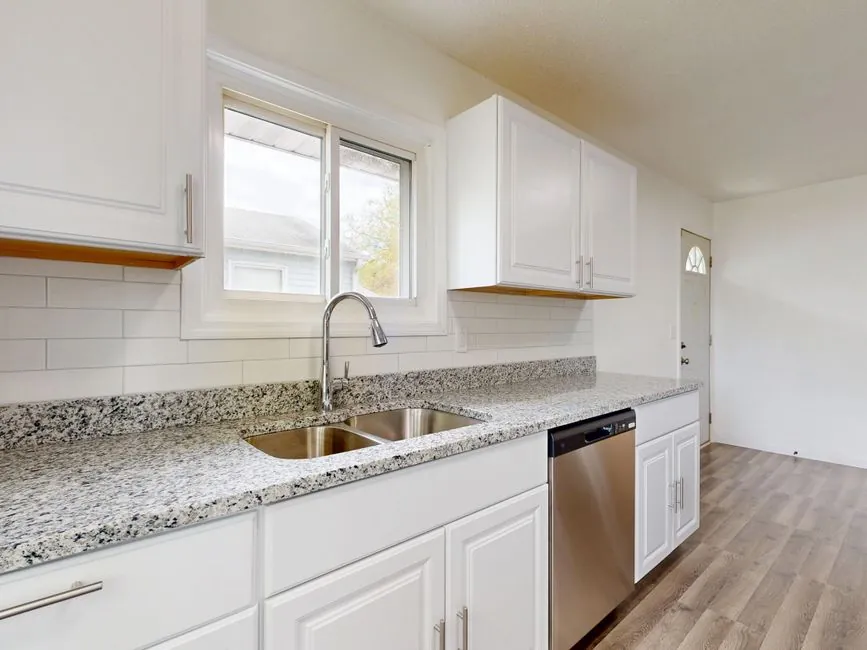
Engineered quartz slabs containing crushed quartz and resin provide a non-porous countertop surface with strong resistance to common stains [S2].
Quartzite, granite, marble, porcelain, and sintered stone require different chemical-resistance assessments because hardness, porosity, binder chemistry, and mineral composition do not predict staining performance by themselves [S3].
Define Chemical Resistance for Countertop Selection
Chemical resistance is the ability of a countertop surface to resist staining, etching, discoloration, or loss of binder or glaze when exposed to acids, alkalis, solvents, oils, or oxidizers [S3]. A stain is a permanent color change, while etching is surface pitting or dulling caused by chemical attack, so visible damage does not always have the same mechanism [S3].
Mineralogy is the first screening criterion. Silicate-rich quartzite and sintered stone resist many acids and solvents, while calcium-based marble dissolves in acids because carbonate minerals react with acidic liquids [S3]. Porosity is another independent variable because porous stone can absorb colored chemicals and retain stains below the surface [S3].
For a broader view of the material family used in slabs and counters, see the building stone reference. Procurement should record the exact commercial product, finish, batch or lot where available, and intended chemical exposure rather than relying on a broad material label [S2].
Compare Quartz, Quartzite, Granite, and Marble
Coffee, wine, juice, and grease wipe away from quartz with a damp cloth because the low-porosity matrix limits absorption [S6].
Quartzite is a natural stone with Mohs hardness near 7 and stronger scratch resistance than granite, but its chemical behavior depends on the specific mineral assemblage rather than the trade name alone [S3]. Granite is also mineralogically variable, with staining resistance governed by porosity and the presence or absence of vulnerable minerals [S3]. Marble has practical hardness near Mohs 3 yet remains chemically vulnerable to acids [S3].
On stain resistance, engineered quartz ranks highly for routine household spills; quartzite and sintered stone rank highly when their silica-rich composition is confirmed; granite is variable and needs slab-specific assessment; marble is unsuitable where acids are routine [S3][S4]. On acid resistance, quartz, quartzite, and sintered silicate materials generally outperform calcite-rich marble [S3]. On maintenance, quartz requires no routine sealing, while porous natural stone must be assessed and sealed as required [S4].
Test Acids, Alkalis, and Solvents Before Approval

Slab qualification should include separate acid, alkali, and solvent resistance tests rather than one generic stain test [S2]. Acid testing is essential for kitchens exposed to citrus juice, vinegar, wine, and acidic cleaners, while alkali and solvent tests cover bleach, concentrated cleaning agents, nail-polish remover, acetone, and strong ketones [S2][S3].
Laboratory evaluation should distinguish surface discoloration from etching, because an apparently unchanged color does not prove that the surface was not chemically attacked [S3]. Engineered resin binders may swell or leach when exposed to aggressive solvents, while quartzite and sintered silicate composites resist many acids and solvents because of robust silica bonding [S3].
Samples should represent the final finish, edge detail, and fabrication condition. A polished sample, a honed sample, and the actual production slab can behave differently because surface preparation affects wetting and absorption [S2][S3].
For project-specific testing, slab chemical and stain resistance testing should define exposure agents, contact time, visual criteria, and remedial limits in the project specification [S2].
Match the Surface to the Exposure Profile
Quartz is suited to kitchens where coffee, wine, juice, grease, soap, and routine cleaning are common, and its non-porous surface supports simple maintenance with a damp cloth [S4][S6]. Porcelain is also a dense, low-porosity choice, while sintered stone combines high heat resistance with strong chemical resistance [S1][S3].
Quartzite fits kitchens that value natural-stone appearance and scratch resistance, provided the selected slab is checked for acids and porosity [S1][S3]. Soapstone has useful chemical tolerance and heat absorption but is softer, so scratch resistance and mechanical wear must be considered separately from stain resistance [S1][S3].
Marble and some limestones are not appropriate for work surfaces exposed to vinegar, citrus, wine, or acidic cleaners unless the owner accepts etching and a defined maintenance program [S3]. Natural stone is also less predictable than engineered quartz because one geological family can contain slabs with different absorption and acid sensitivity [S2][S3].
Control Maintenance and Sealing Requirements

Quartz normally requires no sealing because it is non-porous, while granite, marble, and other natural stone require an assessment based on absorption and intended use [S4].
Cleaning practices are part of the chemical-resistance specification. Quartz can generally be maintained with soap, water, and a damp cloth, but acetone, strong ketones, bleach-based products, and concentrated cleaners should still be excluded from engineered and natural-stone surfaces unless the manufacturer permits them [S3][S4].
For natural stone, sealing improves stain resistance by reducing liquid entry into pores, but it does not make acid-sensitive marble chemically inert [S5]. Test the selected sealer on the actual slab because performance can vary with stone color, porosity, finish, and sealer chemistry [S5].
Set Procurement and Acceptance Criteria
A purchase order should identify the material family, exact product, slab dimensions, finish, edge profile, fabrication method, and maintenance requirements, then reference the approved chemical- and stain-test report [S2]. For engineered quartz, request composition or manufacturer data showing a resin system engineered for the stated chemical exposures, rather than accepting the generic phrase “stain resistant” [S2].
Acceptance criteria should define what constitutes a stain, etch, discoloration, or surface loss, along with the permitted appearance change and the repair or replacement procedure [S2]. Quartz slabs warrant one moisture-related stain test, natural stone slabs warrant separate acid, alkali, and solvent exposure tests, and sintered stone should be evaluated for both stain formation and chemical attack [S2][S3].
Engineered quartz is the default for low-maintenance kitchen use, but the final approval should rest on the specific slab, finish, and chemical exposure. Track two procurement signals before release: a signed report that separates staining from etching, and a maintenance schedule that names every cleaner permitted by the manufacturer [S2][S3].