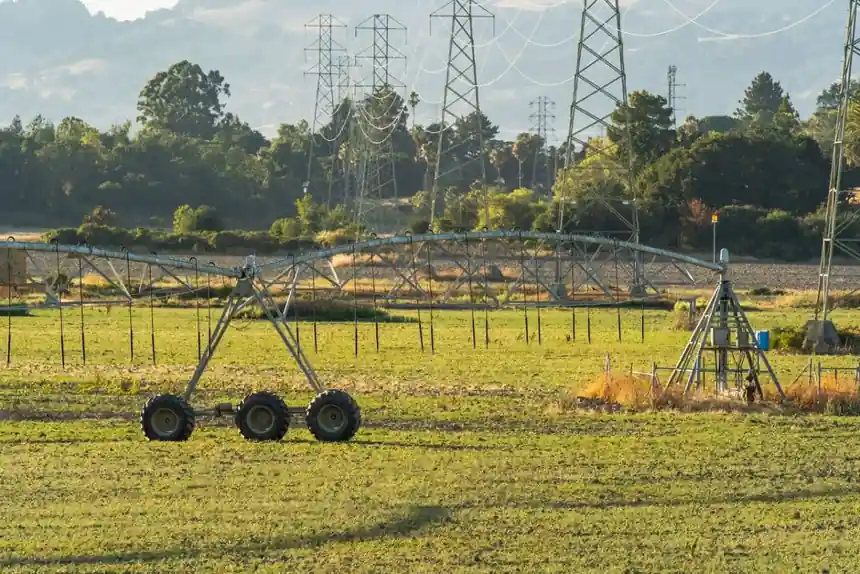
Gate valves provide low-pressure-loss isolation for irrigation water, but their wedge is intended for fully open or fully closed service rather than throttling.
Selection must cover pipe size, flow, pressure, water debris, corrosion exposure, stem travel, and operating frequency before a brass or cast-iron valve is ordered.
Gate Valve Scope for Irrigation Networks
A gate valve uses a disk or wedge attached to a stem to block or expose the flow path. In the fully open position, the wedge clears the passage, producing minimum loss through the valve. Gate, ball, and plug valves are identified as suitable choices for normal on-off control, while the gate valve is the most common type of on-off service valve in irrigation systems [S3].
That low-pressure-loss behavior makes a gate valve relevant to pump discharge isolation, main-line isolation, field manifolds, and manually controlled zones. The same design creates a limitation in throttling service. As the wedge approaches closure, most shutoff occurs near the last part of travel, while the narrowing flow area can increase liquid velocity and accelerate erosion of the wedge and lower seating surface [S3].
For an irrigation network, the application should therefore be classified before the valve type is selected. Full isolation favors a gate valve. Continuous flow adjustment requires a control valve designed for modulation, and periodic cycling favors a faster-operating valve. The broader gate valve reference covers the operating principle, while field selection also depends on water quality, installation conditions, and required control method.
Pressure and Flow Define the Valve Size
Selection should begin with the design flow, available pressure, pipe diameter, allowable pressure loss, and required valve size, not with the nominal pipe size alone. A 4-inch full-port brass gate valve is listed as an available irrigation product [S2], while one retail category spans a $18.55 to $332.10 price range for threaded full-port cast-brass gate valves in IPS sizes [S7]. These examples show why material, port design, end connection, and diameter must be separated during specification.
Large transmission pipelines in medium and large irrigation projects are often DN200 and above, according to the system characteristics described in 2026-04-17 guidance [S5]. At those sizes, hydraulic fit matters: excessive pressure drop reduces downstream coverage, while an oversized control valve can lose useful control authority at low flow. Pump start-stop cycles also create flow reversal and pressure-surge conditions, particularly near the pump discharge [S5].
This comparison is deliberate: a gate valve is not a better ball valve, butterfly valve, or check valve. It is the stronger choice when slow, full-isolation service and minimum fully open pressure loss dominate the duty. A ball valve is more appropriate where rapid shutoff or frequent cycling is the controlling requirement, while a butterfly valve can be evaluated for compact large-diameter isolation.
Brass, Cast Iron, and Ductile Iron Match the Exposure
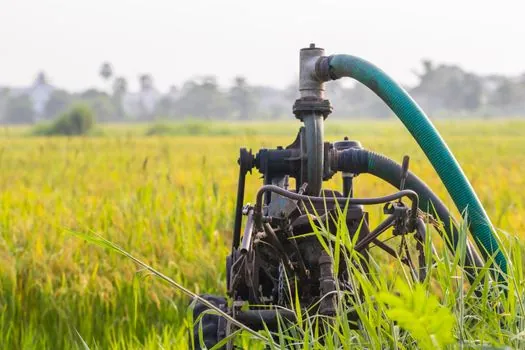
Brass and ductile cast iron are both used for agricultural and commercial irrigation gate valves [S6]. The listed product families also include resilient-wedge cast-iron valves with push-on connections, and the supplier identifies cast iron as the least expensive material option in its range [S2]. The material choice should track water chemistry, soil contact, maintenance access, and replacement cost rather than price alone.
Water from wells, ponds, and canals can carry sand, silt, algae, fertilizer residue, organic matter, and chemical residue [S4]. Those contaminants can interfere with the stem, wedge guides, threads, and seating surfaces. A valve with tight internal clearances is less suitable for debris-laden water because sticking, incomplete closure, and leakage become more likely [S4].
Ductile iron, stainless-steel trim, UV-stabilized PVC, and chemical-resistant elastomers are identified as material options for outdoor agricultural exposure [S4]. For a manually operated metal gate valve, the exposed stem and operating nut also need space for routine service. A rising-stem design makes the open position easier to identify because the threaded stem is exposed, but sufficient installation clearance is required for full stem travel [S3].
Manual, Rising-Stem, and Automated Control
A manual gate valve is appropriate where zones are opened and closed infrequently and a person can operate the valve safely. A rising-stem gate makes the position easier to read, while a nonrising-stem design saves vertical space. Gate valves are slow acting because the stem must turn to move the wedge, so a mechanical lever can provide faster travel when quicker shutoff is needed [S3].
Automatic irrigation requires a controllable actuator or valve arrangement, not a standard manual gate valve treated as an automatic control device. Electric solenoid valves are used for automated flow control, while high-frequency operation favors suitable butterfly, ball, or purpose-built solenoid valves rather than isolation-only valves [S4]. For the broader operating principle, see the knife gate valve, but its moving-element construction should not be confused with the threaded wedge used in conventional irrigation gate valves.
Before specifying automation, establish the cycle frequency, coil voltage, control signal, available electrical capacity, and permissible fail position. These details are absent from the general irrigation valve listings, which mainly organize products by valve type and irrigation application [S1].
Connections, Maintenance, and Sizing Checks

End connection must match the actual pipe and coupling method. Available examples include threaded full-port cast-brass construction, push-on resilient-wedge cast-iron construction, and flanged cast-iron construction with an operating nut [S2][S7]. Threaded, push-on, and flanged joints are not interchangeable without checking the pipe material, diameter, pressure class, restraints, and installation practice.
Verify the valve bore against the nominal pipe size and the required flow. A full-port designation is a meaningful selection point, but it does not replace a pressure-loss or flow-capacity calculation. Also check stem orientation, required wrench clearance, service access, and whether the valve must isolate pump suction, pump discharge, a main header, a field manifold, or an individual zone.
Gate valves should remain fully open during normal service unless isolation is intentional. Partial closure creates a nonlinear flow-control profile, raises local velocity, and can erode the wedge and lower seat [S3]. Record that operating instruction on the valve or in the commissioning plan so a partially closed gate is not mistaken for a regulating valve.
Application Limits and Procurement Evidence
A gate valve is not the correct selection for continuous throttling, frequent automated cycling, or reverse-flow prevention. Those duties require a regulating valve, a rapid shutoff valve, or a dedicated check valve. Agricultural selection is also not primarily an extreme-pressure exercise; it is a duty-cycle problem involving large water volumes, debris, outdoor exposure, pump cycling, and system stability [S4].
Procurement evidence should include valve size and bore, body and trim material, end connection, pressure and temperature rating, allowable pressure loss at design flow, operating method, stem type, and whether the seat is rising, nonrising, or another specified configuration. Irrigation suppliers list brass, cast iron, and ductile cast iron families, while individual retail listings span threaded IPS and flanged configurations [S2][S6][S7].
The decisive specification is therefore a matched valve, not a generic label. Match the body to the water and exposure, the seat and trim to debris, the operator to the cycle frequency, and the hydraulic opening to the design flow. A quotation that states only “gate valve” is not ready for installation.
Track three procurement signals before release: the selected valve must have a published bore and end connection matching the line, a documented pressure rating suitable for the design condition, and a flow-capacity statement or test basis covering the intended operating point. If any of those three items is missing, keep the valve unqualified.