
A jaw coupling's torque ceiling is set by the elastomer spider's compression strength rather than the steel hub teeth, allowing short-term load spikes of roughly 6 to 7 times the catalog nominal rating before the jaws themselves shear off [S3]. A gear coupling instead uses two hubs with external gear teeth meshing into two flange sleeves with internal gear teeth, eliminating the elastomer element entirely and shifting the margin question to lubrication intervals and seal integrity [S6].
Design torque is computed the same way for both topologies — Nominal Torque multiplied by the Application Service Factor — and the metric torque in N·m is derived from kW and shaft speed using RPM·Nm = (kW × 9550) / RPM, so margin against an application's peak load is the first number an engineer should check on a coupling datasheet [S4].
What Each Coupling Actually Is
A jaw coupling consists of two hubs with interlocking axial jaws that grip a thermoplastic or rubber spider, providing a fail-safe connection that keeps transmitting torque even if the elastomer fails completely, with no metal-to-metal contact in normal operation [S3]. A gear coupling's two hubs carry external teeth that engage matching internal teeth on a pair of sleeve flanges, sealed by O-rings and a gasket and held together by furnished fasteners, with angular misalignment capacity of about 2° and parallel misalignment of 0.25 to 0.5 mm [S6].
Both designs are flexible couplings rather than rigid ones, meaning each is chosen specifically because the engineer needs a small amount of angular, axial, or parallel compliance between driver and driven shafts, but the mechanism of that compliance is fundamentally different — elastomer shear in the jaw, sliding gear contact in the gear coupling [S4].
How Torque Margin Is Calculated
Torque utilization for a jaw coupling is the ratio of applied load to rated capacity: T_load / T_rated × 100, with typical misalignment budgets evaluated the same way — angular utilization = theta / 1° × 100 and parallel utilization = e / 0.4 mm × 100 — so an engineer can see in one calculator pass whether the coupling is overloaded on torque, angle, or offset independently [S2]. The implication is that a coupling can pass on torque margin but still fail on parallel offset, and the two should always be checked against the catalog limits rather than assumed safe because the torque number looks comfortable.
For both jaw and gear couplings, the catalog nominal torque is multiplied by an application service factor that captures shock, starting duty, and peak-to-average ratio, then compared to the running motor torque at full load; the same N·m value that comes out of (kW × 9550) / RPM is the input to the service-factor check, and a coupling that passes at 1.0× service factor often fails at 1.5× or 2.0× even though the metal would physically survive [S4].
Where Jaw and Gear Couplings Diverge
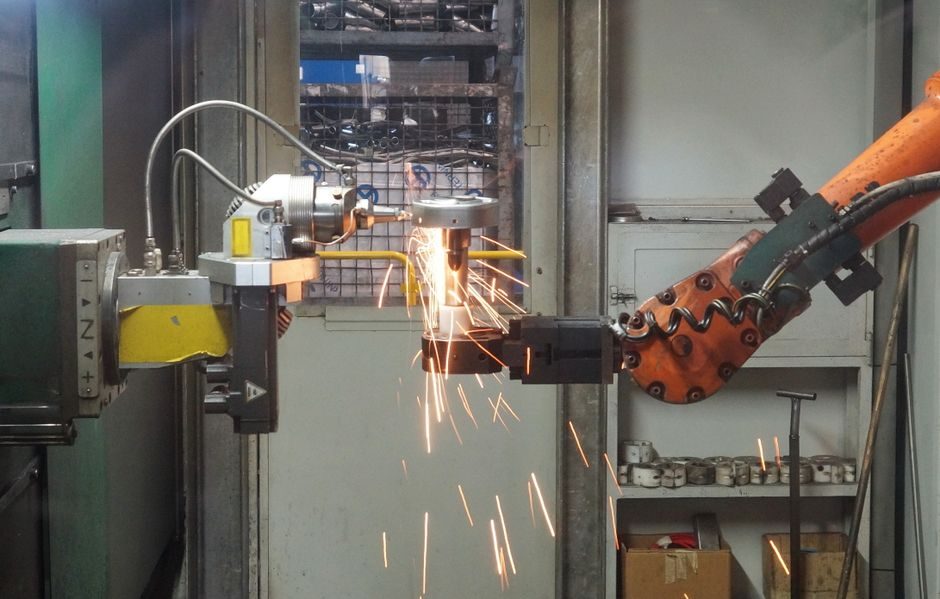
The most direct divergence is in the failure mode: a jaw coupling with a worn or melted spider keeps turning the load because the jaws remain engaged on the elastomer body until the elastomer disintegrates — manufacturer literature describes this directly as "Fail-safe – will still perform if elastomer fails" and "No metal to metal contact" [S3][S4]. A gear coupling carries torque through meshing steel teeth that need a continuous lubricant film; if the cover seal is breached, the lubricant escapes, the teeth go metal-on-metal, and the coupling fails by galling rather than by a designed-in decoupling event [S1].
The second divergence is in maintenance: a jaw coupling's only wear part is the spider, which can be swapped in minutes without moving the hubs on the shafts, and the elastomer grades — natural rubber, Hytrel, polyurethane — let the engineer trade compression strength, temperature resistance, and damping against the same hub body, with Hytrel delivering substantially higher compression strength than natural rubber for the same coupling size [S3]. A gear coupling requires periodic grease relubrication through the cover and a maintenance plan to keep the O-rings and gasket serviceable, which is why gear couplings are typically specified for high-torque, high-shock applications like conveyors, crushers, and mixers where the maintenance cost is acceptable in exchange for higher torque density [S1].
Decision Criteria Side by Side
On four practical decision criteria, the two topologies split clearly. First, torque range and lubrication: jaw couplings offer a published torque range of 0.4 N·m to 19,209 N·m across 24 standard sizes with bore coverage from 4.45 mm to 178 mm and zero lubrication requirement, while gear couplings are typically chosen when torque density and misalignment capacity must exceed what an elastomer spider can survive — accepting the lubrication burden in return [S3]. Second, misalignment: jaw couplings are constrained to roughly 1° angular and 0.4 mm parallel before spider loading accelerates wear, while gear couplings extend to 2° angular and 0.25 to 0.5 mm parallel with sliding metal contact that does not fatigue in shear the way an elastomer does [S2][S6].
Third, shock absorption: a jaw coupling dampens torsional vibration through the elastomer's hysteresis and is typically specified for pumps, gear boxes, compressors, blowers, mixers, and conveyors, while a grid coupling sits between the two on shock absorption by flexing a serpentine grid spring, with gear couplings generally last in line for the highest steady-state torque density when lubrication is reliable [S1][S3]. Fourth, serviceability: a jaw coupling's spider is a stocked spare part that changes in minutes, whereas a gear coupling's relube interval and seal inspection are scheduled-maintenance items and must be tracked in the CMMS rather than run to failure.
Where Each Coupling Is the Wrong Choice
Jaw couplings are the wrong choice when the application's steady-state torque approaches the catalog nominal of the largest available size, because the elastomer will heat-soak and lose compression strength well before the steel jaws yield, and the spider's RPM limit is a separate constraint that must be checked against the elastomer's thermal rating at the actual operating speed [S3][S4]. Gear couplings are the wrong choice when continuous greasing is impractical — for example, on a vertical-shaft pump high on a mezzanine, in a cleanroom, or in any application where a failed seal would contaminate the product — because the maintenance cost of the gear coupling is real and a missed relube leads to a catastrophic galling failure rather than a controlled spider change [S1][S6].
Both designs share one common misuse: substituting a jaw or gear coupling where a rigid coupling should have been used because the shafts are perfectly aligned, or substituting either for a flexible coupling on a drivetrain that actually needs a torsionally soft element to protect a servo motor or a precision flow meter from step-load reversals. In practice, a PLC commanded indexer driving a high-inertia load through a stiff coupling is a much harder problem on the motor bearings than the same drivetrain with a properly sized elastomer jaw coupling, and the failure shows up as premature encoder or bearing wear rather than coupling wear.
Sourcing and Standardization
Manufacturers publish torque, RPM, bore, and service-factor data on a per-hub basis and the design calculation chain — catalog nominal × service factor compared to motor full-load torque derived from (kW × 9550) / RPM — is identical for jaw and gear couplings, so the engineering reviewer's job is to verify that the service factor selected matches the actual load profile (uniform, light shock, heavy shock) and that the spider or lubricant grade is appropriate for the ambient temperature and chemical exposure [S4]. Bore and keyway options across AGMA, SAE, and DIN are typically stocked in the standard bore program of major jaw-coupling lines, which simplifies the dimensional match to driver and driven shafts but does not relieve the engineer of confirming the keyway proportions against the catalog's bore-to-keyway compatibility table [S3].
For applications driving an industrial valve actuator or a chemical-metering pump, the elastomer's chemical compatibility with the process atmosphere is the deciding specification rather than torque — natural rubber, Hytrel, and polyurethane each have different resistance profiles, and an elastomer that survives the torque is worthless if it swells in the first month of service. Sourcing the elastomer from the coupling OEM, rather than a generic aftermarket replacement, is the practical safeguard for both torque rating validity and chemical compatibility [S3][S4].
Watch for the next junction in the comparison: as more drivetrains move to integrated servo-driven pump skids with onboard pressure transmitter feedback, the coupling selection question is shifting from "jaw or gear" toward "jaw or zero-backlash disc" because the closed-loop control band rejects the small torsional wind-up of an elastomer spider only if the loop is slow enough — a tradeoff the process engineer has to set explicitly rather than inherit from the coupling catalog.