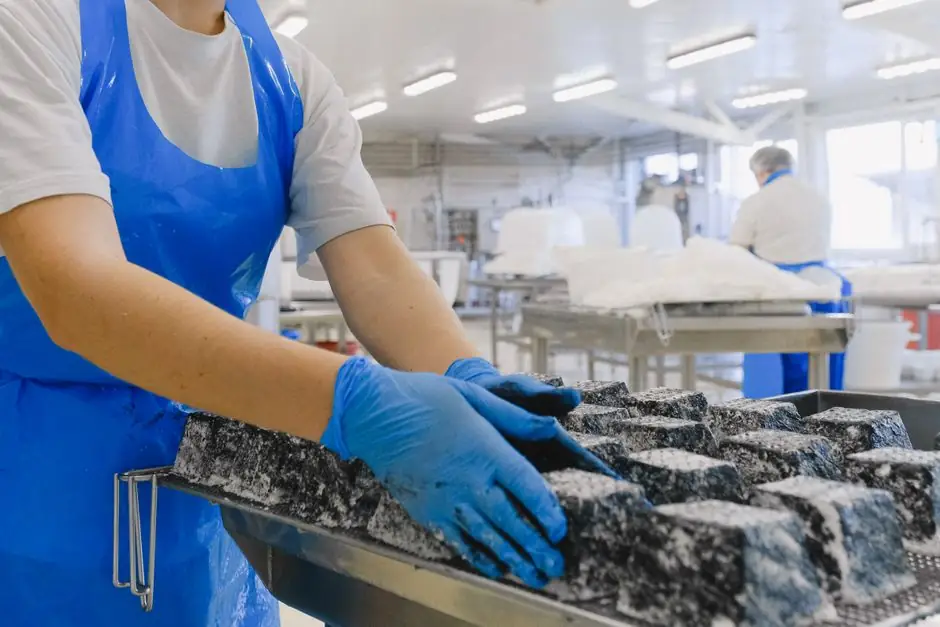
Food-grade self-aligning bearing selection hinges on three engineering gates: corrosion-resistant ring material (typically AISI 304 or 316 stainless), H1-registered incidental-contact lubricant, and a cage polymer that survives hot water and CIP chemicals up to 80–90 °C.
Misalignment tolerance of 1.5–3° (inner-ring swing) is the decisive spec for washdown conveyors, ribbon mixers, and bottle-filler agitator shafts where belt stretch or frame deflection cannot be eliminated [S1].
Why Misalignment Tolerance, Not Load Rating, Drives Food-Plant Specs
Misalignment tolerance is the primary reason a process engineer chooses a self-aligning ball or spherical roller bearing over a deep-groove ball bearing on a food line, because shaft deflection, belt stretch, and thermal growth cannot be economically dialed out of long conveyors or cantilevered agitators [S1].
Self-aligning ball bearings compensate 1.5–3° of static misalignment between shaft and housing through a spherical outer race and two rows of balls, an architecture that sacrifices a portion of radial load capacity (typically 60–75% of an equivalent deep-groove ball bearing) in exchange for that compliance [S1]. Spherical roller variants recover most of that load capacity while still accepting 0.5–2° of misalignment, at the cost of lower limiting speeds. For a 60 mm bore 22-series self-aligning ball bearing, published dynamic load ratings typically land in the 25–35 kN range versus 40–50 kN for a comparably sized deep-groove ball bearing.
Material Map: Races, Balls, Cages, Seals, Lubricant
Standard chromium-steel self-aligning bearings are not acceptable in washdown zones; 304 stainless races are the minimum food-grade spec, with 316 stainless required for chloride-bearing cleaners (caustic, sodium hypochlorite) and high-salt processes such as brine injection or cheese brining. [S1]
Balls should match race material: 440C stainless (HRC 58–60) is the most common spec for food-grade self-aligning ball bearings because it balances corrosion resistance with rolling-contact fatigue life; full-ceramic Si3N4 balls paired with stainless races push upper speed limits and eliminate metallic wear debris, but at 3–5× the unit cost. Cage selection is critical: pressed steel or brass cages trap moisture and corrode; engineered polymers (PEEK, PPS, or food-grade PTFE) are the standard, and a PEEK-cage 1200-series self-aligning ball bearing is now a stock SKU from multiple Shandong-based bearing exporters [S4]. Seals must be food-grade nitrile (NBR) or FKM, with 2RS (rubber seal both sides) preferred over open or shielded configurations in washdown service.
Lubricant, Cleanability, and NSF/FDA Compliance
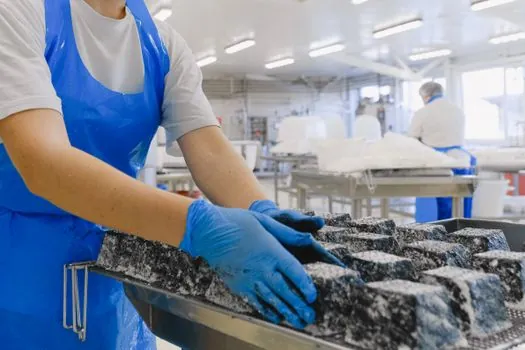
The lubricant almost always determines whether a self-aligning bearing passes or fails a food-plant audit; H1-registered greases, defined for incidental food contact up to 10 ppm, are the baseline spec, and H2 greases (non-food-contact) are explicitly disallowed in any zone where contact is possible. [S1]
FDA 21 CFR 178.3570 is the US federal regulation governing lubricants with incidental food contact, and NSF International administers the H1/H2 registration scheme; audit-ready plants also reference ISO 22000 food-safety management and the EHEDG Doc. 2 cleanability guidelines when specifying sealed units. Grease choice must survive CIP chemical exposure: typical alkaline cleaners run pH 11–13 at 70–85 °C, and acidic cleaners (phosphoric, nitric) run pH 1–3; H1 aluminum-complex or PFPE-thickened greases are the most broadly compatible. Washdown ingress protection is gated by the seal design: 2RS (contact rubber seal) typically reaches IP54–IP65 equivalent splash resistance, while 2CS (additional slinger) or fully sealed stainless end caps push toward IP66–IP67. Bearing life in a washdown environment with daily CIP cycles is usually governed by grease degradation, not rolling-contact fatigue, so a relube interval of 1,000–2,000 hours is the practical operating envelope.
Selection Criteria: Ball vs. Roller, Open vs. Sealed, Steel vs. Stainless
On four decision axes the two main self-aligning architectures split clearly: misalignment window, load rating, limiting speed, and food-grade material availability. The table below is the working spec map for 2026 food-line retrofits and new builds. [S4]
Self-aligning ball bearing (1200/1300 series, 22xx series): misalignment 1.5–3°, dynamic load (60 mm bore) 25–35 kN, limiting speed ~5,000–6,300 rpm open / 3,200–4,000 rpm 2RS, food-grade material availability: 304/316 stainless + PEEK cage widely available. Spherical roller bearing (222xx series, 223xx series): misalignment 0.5–2°, dynamic load (60 mm bore) 90–150 kN, limiting speed ~3,000–4,500 rpm open / 1,800–2,400 rpm sealed, food-grade material availability: 304 stainless available, 316 stainless limited lead time, ceramic hybrid on request. For a ribbon-mixer agitator with high radial shock and slow rotation, spherical roller wins. For a bottle-conveyor idler with belt stretch and 1,750 rpm, self-aligning ball with 2RS is the lower-cost, lower-friction answer. For cross-line comparison with another common bearing family in automotive-class transfer conveyors, see Angular Contact Bearing Selection for Automotive Production Lines.
Real Use Cases: Mixer, Conveyor, Filler, Centrifuge
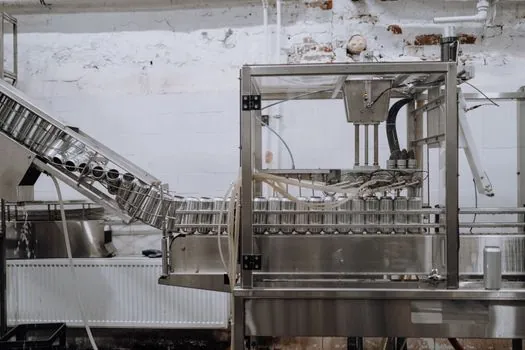
Stainless self-aligning ball bearings in 22xx series are now a default spec for ribbon and paddle mixers in dairy and sauce plants, where cantilevered shaft deflection under high-viscosity loads (up to 50,000 cP) exceeds what deep-groove bearings can absorb without hot spots. [S1]
Washdown conveyors running 30–120 m/min typically spec 2RS sealed 1200-series units in 304 stainless, relubed every 6 months, with H1 grease and PEEK or PPS cages. Centrifuge and bottle-filler applications push speeds toward 5,000–6,000 rpm and require tighter internal clearance (C3) and ABEC-3 or ABEC-5 tolerance grade; for these, a hybrid ceramic-ball self-aligning bearing in 316 stainless is the published high-end reference design, and parallels the load/misalignment pattern engineers also apply on Self-Aligning Bearing Selection for Cement Plants: 2026 Spec Map, where contamination is the controlling design driver. Freezer-tunnel conveyors at –25 to –40 °C must use low-temperature H1 greases (polyalphaolefin base, pour point below –40 °C) and dry-film or stainless end-cap seals, since standard nitrile rubber hardens below –20 °C and leaks.
Failure Modes and Sourcing Pitfalls
Three failure modes dominate food-plant self-aligning bearing returns: corrosion pitting of the outer race under failed seals, grease washout during repeated CIP cycles, and cage cracking when standard nylon 66 (PA66) is used above 100 °C in steam-sterilization service. [S1]
Each of these is a spec error, not a bearing defect. Sourcing pitfalls to flag in 2026 purchasing documents: demand mill certificates for 304/316 stainless (not "stainless" as a generic descriptor), require H1 registration number printed on the lubricant SDS, and reject any cage material that is not explicitly PA66-GF25, PPS, PEEK, or PTFE. A second pitfall: many "food-grade" bearings on B2B trading platforms are relabeled general-industry units with only the packaging changed; the only reliable verification is the H1 grease registration number cross-checked against the NSF White Book listing. Shengyuan Bearing Steel Ball Co. and similar Shandong-based exporters in the Liaocheng cluster (Guan County) are now listing 1200/1300/22xx series self-aligning ball bearings with PEEK cages and 2RS seals as stock SKUs, with stated production capacities in the 50,000-piece-per-year range, and Tik Bearing Manufacturing Co. advertises self-aligning ball bearings with negotiable MOQ through standard B2B channels [S2][S3][S4].
Standards, Documentation, and the 2026 Audit Trail
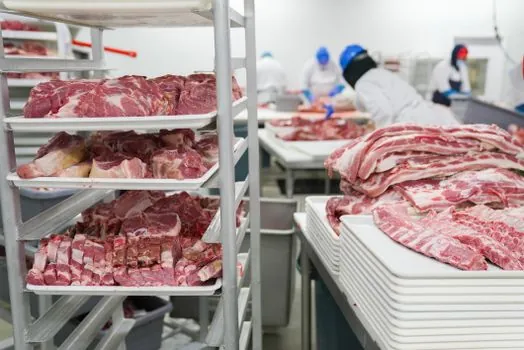
For a defensible food-grade bearing specification, the documentation package should list: AISI 304 or 316 stainless per ASTM A276/A479, H1 lubricant with NSF registration, FDA 21 CFR 178.3570 compliance statement, ISO 22000 food-safety context, and EHEDG Doc. 2 cleanability note for the seal/housing interface. [S1]
NSF/ANSI 169 (formerly NSF 51) covers food equipment materials, and the NSF H1 registration scheme is administered separately under ANSI 133.41; both are commonly referenced in food-plant purchase specifications but neither replaces the FDA 21 CFR 178.3570 federal citation for incidental-contact lubricant. Where bearings sit inside USDA-inspected meat, poultry, or egg processing lines, the USDA Food Safety and Inspection Service (FSIS) sanitation requirements add an extra documentation layer, and the bearing supplier must provide a letter of guarantee covering lubricant composition, cage polymer, and seal elastomer. For 2026 projects, also retain the bearing maker's ISO 9001:2015 certificate and the grease maker's ISO 21469 (lubricant hygiene) certificate, since ISO 21469 is increasingly requested by EU-based food-safety auditors.
Trackable signals to watch over the next reporting cycle: (1) broader stocking of 316 stainless PEEK-cage 22xx self-aligning ball bearings out of Shandong and Liaocheng suppliers, which would compress lead times from 8–12 weeks toward 4 weeks; (2) ceramic-hybrid 316 stainless spherical roller bearings in 222xx series entering standard B2B catalogs at sub-USD 800 list price, a price point that would meaningfully open the segment to mid-tier dairy and beverage plants.
Spec-level background on the components involved: self cleaning filter, and self priming pump.