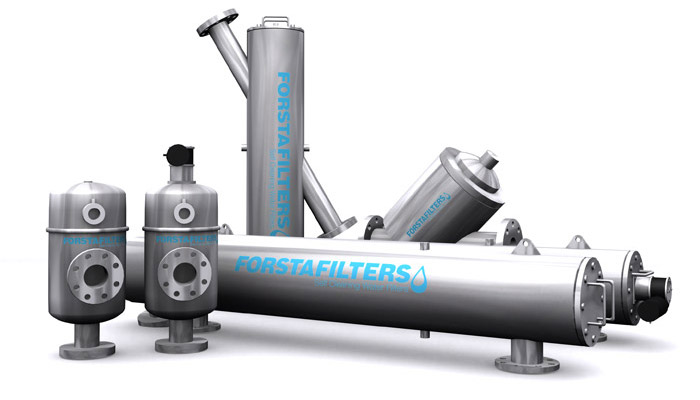
A self-cleaning filter is an automatic in-line filter that removes captured solids from its own screen without an operator opening the housing, and in most designs without interrupting downstream flow. It combines a fixed filtration screen with a cleaning mechanism (backwash, suction scan, brush, or motor-driven scraper) actuated by a differential-pressure or timer trigger, so it holds a stable pressure drop on continuous, high-dirt-load duties where a manual basket strainer would clog and force a shutdown.
This is the category that protects cooling-water circuits, seawater intakes, reverse-osmosis pre-treatment, irrigation headers, and process nozzles from particulate fouling. Choosing one correctly means matching the cleaning mechanism to the medium, then sizing the screen for flow, micron rating, and trigger differential. This guide decodes each of those decisions in turn.
This guide is written for industrial purchasing engineers and design engineers. It covers 6 chapters, from what a self-cleaning filter is, through cleaning mechanisms, screen construction, materials and standards, spec-sheet decoding, to a selection decision sequence, with 7 selection FAQs and verified manufacturer references. Performance and screen ratings reference public engineering practice and the ISO 16889 multipass beta-ratio method, with mesh sizing per ASTM E11, pressure-vessel scope governed by PED 2014/68/EU and ASME Section VIII, and valve pressure-class ratings by ASME B16.34.
Chapter 1 / 06
What is a Self-Cleaning Filter
A self-cleaning filter is a permanent-media liquid filter that automatically removes the solids it captures, restoring its own filtration capacity without manual disassembly. Functionally it sits between a simple pipeline strainer and a media or membrane filter: it provides defined particle removal at a fixed micron rating, like a strainer, but it adds an integral cleaning mechanism that lets it run continuously on dirty fluids that would blind a static screen within hours. The defining feature is not the screen itself but the automated cleaning cycle and the control logic that triggers it.
Structurally, a self-cleaning filter is composed of five subsystems: (1) a pressure-retaining body or tank, usually carbon steel, stainless steel, or coated steel, governed as a pressure vessel under PED 2014/68/EU in Europe and ASME Section VIII Division 1 where a U-stamp is required; (2) the filtration screen, made of stainless steel woven mesh, perforated plate, or wedge wire, which sets the micron cut-point; (3) the cleaning device, a backwash valve and nozzle, a suction-scanning rotor, a brush assembly, or a motor-driven scraper or cleaning disc; (4) a drain or purge port that discharges the dislodged solids; and (5) the electrical or hydraulic control system that monitors differential pressure and sequences the cleaning cycle.
The cleaning cycle is what separates this category from a manually cleaned basket strainer. In a basket strainer, an operator stops the line, opens the cover, and rinses the basket by hand. In a self-cleaning filter, the controller watches the pressure drop across the screen; when it rises past a setpoint, typically in the region of 0.3 to 0.7 bar (about 5 to 10 psi), the cleaning device activates, removes the accumulated cake, and the differential collapses back to its clean value. In most water-duty designs the main flow is not interrupted during this cycle, so the process never sees a stoppage. On a mechanically cleaned filter such as Eaton's MCS-1500, a spring-loaded cleaning disc travels the length of the element and pushes the collected solids into a purge chamber at the bottom of the housing.
The application scale is broad. The same architecture protects municipal and industrial water systems, cooling-tower side-streams, seawater intake and desalination pre-treatment, reverse-osmosis and ultrafiltration pre-filters, drip-irrigation headers, district-heating loops, food and beverage process water, and the spray nozzles of steel and paper mills. Flow capacities run from a few cubic meters per hour on a small skid up to several hundred cubic meters per hour in large single bodies (Amiad's Filtomat M100 reaches about 400 m3/h, or roughly 1,760 gpm), and far higher in duplex or multiplex banks that keep filtration online while one body cleans.
Three engineering outcomes justify the added capital cost over a manual strainer: a stable, low pressure drop that protects downstream pumps and membranes, the elimination of manual basket-change labor and the downtime it causes, and predictable, unattended operation on high and variable dirt loads. On a continuous line, the labor and lost-production savings typically dominate the purchase-price difference within the first one to two years.
Chapter 2 / 06
Cleaning Mechanisms and Types
Self-cleaning filters are classified primarily by how they clean the screen, because that choice determines which media, viscosities, and dirt loads the filter can handle. Five mechanisms dominate industry: backwash (reverse flush), suction scanning, brush, scraper, and motor-driven cleaning disc. Selecting the wrong mechanism is the most common and most expensive mistake in this category, because a suction-scan filter on a viscous fluid simply will not self-clean. The table below compares the five.
Mechanism
How it cleans
Best media
Flush liquid use
Flow interrupted?
Backwash (reverse flush)
Reverse filtered flow bursts through the screen segment
Clean to moderately dirty water, fuels
~1 to 5%
Usually no
Suction scanning
Vacuum nozzles scan and spot-clean the inner screen
Surface and ground water, light slurries
<1%
No
Brush
Rotating brushes wipe debris off the screen
Silt, fibers, suspended matter
Low
No
Scraper
Blades scrape cake into a purge chamber
Viscous, sticky, abrasive liquids
Very low
No
Cleaning disc (mechanically cleaned)
Driven discs wipe the screen continuously
High-viscosity, abrasive process fluids
Very low
No
Backwash filters reverse a short burst of already-filtered liquid through the fouled screen, knocking the cake loose and flushing it to drain. The cycle can be hydraulic, using line pressure across an opened drain valve, or driven by a sequenced multi-port valve. Backwash designs are simple and reliable on water and clean fuels, but they need adequate line pressure to generate the reverse flow, commonly a minimum on the order of 2 bar (about 30 psi), and they consume a percentage of throughput as flush. BOLLFILTER is a long-established supplier of automatic backwash filters for marine fuel, lube, and process duties.
Suction-scanning filters place a set of nozzles a small distance from the inner screen surface and open them to a low-pressure drain. When the flush valve opens to atmosphere, the pressure difference creates a focused suction that lifts the cake only from the screen segment directly under the nozzle, while the scanner and an axial drive sweep the nozzles across the entire screen. Because only a small isolated area is cleaned at a time, flush-water use is reported at under 1 percent of throughput, and the main flow is never interrupted. Amiad states its suction-scanning technology gives 100 percent cleaning of the screen area while using less than 1 percent of the process water; the Filtomat and the heavy-duty MG series are representative hydraulic suction-scanning screen filters with a minimum operating pressure around 2 bar.
Brush and scraper filters use mechanical contact rather than reverse flow. Rotating brushes are effective on silt, fibers, and suspended solids that release with a light wipe, while scrapers use blades to shear a thicker or stickier cake off the screen and drive it into a collection chamber for a concentrated purge. Both run independently of flush flow, so they suit raw water with heavy dirt loads and they waste very little liquid. Mechanically cleaned filters with driven cleaning discs, such as Eaton's DCF series, extend this idea to genuinely viscous, abrasive, or sticky process liquids, where no hydraulic mechanism could generate the flow needed to self-clean.
A secondary classification is by arrangement. A simplex filter is a single body and must be bypassed for any screen service. A duplex pair shares inlet and outlet manifolds with a changeover valve so one body filters while the other is isolated, cleaned, or serviced; many automatic self-cleaning filters run duplex or multiplex to guarantee uninterrupted filtration even during maintenance, not just during the cleaning cycle. The arrangement decision is independent of the cleaning mechanism: a backwash, suction-scan, or scraper filter can each be built simplex or duplex.
Chapter 3 / 06
Screen Construction and Micron Ratings
The screen sets the particle cut-point, and its construction governs pressure drop, mechanical strength, and how readily the cake releases during cleaning. Three constructions dominate: woven wire mesh, perforated plate, and wedge wire (profile wire). For a given micron rating they behave very differently, and self-cleaning service rewards screens that release cake cleanly. The table below compares the three plus the common fused-mesh hybrid.
Screen type
Typical micron range
Open area
Strength
Self-release of cake
Woven wire mesh
~5 to 500 um
High
Low
Fair, blinds faster
Perforated plate
~500 to 3000 um
Low
High
Good
Wedge wire (profile wire)
~25 to 1000 um
High
High
Excellent (slot widens inward)
Mesh fused to perforated support
~10 to 200 um
Medium
High
Good
Woven wire mesh offers the finest filtration and a high open area for a given micron rating, so it gives a low pressure drop at a fine cut. Its weakness is mechanical: it is the least robust, it deforms under shock, and very fine mesh blinds quickly as particles wedge into the weave. It suits light-duty fine straining and is often the inner element when fused onto a stronger support. Initial cost is typically lowest for woven mesh, which is why it remains common on low-pressure service.
Perforated plate is a sheet punched with round holes. It is mechanically strong and durable with a long service life, but for the same nominal opening it has much lower open area than mesh, so it runs at a higher pressure drop. It is the standard choice for coarse cut-points and abrasive duties where screen survival matters more than fineness, and it is well suited to lower-pressure environments.
Wedge wire, also called profile wire or Johnson screen, is built from V-shaped or trapezoidal wires wound so the slot is narrowest at the surface and widens inward. This geometry gives a precise, repeatable cut-point, a high open area, a low pressure drop, high mechanical strength, and, most usefully for self-cleaning filters, excellent cake release: a particle that passes the surface slot cannot lodge because the slot only widens behind it. The continuous slot also minimizes dead zones, which is exactly the behavior a backwash or scraper cycle needs. Welded wedge wire handles mechanical and thermal stress better than perforated plate, so high-pressure and high-temperature self-cleaning screens are frequently built from 316L stainless steel trapezoidal wedge wire. The trade-off is initial cost, which is typically highest of the three, though its higher open area lowers pumping energy and lengthens the interval between cleaning cycles.
Micron rating is the actual opening dimension; mesh count is the number of openings per linear inch and depends on the wire diameter as well as the opening, so the two are not interchangeable without knowing the weave. Industrial self-cleaning filters commonly cover roughly 5 to 3,000 microns. The table below gives a practical micron-and-mesh reference (U.S. mesh per ASTM E11) for selection conversation; always confirm against the specific screen datasheet because wire diameter shifts the mesh equivalence.
Micron rating
Approx. U.S. mesh
Filtration class
Typical capture
25 um
~500 mesh
Fine
RO pre-filter fines, fine pigment
44 um
325 mesh
Fine
Fine sand, silt
100 um
~150 mesh
Medium
Coarse silt, scale flakes
149 um
100 mesh
Medium
Fine grit, algae
500 um
~35 mesh
Coarse
Sand, debris, nozzle protection
841 um
20 mesh
Coarse
Leaves, weld slag, large debris
2000 um
~10 mesh
Very coarse
Intake trash, pump protection
A practical rule follows from this table: every step finer reduces the effective open area, so a finer screen raises pressure drop and demands more screen area for the same flow. Specify the micron rating from the smallest particle that must actually be removed to protect the downstream equipment, not finer for its own sake.
Chapter 4 / 06
Materials, Media and Standards
Two material decisions matter: the wetted screen and seal materials, which must survive the chemistry, and the pressure-retaining body, which is governed as a pressure vessel. A mismatch on either side ends in corrosion, screen failure, or a non-compliant vessel. Wetted metals follow the same logic as any process equipment: 304 and 316L stainless steel for water and mild service, duplex stainless and titanium for chlorides, and nickel alloys for aggressive acids.
316L stainless steel is the default screen and wetted material, compatible with water, steam condensate, light hydrocarbons, and dilute organic acids, and it is the standard alloy for high-precision wedge-wire screens; Eaton's MCS-1500 vessel, for example, is built in 316 stainless steel. The limit of 316L is chlorides: above roughly 200 ppm chloride with warm temperature it becomes vulnerable to pitting and chloride stress-corrosion cracking, so seawater and brine intakes move to duplex 2205, super-duplex, or titanium screens, and the body is often coated or rubber-lined carbon steel for cost. For aggressive acids such as hydrochloric or wet chlorine, nickel alloys like Hastelloy C-276 or C-22 are required, at several times the cost of stainless.
For the cleaning components, mechanically cleaned filters use replaceable polymer cleaning discs or scraper tips matched to the medium. Eaton's DCF series, for example, offers cleaning discs in UHMWPE, urethane, PTFE (Teflon), and Kynar (PVDF), so the wiping element can be selected for abrasion, temperature, or chemical resistance independently of the screen, while the same series offers stainless steel screens from about a 15 micron slot up to quarter-inch perforations. Seals are typically EPDM, FKM (Viton), or perfluoroelastomer (FFKM) for the most aggressive or high-temperature chemistries, with NBR limited to oils and fuels.
On the standards side, the pressure-retaining body in Europe is a pressure vessel under the Pressure Equipment Directive PED 2014/68/EU, with the category set by volume and pressure; ASME Section VIII Division 1 is the equivalent code where U-stamp vessels are required. The integral backwash and drain valves take their pressure-temperature class ratings from ASME B16.34, the steel valve standard for flanged, threaded, and welding-end valves, and flange ratings follow ASME B16.5 or EN 1092-1. Where a micron rating must be defended quantitatively, filtration efficiency is expressed as a beta ratio measured by the ISO 16889 multipass method: capture efficiency equals (beta minus 1) divided by beta, so beta 2 is 50 percent capture at a given particle size, beta 10 is 90 percent, beta 100 is 99 percent, and beta 1000 is 99.9 percent. The table below summarizes the standards most often cited on a self-cleaning filter datasheet.
Standard
Scope
Why it matters
PED 2014/68/EU
Pressure equipment (EU)
Governs the filter body as a pressure vessel; sets CE category
ASME VIII Div 1
Pressure vessels
U-stamp body construction where required
ASME B16.34
Valves (flanged, threaded, welding end)
Pressure-temperature class ratings for the integral backwash and drain valves
ISO 16889
Multipass filter test
Defines beta-ratio capture efficiency at a particle size
ASTM E11
Test sieves / mesh
Standard mesh-to-micron opening reference for screens
ASME B16.5 / EN 1092-1
Pipe flanges
Flange dimensions and pressure class for connections
ATEX 2014/34/EU
Explosive atmospheres
Required for motor-driven units in hazardous areas
Chapter 5 / 06
Key Specification Parameters
A self-cleaning filter datasheet can list two dozen lines, but only a handful drive the selection. Read these eight before anything else: filtration degree (micron rating), design flow rate, maximum working pressure, minimum operating pressure for cleaning, clean and dirty differential pressure, cleaning trigger and cycle, screen and body materials, and connection size and rating. The table below frames the spread, and each parameter is decoded after it.
Parameter
Typical range
What it drives
Filtration degree (micron)
5 to 3000 um
Particle cut-point, open area, pressure drop
Design flow rate
~1 to 800 m3/h per body
Screen area, body and connection size
Max working pressure
~10 to 16 bar typical
Body rating, flange class, vessel code
Min operating pressure (hydraulic)
~2 bar
Whether backwash / suction can self-clean
Clean differential pressure
<0.2 to 0.3 bar
Headroom to the cleaning trigger
Cleaning trigger differential
0.3 to 0.7 bar (5 to 10 psi)
When a cleaning cycle starts
Max process temperature
~80 C water-like; higher jacketed
Screen, seal, fill, and disc material limits
Connection size / rating
DN15 to DN600+ (1/2 to 24 in)
Install envelope, flange standard
Filtration degree (micron rating) is the screen opening that sets the particle cut-point, commonly offered in fixed steps from about 25 to 2,000 microns and as fine as 5 microns in special screens. Remember that a finer screen has less effective open area, so dropping the micron rating raises pressure drop and demands more screen area for the same flow. Specify the rating from the smallest particle that must be removed to protect the downstream equipment, not finer.
Design flow rate must be the peak process flow, not the average, because the cleaning trigger and the screen sizing both depend on the worst case. Capacity runs from a few cubic meters per hour on small skids to several hundred in a single body; Amiad's Filtomat M100 is rated up to about 400 m3/h (roughly 1,760 gpm), and high-flow mechanically cleaned units such as Eaton's MCS-1500 reach about 1,500 gpm in a single body. Beyond a single body, duplex and multiplex banks add capacity and keep filtration online during service.
Maximum working pressure is the body rating, and minimum operating pressure is just as important for hydraulic self-cleaning filters: backwash and suction-scan mechanisms need a minimum line pressure, often on the order of 2 bar, to generate the reverse or suction flow that lifts the cake. The MCS-1500, as an illustration, operates over roughly 30 to 150 psi (about 2 to 10.5 bar) at temperatures up to 82 degrees Celsius. If the available pressure is too low, a hydraulic filter cannot self-clean and a motor-driven design is required instead.
Differential pressure appears as a clean value and a dirty trigger value. A well-sized filter has a low clean differential, commonly under 0.2 to 0.3 bar, so that the rise to the cleaning setpoint, typically around 0.3 to 0.7 bar (about 5 to 10 psi), is a clear signal rather than noise. Cleaning trigger and cycle describe how the filter decides to clean (differential pressure, timer, or manual) and how long a cycle lasts and how much flush liquid it consumes, which feeds directly into water cost and discharge planning.
The remaining parameters define construction and interface. Screen and body materials follow Chapter 4: 316L as the default screen, duplex or titanium for chlorides, polymer cleaning discs for mechanical designs, and a coded body under PED or ASME VIII. Connection size and rating set the install envelope: threaded for small DN15 to DN50 (1/2 to 2 inch) units, flanged DN50 to DN600 (2 to 24 inch) and larger to ASME B16.5 or EN 1092-1 for the rest. Outdoor or hazardous installations additionally require an enclosure rating (IP65 or above) and, for driven units, ATEX or equivalent area certification.
Chapter 6 / 06
Selection Decision Factors
To convert the preceding chapters into a specific model, follow the sequence below. Most selection failures come not from one wrong number but from deciding the mechanism after the screen, or the screen after the body. Work the steps in order, and this list doubles as a fixed RFQ template.
Characterize the medium and dirt load first: liquid type, viscosity, temperature, solids concentration, particle size distribution, and whether the solids are soft, sticky, or abrasive. This single step decides the cleaning mechanism: hydraulic backwash or suction-scan for clean-to-moderate water, brush or scraper for heavy or fibrous loads, motor-driven cleaning disc for viscous or sticky liquids.
Set the filtration degree: choose the micron rating from the smallest particle that must be removed to protect the downstream pump, membrane, nozzle, or heat exchanger. Do not over-specify fineness, because every step finer raises pressure drop and screen area.
Size for peak flow and pressure drop: use the peak, not average, flow; keep the clean differential low (under about 0.2 to 0.3 bar) so the cleaning trigger has headroom; verify the available line pressure exceeds the minimum the cleaning mechanism needs (often around 2 bar for hydraulic types).
Select screen construction and wetted materials: wedge wire for low-drop fine self-release, perforated plate for coarse and abrasive, mesh-on-support for fine duties; 316L default, duplex or titanium for chlorides, nickel alloys for aggressive acids; seal and cleaning-disc materials matched to chemistry and temperature.
Choose the cleaning control and trigger: differential-pressure trigger as primary with a backup timer is the accepted practice; confirm cycle duration and flush-liquid consumption against water cost and any discharge permit.
Fix the connection, arrangement, and body code: threaded or flanged size and rating to ASME B16.5 or EN 1092-1; simplex, duplex, or multiplex per the need to service without stopping filtration; body coded under PED 2014/68/EU or ASME VIII as the jurisdiction requires.
Confirm certifications and environment: PED or ASME for the vessel, ATEX or equivalent for driven units in hazardous areas, marine class approval for shipboard duty, and the enclosure rating (IP65 and above) for outdoor or washdown locations.
Evaluate total cost of ownership: purchase price plus installation, power or flush water, spare screens and cleaning discs, and the value of avoided manual-cleaning downtime. On a continuous high-dirt-load line, the eliminated labor and lost production usually repay the premium over a manual strainer within one to two years.
One dimension that is easy to overlook at the purchasing stage but decisive over a ten-year service life is serviceability: availability of spare screens and cleaning discs, field service for the actuator and controller, and the ease of removing the screen for inspection. A filter chosen on price alone but with a long screen lead time can idle a line for weeks. Established suppliers of industrial self-cleaning and mechanically cleaned filters, including Eaton (DCF, MCS), Amiad (Filtomat, MG), BOLLFILTER, Forsta, and Filternox, maintain spare-part and service networks that should weigh in the final decision alongside the technical fit.
FAQ
What is the difference between a self-cleaning filter and a basket strainer?
A basket strainer is a manual device: when the screen clogs, an operator stops the line, opens the cover, and physically removes and rinses the basket. A self-cleaning filter integrates an automatic cleaning mechanism (backwash, suction scan, brush, or scraper) that removes captured solids on a timer or differential-pressure trigger without opening the housing and, in most designs, without interrupting downstream flow. The trade-off is capital cost and complexity: a self-cleaning filter adds a motor or hydraulic actuator, a drain valve, and a controller, but it eliminates the labor and downtime of manual basket changes, which is decisive on continuous high-dirt-load duties.
How does the automatic cleaning cycle get triggered?
Three trigger modes are standard, and most controllers combine them. Differential-pressure trigger starts a cleaning cycle when the pressure drop across the screen, measured by a differential gauge or two transmitters, exceeds a setpoint, commonly 0.3 to 0.7 bar (about 5 to 10 psi). Timer trigger starts a cycle at fixed intervals regardless of clogging, useful for low but steady dirt loads. Manual trigger lets an operator force a cycle for testing or commissioning. The accepted practice is differential-pressure as the primary trigger with a backup timer, so that a slow fouling buildup still gets flushed even if it never reaches the pressure setpoint.
How much water does a backwash self-cleaning filter waste per cycle?
It depends on the cleaning mechanism. Suction-scanning screen filters isolate only the fouled screen segment under the nozzle, so flush water is typically reported at under 1 percent of total throughput, with a cycle lasting a few seconds to tens of seconds. Full backwash designs that reverse flow through the whole screen consume more, often 1 to 5 percent depending on cycle duration and line pressure. Mechanical scraper and brush filters that discharge a concentrated purge can waste even less liquid because they push solids to a collection chamber rather than flushing the full screen area. Always confirm the manufacturer flush-volume figure against your water cost and discharge permit.
What micron ratings are available, and how do micron and mesh relate?
Industrial self-cleaning filters commonly cover roughly 5 to 3,000 microns, with standard screen steps such as 25, 50, 75, 100, 150, 200, 300, 500, 800, 1000, and 2000 microns. Micron rating is the actual opening dimension; mesh count is the number of openings per linear inch and depends on wire diameter. As a reference under ASTM E11, 20 mesh is about 841 microns, 100 mesh about 149 microns, and 325 mesh about 44 microns. For self-cleaning service, very fine woven mesh below about 50 microns blinds faster, so wedge-wire or perforated screens are often preferred at the fine end because their defined slot geometry releases cake more readily during a flush.
What screen construction should I choose: wire mesh, perforated plate, or wedge wire?
Woven wire mesh gives the finest filtration and highest open area for a given micron rating but blinds faster and is the least robust, suiting light-duty fine straining. Perforated plate is mechanically strong and durable with a long service life, but for the same micron rating it has lower open area and therefore higher pressure drop, suiting coarse and abrasive duties. Wedge wire (profile wire) has a V-shaped slot that widens inward, giving a consistent cut-point, high open area, low pressure drop, high mechanical strength, and excellent self-release of cake, which is why mid-to-fine self-cleaning filters frequently use it. Many designs sinter or fuse a fine mesh onto a perforated support plate to combine a fine cut-point with strength.
Can a self-cleaning filter handle high-viscosity or sticky liquids?
Hydraulic backwash and suction-scan filters rely on a fast reverse flow that high-viscosity liquids cannot supply, so they are poor choices for viscous or sticky media. The correct technology is a mechanically cleaned filter: a motor-driven scraper or cleaning disc continuously wipes the screen and pushes solids to a purge chamber, working independently of flush flow. Eaton's DCF mechanically cleaned filter series is built specifically for highly viscous, abrasive, or sticky liquids and uses replaceable cleaning discs in materials such as UHMWPE, urethane, PTFE (Teflon), or Kynar (PVDF) matched to the chemistry. For very high viscosity the body is often heat-jacketed to keep the medium fluid.
Which manufacturers make industrial self-cleaning filters?
For mechanically cleaned filters on viscous and abrasive media, Eaton offers the DCF and MCS series, including the high-flow MCS-1500 rated to about 1500 gpm with magnetically coupled actuation. For hydraulic suction-scanning and screen filters on water duties, Amiad offers the Filtomat and MG series, and Forsta and Filternox supply comparable automatic screen filters. BOLLFILTER is a long-standing supplier of automatic backwash filters for marine, fuel, and industrial process duties. Selection should weigh the cleaning mechanism against the medium, the certifications required (for example PED 2014/68/EU for the pressure vessel, marine class approvals, or ATEX for hazardous areas), and local spare-screen and service availability rather than brand alone.
Self-Cleaning Filter Manufacturers
Source-backed product routes. Open a company dossier for procurement scope and cited evidence.
Russell Finex publishes the self-cleaning Russell Eco Filter for industrial liquid filtration, with published removal down to 15 microns.
Published product fact
The enclosed Russell Eco Filter uses a removable filter element and wiping system to continuously remove solids from liquids without stopping production.
Tekleen publishes the ABW Series of automatic backwash water filters for high-flow industrial, municipal and process-water systems.
Published product fact
ABW Series automatic backwash filters use a stainless-steel screen and an automatic differential-pressure cleaning cycle for high-flow water filtration.