Angular contact ball bearings in textile machinery are specified for combined radial and axial load duty at sustained high rotational speed, with JTEKT catalogues listing standard contact angles of 15°, 30°, and 40° across the 7000, 7200, 7300, and 7400 series for single-row units [S1].
Textile spindles, drafting rollers, and loom cam followers impose both radial and thrust loads simultaneously, which is the operating envelope an angular contact bearing is designed for rather than a pure radial ball bearing [S1][S4].
Contact Angle Selection by Spindle Type
JTEKT assigns 15° contact angle to 7900C, 7000C, 7200C, 7300C, and HAR900C/HAR000C variants, 30° to the 7000/7200/7300/7400 B-less series, and 40° to the 7000B/7200B/7300B/7400B variants, so the choice of contact angle is the primary spindle-design lever rather than bore size alone [S1].
For ring-spinning and rotor-spinning frames where axial load from belt tension and yarn pull is moderate but speed is high, a 15° contact angle supports higher limiting speeds at the cost of lower thrust capacity. For loom sundry drives, lifting cams, and picker sticks where reciprocating冲击 pushes thrust loads sharply upward, a 40° contact angle carries the combined load better at the cost of lower top-end speed. Double-row 3200/3300 (32° contact) and 5200/5300 (24° contact) units consolidate both directions of thrust into a single envelope, useful where a DB or DF stack of singles is not practical to set up [S1].
Load, Speed, and Preload Configuration
Single-row angular contact ball bearings are thrust-capable in one direction only, so the catalogue explicitly groups them as DB (back-to-back), DF (face-to-face), and DT (tandem) for paired mounting when bidirectional thrust is present [S1].
For ball-screw support derivatives, which share the textile spindle requirement for high rigidity, paired sets are matched to ABEC tolerances with pre-load classes A (light), B (medium), and C (heavy) marked as the G-suffix universal-match group on the part code, with P4 and P2 accuracy grades offered for the highest-precision applications [S4]. Spinning frames typically run lighter preloads (class A) to limit frictional heat, while loom cam followers and lifting straps run heavier preloads (class B or C) to hold geometry under reversing冲击 loads. The 60° contact angle used in screw-support bearings sits outside the 15° to 40° single-row range and is a specific heavy-preload, high-rigidity variant rather than a general-purpose choice [S1][S4].
Material, Lubrication, and Contamination Resistance
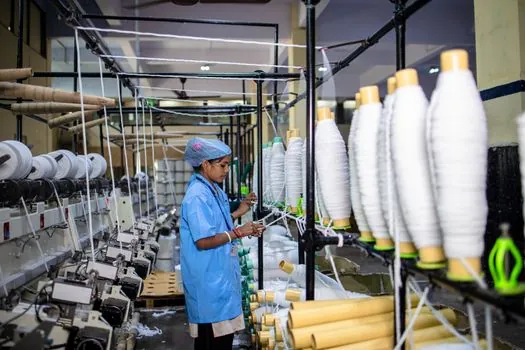
Textile mills carry airborne fibre lint, size chemicals, and humid processing air into every bearing housing, so material choice and sealing drive service life more than the catalogue limiting speed. Standard production uses through-hardened chrome steel, with stainless steel specified for wet-processing zones (dyeing, bleaching, washing) where water and chemicals attack standard raceways. [S1]
Changzhou Fenglin lists 7004-7048, 7204-7236, and 7304-7332 angular contact series in both chrome steel and stainless steel, the same bore and OD envelope as JTEKT's 7000/7200/7300 single-row family, so a mill can switch materials without changing the housing [S3]. Koyo (JTEKT) lists Special Environment Ball Bearings as a product type within its industrial bearings range. A ceramic bearing hybrid (ceramic balls, steel races) is the spec step for high-speed ring-spinning shafts above 18,000 r/min where lube starvation is a failure mode.
Comparison of Angular Contact Bearing Choices for Textile Service
Three practical options cover the bulk of textile mill applications, and the choice is driven by load direction, speed, and environment rather than by a single dominant parameter. [S1]
Single-row 15° contact angle (7000C / 7200C series) suits high-speed drafting rollers and ring-spinning spindles where thrust is unidirectional, the limiting speed is high, and preload is light. Single-row 40° contact angle (7000B / 7200B series) suits loom cam followers, lifting motion, and combined-load drives where thrust is heavy and reversing, with speed sacrificed for load capacity. Double-row 3200/3300 (32°) or 5200/5300 (24°) variants suit drafting unit gearboxes and combined sundry drives where the designer wants a single bearing to carry radial plus bidirectional thrust, simplifying assembly at the cost of slightly lower top speed [S1]. The bearing envelope, cage type, and seal arrangement are equal partners with contact angle: for related radial-only service such as roll-neck idlers or dryer section rollers, a roller bearing carries the radial load more efficiently.
Standards, Sourcing, and Mounting Practice
Acceptance class is governed by ISO 492 for radial ball bearings, with ABEC 5 / P5 and ABEC 7 / P4 grade angular contact bearings standard for spinning and winding applications, and P2 reserved for precision winders and texturing machines. Bore and OD follow ISO 15:2017 dimension series, so 7004, 7204, and 7304 share a common 20 mm bore across manufacturers, which simplifies cross-sourcing between JTEKT, domestic Chinese suppliers such as Changzhou Fenglin, and other Asian makers [S1][S3].
For mills that standardise on a single-row DB or DF matched pair, ordering should specify matched pair suffix (DB, DF, DT) and a defined preload class rather than individual loose bearings, because preload set at the factory is the only repeatable way to control spindle runout. For linear guide rails on winding and creel carriages, a linear bearing is the correct spec, not an angular contact bearing, and the two should not be cross-substituted in a rebuild. Related spec work for the same 7000-series envelope in different load profiles is covered in Angular Contact Bearing Selection for Agriculture Machinery: 2026 Spec Gates and Angular Contact Bearing Selection for Material Handling: 2026 Spec Map, which use the same contact-angle and preload logic in different service environments.
Common Failure Modes and Misapplications
The three failure modes a mill should spec against are: (1) brinelling from static overload during loom stop-start, addressed by heavier preload and a 40° contact angle; (2) premature fatigue from undersized bore, addressed by stepping up one 10-series (for example from 7204 to 7304) at the same 20 mm bore for higher dynamic load rating; and (3) chemical attack on raceways in wet-processing zones, addressed by stainless steel or hybrid ceramic construction [S1][S3].
For very large ring tubes and stenter frames where the load is essentially radial, a slewing bearing is the correct large-bore choice, not an angular contact bearing. Spindle builder catalogue guidance from Koyo/JTEKT explicitly maps the 7000C / 7200C family to high-speed combined-load service, so substituting a deep-groove ball bearing on a spindle that needs real thrust capacity is the most common field misapplication [S1].
For procurement, the next trackable signal is the 2026 update to the EXSEV special-environment and ceramic-bearing catalogues, which extend the available sealing and material options for the same 7000/7200/7300 envelope used in spinning and weaving. Mills rebuilding draft gearboxes and ring frames in the second half of 2026 should confirm matched-pair suffix, preload class, and cage/seal grade on every purchase order rather than accepting generic 7000-series part codes, because the same bore can ship in configurations ranging from light-preload high-speed to heavy-preload combined-load within a single 7204 part number [S1][S4].