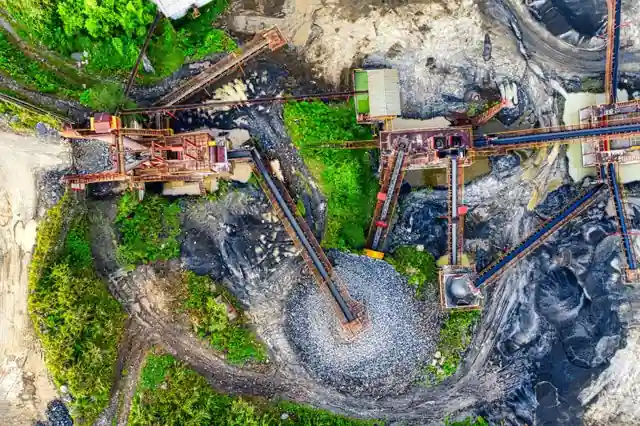
Self-aligning bearings compensate the shaft deflection and frame distortion that mining equipment routinely produces, and they are specified as a dedicated product line in 2025–2026 supplier catalogs covering both ball and spherical-roller constructions [S1][S2].
Two-row self-aligning ball bearings and double-row spherical-roller bearings are the two families on every mining OEM short list; both are sold as off-the-shelf items from Hebei and Shanghai manufacturers alongside cylindrical, tapered, and deep-groove ball bearings, with OEM/ODM service available for special mining frames [S1][S3][S4][S5].
Two-row ball vs. spherical-roller: load, speed, and misalignment
A two-row self-aligning ball bearing has two rows of balls running on a common concave sphered raceway in the outer ring, and this geometry is what gives the family its roughly 1.5° to 3° of static misalignment tolerance without inducing internal stress [S4]. Because the rolling elements are balls, allowable speeds and acceleration are higher than for any roller design, but the radial load capacity per given bore is lower, which is why mining applications under heavy shock loads step up to a spherical-roller variant.
Spherical-roller (or self-aligning roller) bearings carry combined radial and moderate axial load through barrel-shaped rollers between a common spherical outer raceway and two inner-race guidance ribs, and they tolerate similar misalignment angles (commonly up to about 1.5° to 2.5°, dropping as the load and speed rise) while delivering several times the radial capacity of a same-bore ball design [S5]. Where mining specifications call out shock loading from a jaw crusher or a SAG mill, the roller variant is the default, and the ball variant stays on lighter conveyor pulleys, fan shafts, and bucket-wheel slew drives.
Where self-aligning bearings actually pay off in a mining plant
Belt conveyors, especially the head, tail, and take-up pulleys, are the single largest population of self-aligning bearing housings on a mine site, and the same Hebei supplier that lists self-aligning bearings also lists the matching idler, roller, and conveyor pulley product family as a single OEM package [S1]. Spherical-roller pillow blocks are standard on vibrating screens and feeders because the screen box flexes under deck load and the shaft walk that results would preload a cylindrical or tapered bearing within weeks.
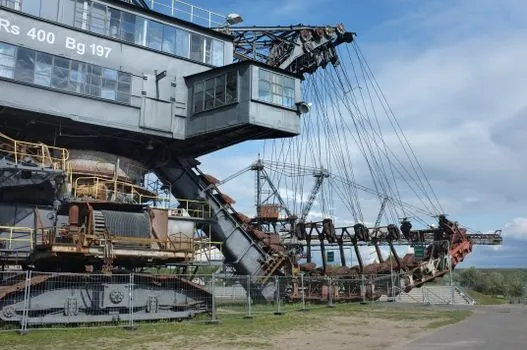
Crushers (gyratory, jaw, cone) and large mill gear-pinion shafts are a separate application group, where the combined heavy radial load plus dynamic deflection from foundation settlement pushes selection toward sealed spherical-roller cartridges, often with adapter-sleeve mounting on the straight shaft. Bucket-wheel and stacker-reclaimer slew bearings use related large-bore self-aligning roller arrangements to absorb the boom deflection seen when the bucket cuts into the muck pile. The wider bearing ecosystem on a mine site, including angular contact bearings for gearbox stages, is typically specified separately rather than mixed into the self-aligning family.
Sealing, clearance, and contamination: the mining-specific gates
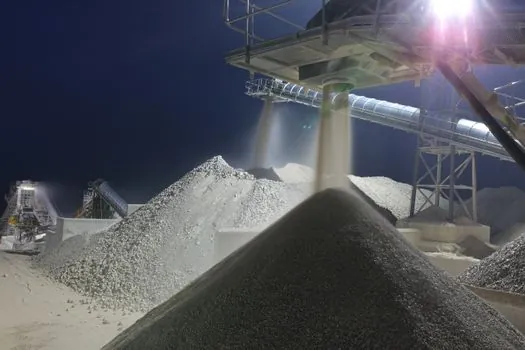
Self-aligning bearings fail in mining service for three reasons that have nothing to do with load math: contamination ingress, water washout of the grease pack, and vibration-induced false brinelling while the machine sits idle in a stockpile. Effective sealing (2RS, 2RSR, or heavy-duty labyrinth taconite-style end caps), grease fill matched to the calculated L10 life, and a clearance class (C2, C0, C3, C4) chosen to compensate for thermal growth under continuous service are the three specification gates that decide whether the bearing lasts one shift or one rebuild cycle. [S3]
For wash-down or slurry-splash duty, suppliers offer sealed-on-both-sides (2RS) variants and machined-brass or pressed-steel cage options; for high-temperature mills, a C3 or C4 clearance is normally specified so the inner ring does not clamp the rollers once the housing warms. Solid-machined-brass cages are generally preferred over pressed-steel in heavy mining shock because they survive shock loading without cracking. The base self-aligning ball bearing type is the right starting reference, with the ball bearing page covering the rolling-element physics that drives the speed and load trade-off.
Selection criteria: a four-axis decision
For any given shaft on a mining machine, four axes decide the part number: (1) effective radial load and any axial component, which sets ball vs. roller; (2) required misalignment tolerance in degrees, which both families claim in the 1.5° to 3° band but with roller falling faster as speed and load rise; (3) sealing class (open, 2RS, or taconite), driven by slurry and water exposure; (4) bore method (direct cylindrical, adapter sleeve, or withdrawal sleeve), which affects whether a SNH or SN-series plummer block can be used. [S2]
For shock-loaded crusher shafts under radial load with light axial, the spherical-roller variant wins on every axis except speed; for high-speed conveyor idler shafts under pure radial load with moderate contamination, the two-row self-aligning ball variant is the lower-cost, higher-rpm answer. A practical side-by-side: ball design allows higher limiting speeds (often 20% to 40% above same-bore roller) and lower friction torque, while the roller design offers roughly 2x to 3x higher basic static load rating C0 and a far better shock-load margin. The self-aligning bearing encyclopedia page consolidates the geometry terms (bore series 222, 223, 230, 231, 222S) used in real mining RFQs.
For most mine operators, the smarter spend is on grease quality, seal integrity, and condition-monitoring vibration pickups, not on the ceramic upgrade. The ceramic bearing reference covers the material trade-off in more depth, while related maintenance guidance for adjacent mechanical systems, such as rebar threading on remote concrete pads, is unrelated to the bearing decision itself but illustrates the same spec-map discipline applied across mine infrastructure.
Common failure modes and what they tell the spec writer
Premature self-aligning bearing failures in mining fall into a small, repeatable set: spalling from under-rated C (basic dynamic load rating), raceway brinelling from shock overload on crusher start-up, grease purge and water contamination through inadequate sealing, and false brinelling from micro-vibration during stockpile storage. Each one points to a specific spec gate: C3 or C4 clearance for hot-running housings, a higher C-series bore for under-rated applications, a 2RS or taconite seal class for wash-down, and transport/storage clamping procedures (sleeve-locked, shaft-grounded) for idle units. [S2]
Specifying a spherical-roller cartridge that is sealed, lubricated-for-life, and mounted on an adapter sleeve with a positive-locking device eliminates roughly two-thirds of the field failures seen with open bearings on adapter sleeves alone, and it is now the default configuration on most 2025–2026 mobile mining equipment for that reason. The self-aligning bearing and ball bearing encyclopedia entries remain the spec reference for the part-number geometry behind these failure-mode corrections.
Also watch for OEM 2026 tender documents from large open-pit truck and shovel operators, where a consolidated move to sealed spherical-roller cartridges on haul-truck wheel ends and slew gearboxes typically shows up first.