Self-aligning ball bearings are recommended where aligning the shaft and housing is difficult or where the shaft may bend, with a spherical outer race accommodating initial misalignment [S1].
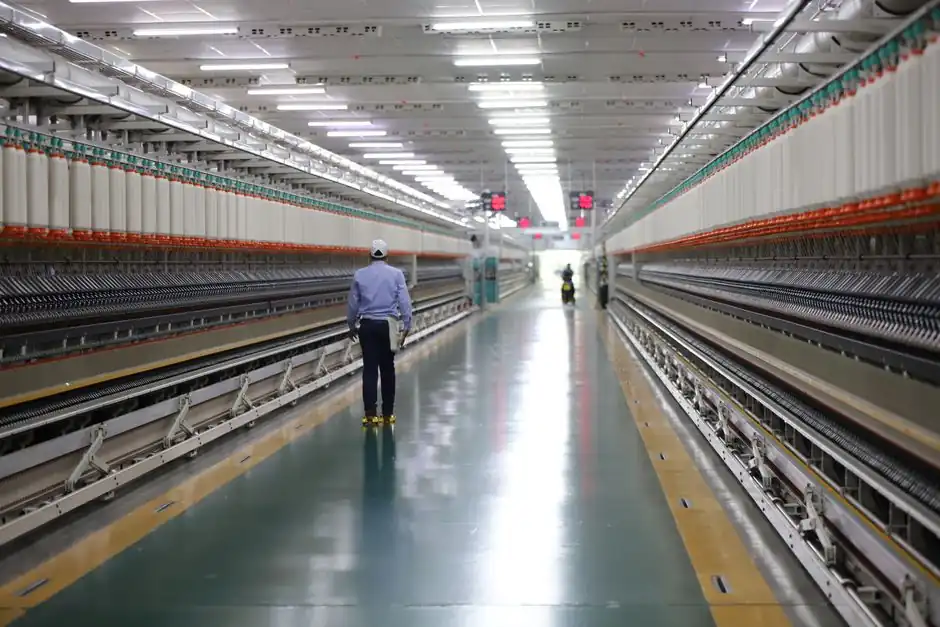
For a textile mill, that statement covers most ring-, rotor-, and air-jet-spinning frames, plus carding and drafting sections, where the shaft is long, the load fluctuates, and the foundation settles. Picking the right variant, sealed vs. open, the right seal material, the right grease grade, and verifying C vs. effective load Pr with a 1.5 minimum safety factor separates a bearing that lasts five years from one that fails inside the first annual shutdown.
Shaft-deflection and misalignment budget: 0.5° to 2° static, ~0.001 rad dynamic
Self-aligning ball bearings typically accept up to 1.5°–2° of static misalignment, and some series allow ~0.001 rad dynamic misalignment under load [S1]. For a carding cylinder 1500–1800 mm long between centres, the calculated shaft deflection is well under 0.001 rad, so the allowance is not theoretical, it is what lets the bearing absorb the bend at start-up and during belt tension transients.
For draw frames, ring frames, and roving frames the numbers are tighter: a typical 28 mm shaft at 1200–1500 rpm, supporting a 6–8 kg loading between centres, deflects in the 0.0003–0.0008 rad range, which sits comfortably inside the self-aligning bearing envelope. The situation that pushes you off the catalogue curve is misalignment plus axial load: a self-aligning ball bearing tolerates little axial thrust, so on a ring frame with combined load you should step up to a spherical roller bearing or add a separate ball bearing in a back-to-back arrangement to take the thrust.
Selection criteria: type, bore, seal, clearance, accuracy class
The decision tree starts with four variables: (a) misalignment magnitude, (b) load direction, (c) environment (fibre fly, humidity, lint, solvent exposure), and (d) lubrication interval the plant will actually perform [S1]. A 22 mm bore sealed 2RS unit in a 22-series housing on a draw-frame top roller is the most common textile-mill spec; a 40 mm bore open unit with a grease nipple is more typical on a carding cylinder.
Compare the three practical options against the same five criteria (typical):
Option 1: Sealed 2RS self-aligning ball bearing, 22–40 mm bore. Misalignment tolerance 1.5°–2°. Axial load: minimal. Speed: OK up to ~10 000 rpm. Lube interval: none for the design life of the grease pack (commonly 5 years at 70 °C). Best fit: draw-frame top rollers, drafting zone bearings, and any zone with high humidity or fibre fly that would foul a grease nipple [S1].
Option 2: Open self-aligning ball bearing with relube. Misalignment tolerance 1.5°–2°. Axial load: minimal. Speed: OK up to ~10 000 rpm. Lube interval: 1500–3000 hours or per plant shutdown, using a polyurea or lithium-thickened grease of consistency NLGI 2. Best fit: carding cylinders, dryer-can shafts, and other heavy frames where relube is part of the planned PM cycle.
Option 3: Spherical roller bearing. Misalignment tolerance up to 0.5°–1°, lower than a ball unit, but radial load capacity 2–3× higher and combined load capable. Speed: lower limit, often capped below 4000 rpm. Lube interval: longer service life at high load, but heavier. Best fit: roving-frame main shafts, ring-frame spindle drive shafts, and any heavy combined load where you also need a real axial component absorbed [S1].
For high-speed, low-load zones, ceramic bearing hybrid versions (steel rings, Si3N4 balls) exist in the aftermarket and run cooler, but they are not a default textile spec; only specify when bearing-generated heat is the documented limit on a problem machine.
Seal material, lint ingress, and humidity: choose 2RS, ZZ, or open based on the zone

Textile plants are not one environment. A carding room runs humid (often 60–80 % RH) with airborne fly and short fibres; a ring-spinning room is warmer and lint-heavy; a finishing area may expose bearings to solvent vapour or bleach. For humid + lint zones, the default is a nitrile-rubber (NBR) 2RS contact seal on both faces; NBR 2RS seals are typically rated to 100–110 °C continuous, which covers draft-frame and carding-cylinder operating temperatures, and they keep fly from migrating into the raceway [S1].
For dry zones above 100 °C, step up to fluoroelastomer (FKM/Viton) seals, typically rated to 180–200 °C continuous. NBR fails hard above ~110 °C, so any bearing near a stenter frame, drying cylinder, or hot calendaring roll above that line must run FKM seals or open with a high-temperature grease. Bleach and peroxide exposure on a finishing line attacks NBR, so FKM or a stainless-steel-shielded variant is the correct call, not the cheapest 2RS unit on the shelf.
ZZ (metal shield) bearings are a poor fit for textile service: the shield keeps grease in but does not seal against water vapour, fly, or chemicals, so contamination accumulates and the bearing fails from the inside. The choice between 2RS and open-with-relube is the single biggest lifecycle variable on a textile spec sheet, more important than C3 vs. CN clearance, more important than P0 vs. P6 accuracy class in most zones.
Load rating, lubrication, and ISO 15:2017 dimensional envelope
ISO 15:2017 defines the boundary dimensions for most radial rolling bearings, so a 22-series self-aligning ball bearing and a 22-series linear-bearing cart share the same bore plan and are interchangeable in standard pillow-block housings. Bearing life on the textile floor is mostly limited by contamination and lubrication, not by rolling fatigue, so aim for the 1.5× safety factor on effective load Pr to leave margin for shock loads from sliver breakages and start-stop cycles. [S3]
Grease choice is plant-specific. Polyurea-thickened greases (e.g. typical NLGI 2) hold up well in humid conditions and resist washout, and they are the common OEM fill on sealed 2RS units. Lithium-thickened mineral-oil greases (NLGI 2 or 3) are the workhorse for open relubricated bearings, with base oil viscosity around ISO VG 100–150 for the 1200–3600 rpm range seen on textile shafts. For the high-temperature stenter zone, PFPE or silicone-based greases with FKM seals extend life but cost more and are not interchangeable with polyurea.
One trap to avoid: do not relube a sealed 2RS bearing through a forced-injection line. The seal is not designed for that pressure, and grease pumped past an NBR lip can damage it. Sealed units run for the life of the pack, end of story. If your plant PM schedule says "every 6 months" and the unit is sealed, the spec is wrong, replace it with an open-with-relube, or push the relube interval to coincide with seal-replacement intervals (5+ years).
Who self-aligning is for, and who should use something else
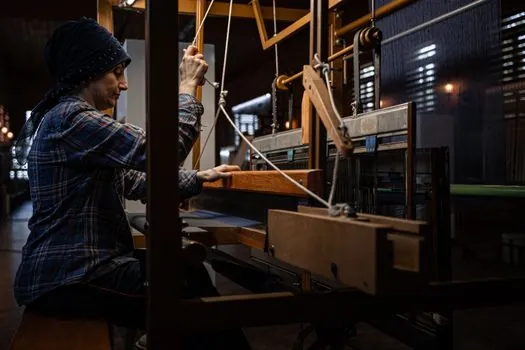
Use a self-aligning ball bearing where the shaft is long relative to the bore, where the housing bores cannot be machined perfectly coaxial, or where the foundation can settle during the life of the machine. That covers most of a textile mill's drafting, spinning, and winding sections. [S1]
Do not use a self-aligning ball bearing where (a) any meaningful axial load exists, (b) the misalignment is fully controlled by precise alignment, and (c) the application is high speed above ~10 000 rpm, where a deep-groove ball bearing or an angular contact unit runs cooler and truer. A precision motor end-of-shaft on a VFD-driven carding motor, for example, wants a deep-groove ball bearing or an ABEC-5 angular contact pair, not a self-aligning unit, because the alignment is set at the factory and the speed is high.
Do not use a self-aligning plain bearing (per SAE AS21154B-2011 or AS83819-2013) on a textile mill's main shafts. Those standards cover aerospace spherical plain bearings with operating envelopes of -54 °C to +71 °C and oscillation cycles around 1400 cpm [S2], with cadmium or zinc-nickel plating to AMS-QQ-P-416 / AMS 2417 specifications, ball hardness HRC 56 minimum, and surface finishes measured to ASME B46.1 [S3]. That spec envelope is correct for rotorcraft flight-control linkages, where oscillation and low-speed swing are the load profile, and it has no cost-effective overlap with a 1500 rpm textile-shaft duty.
Procurement signals to track: 2026 Q3 lead times, sealed 2RS stock, and relube grease standardisation
[S1]
See also our earlier report, Upset-forging rebar couplers for interior finishing: diameter, code class, and congestion.