
Self-aligning bearings are not one product but a small family of designs, each trading misalignment tolerance for load capacity, speed, and friction. The market catalogue in 2025–2026 consistently groups them into three families: self-aligning ball bearings, spherical roller bearings (double-row), and plain self-aligning spherical bearings with metal-on-metal contact [S4][S7][S10].
Common to all three is a spherical outer raceway whose centre of curvature coincides with the bearing axis, letting the inner ring, rolling element, and cage swing through a small angle to absorb shaft deflection or mounting error [S7][S9]. That geometry is what distinguishes the family from standard deep-groove ball bearing and cylindrical-roller designs, which are intolerant of even a fraction of a degree of static misalignment.
Self-aligning ball bearings: low friction, limited load
Self-aligning ball bearings carry the lowest friction of any rolling bearing because the small contact angle between balls and the two grooved raceways keeps the contact ellipse near pure rolling [S7][S9]. NSK catalogues show a pressed-steel cage as standard, with the inner-ring/ball/cage assembly free to rotate inside an outer ring whose spherical raceway shares its centre of curvature with the bearing centre [S7].
Typical bore sizes in the CMW product line span 10–160 mm inside diameter, 30–240 mm outside diameter, and 15–73 mm width [S4]. The trade-off is load: the contact angle is small, so axial capacity is limited and dynamic load ratings sit well below spherical roller equivalents of the same bore [S7]. They are the default pick for fan shafts, conveyor idlers, and textile machinery where misalignment of 1–2.5° is expected but loads stay modest [S3][S9].
Spherical roller bearings: heavy radial load, double-row design
Spherical roller bearings use barrel-shaped rollers running on the common spherical raceway, almost always in a double-row configuration. Kitairu's 2026 supplier listing pegs the common metric series at 21300, 22000, 23000, and 24000, with example part 22238 shown as a typical 222-series unit [S8].
Double-row geometry, combined with line contact instead of point contact, lets these bearings absorb substantially higher radial load than same-bore self-aligning ball bearings and a meaningful amount of axial load in either direction. They tolerate similar angular misalignment (typically up to ~1.5° depending on series) and are the workhorse for rolling mills, gearboxes, mining screens, and paper-machine dryer sections where shaft deflection and shock loads coexist. Compared with the self-aligning bearing family as a whole, the spherical roller variant is heavier, runs hotter, and tolerates less speed, but multiplies the load rating.
Plain self-aligning spherical bearings: Cu-Be ball, CRES race
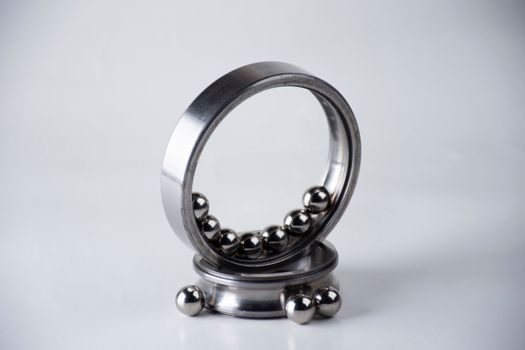
Where rolling elements are not acceptable — typically oscillating motion, high shock, or contaminated/lubricant-starved environments — aerospace and heavy-industry specifiers use plain self-aligning spherical bearings per SAE AS81936A-2006 [S6]. The standard covers bearings with a beryllium-copper ball and a corrosion-resistant steel (CRES) outer race, qualified over -65°F to +350°F (-54°C to +177°C) [S6].
Because there is no rolling element, the part is a true self-aligning plain spherical: the ball swivels inside a spherical CRES race, accommodates misalignment, and carries load through metal-on-metal contact lubricated by grease or a boundary film. These parts dominate aircraft control linkages, helicopter swashplates, and shipboard hydraulic actuators where slow oscillating motion would fatigue rolling-element cages. They sit at the opposite end of the trade-off space from self-aligning ball bearings: far higher shock tolerance, much lower speed limit, and higher friction torque.
Housed units: pillow blocks, flanges, take-ups, oval and sheet-steel variants
Most end-user purchases are not the bearing alone but a housed unit — the bearing pre-assembled into a pillow block, two-bolt or four-bolt flange, take-up, or cartridge. NTN Europe's Premium Line stainless housed unit, for example, is built around a stainless insert ball bearing with a relubrication facility on every housing, designed for food-industry washdown with recess-free contact surfaces to shed process material [S1].
CMW's oval housed unit uses sheet-steel, cast-iron, or resin housings over a self-aligning ball insert, with bores from 12 mm up to 90 mm and an oval flange footprint that delivers higher stability and load-carrying area than a round-flange equivalent [S2]. Melucci's UCPE208 line goes one step further: a single-piece adjustable pillow-block support offered in cast iron, pressed sheet steel, stainless steel, and proprietary zinc alloys branded "Silver" and "Stainless Silver" for corrosive atmospheres [S5]. TIMKEN's setscrew-locking insert adds a hardened stainless band between the setscrews and the shaft, eliminating metal-to-metal gouging and fretting corrosion on shafts that are expensive to replace [S3]. For a deeper look at how these housed units fit beside other bearing families, see the angular contact bearing spec map — the selection logic is the same trade-off between misalignment budget, load, and speed.
Material selection: chrome steel, stainless, sheet steel, cast iron, zinc
Material is not a side issue; it is a primary selection axis. Standard catalogue bearings run in through-hardened chrome steel for maximum load rating. Stainless inserts (AISI 440C or equivalent) are specified for food, beverage, pharmaceutical, and marine washdown — NTN's Premium Line pairs the stainless insert with a high-performance grease resistant to chemical cleaning agents [S1].
Cast-iron pillow blocks remain the cheapest general-purpose housing and dominate agricultural and bulk-handling equipment [S2][S3]. Pressed sheet-steel housings, as in CMW's oval line, drop weight and cost further and are common on conveyors and small fans [S2]. Where corrosion rules out cast iron but stainless is over-specified, zinc-alloy "Silver" and "Stainless Silver" housings sit in the middle of the cost curve [S5]. For non-magnetic or non-sparking requirements in chemical plants, stainless or special zinc housings are the practical answer.
Selection criteria: misalignment, load, speed, environment
The decision tree is short. Step one is the misalignment budget: any shaft expected to deflect or any mounting where concentricity is hard to guarantee (over 0.5° static error) pushes the design out of standard deep-groove and cylindrical-roller territory and into the self-aligning family. Step two is load — light to moderate radial, with minor axial, goes to a self-aligning ball bearing; heavy radial or shock radial goes to a spherical roller. Step three is speed: ball inserts run faster and cooler; roller inserts run slower and need more cooling. Step four is environment: washdown, chemical, or low-lube service pushes selection toward stainless housed units or plain Cu-Be/CRES sphericals. [S9]
A quick comparison across the three families: self-aligning ball bearings win on friction and speed but lose on load and axial capacity (typical bore 10–160 mm, width 15–73 mm) [S4][S7]; spherical roller bearings win on radial and shock load but lose on speed limit and running temperature (series 21300/22000/23000/24000, e.g. 22238) [S8]; plain self-aligning sphericals per SAE AS81936A-2006 win on shock, contamination tolerance, and temperature range (-65°F to +350°F) but lose on speed and friction [S6]. A useful adjacent reference is the linear bearing installation spec map for crews that need to think about the same misalignment-vs-load trade-off in a different motion axis.
Operating limits, failure modes, and lubrication discipline
Self-aligning bearings share a small set of recurring failure modes. Misalignment outside the design envelope — usually above 2–2.5° for ball inserts, around 1.5° for many spherical roller series — converts the rolling contact into a combination of rolling and sliding, accelerating cage wear and overheating. Insufficient lubrication is the second classic: the spherical outer raceway traps less oil than a cylindrical-roller pocket, so relubrication intervals are shorter than the equivalent cylindrical-roller bearing, and every housed unit on the NTN, TIMKEN, and CMW product lines ships with an explicit relubrication feature for that reason [S1][S3][S4].
Contamination is the third mode. Self-aligning ball bearings have the lowest friction of all rolling bearings, which works against them in dirty environments: the low-friction contact does not displace debris the way a cylindrical-roller contact can. Sealed inserts and stainless housings (NTN Premium Line covers, TIMKEN rubber seals) are the standard mitigation [S1][S3]. Temperature is the fourth: standard chrome-steel inserts with standard grease run typically to about 120°C continuous; high-temperature greases push that to roughly 180°C, beyond which stainless or high-temperature steel plus solid lubricant is required. Plain Cu-Be/CRES sphericals per SAE AS81936A-2006 cover -65°F to +350°F in aerospace-qualified form, but at very low oscillating speeds [S6].
Standards, sourcing, and what to verify on the datasheet
The most cited specification in the self-aligning bearing space is SAE AS81936A-2006 for plain Cu-Be/CRES self-aligning sphericals, which is the right document to call out for aerospace and defence procurements [S6]. For rolling-element self-aligning bearings there is no single governing aerospace standard at the AS81936 level; instead buyers rely on ISO 15 (rolling bearings — radial bearings, boundary dimensions) for dimensional interchangeability and on ABMA STD-20 for load-life ratings, neither of which is specific to the self-aligning family but both of which apply.
On the supplier side, the actively stocked product lines as of mid-2026 include NTN Europe's stainless Premium Line, TIMKEN Europe's setscrew-locking insert with hardened band, CMW's oval sheet-steel unit and the broad 10–160 mm bore ball-bearing range, and Melucci's UCPE208 cast-iron/stainless/zinc pillow block [S1][S2][S3][S4][S5]. Buyers should verify four items on every datasheet: the bore and width tolerances against ISO 15, the dynamic and static load ratings to ABMA STD-20, the misalignment limit (often expressed as a permissible static misalignment angle), and the lubricant specification including base oil viscosity, thickener type, and temperature range. Two trackable signals to watch are further adoption of stainless housed units in pharmaceutical and food lines and any revision activity around the AS81936 series for plain self-aligning sphericals.
Spec-level background on the components involved: self cleaning filter.