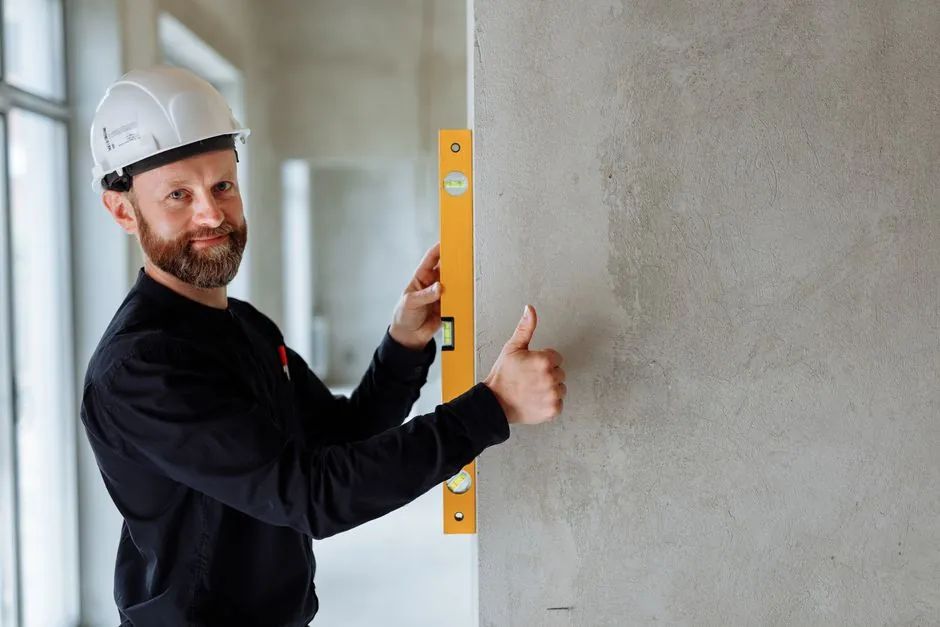
Self-leveling rotary laser levels are spec'd at roughly 1/8 inch per 100 feet, while the best manual-leveling rotary units cap out near 1/8 inch per 30 feet, a 3× working-distance penalty for the same error band [S1].
That gap is what drives the procurement decision on commercial concrete, grading, and formwork jobs, where crews re-setup the instrument dozens of times a day. The March 3, 2026 Mountlaser field test on a 5,000 m² foundation logged 87 man-hours saved per project after switching from optical dumpy levels to a self-leveling rotary kit [S3]. The accuracy line on that test unit read ±3 mm at 30 m, which sits at the upper end of the manufacturer's published window.
How Each Leveling Method Reaches Its Number
Manual leveling relies on a bubble vial and thumb-screws; the operator's eye drives the final reading, so accuracy is bounded by vial quality and human repeatability, published as good as 1/8 inch per 30 feet on a healthy unit [S1][S2]. The mechanics are simple: no motors, no pendulums, fewer parts to fail, and the lowest sticker price in the rotary category [S6]. The downside shows up on relocation, every tripod move restarts the vial dance, which is why the Mountlaser crew flagged 15 to 20 minutes of fine-tuning per setup on the manual baseline [S3].
Self-leveling uses either a pendulum-and-magnet assembly (mechanical self-leveling) or a pair of servo-motors and inclinometers (electronic/auto self-leveling) to drive the beam to true horizontal without operator input [S1]. Mechanical self-leveling commonly quotes 1/8 inch per 100 feet, while electronic self-leveling tightens that to 1/16 inch per 100 feet, roughly double the precision of the manual tier [S1]. Self-leveling range is the catch: the unit only compensates inside a stated window, commonly ±4° to ±6° from horizontal, and outside that window the beam will not level, a parameter that buyers routinely misread as a flatness tolerance [S4][S8].
Decision Matrix: Manual, Mechanical Self-Leveling, Electronic Self-Leveling
Three criteria separate the options for procurement: published accuracy, time-to-relocate, and unit cost tier. On accuracy, manual rotary tops out near 1/8 inch per 30 feet (about ±2.6 mm per 9 m), mechanical self-leveling holds 1/8 inch per 100 feet (±0.85 mm per 30 m), and electronic self-leveling reaches 1/16 inch per 100 feet (±0.42 mm per 30 m) [S1]. On relocation, the Mountlaser test recorded roughly 60% faster setup with the self-leveling kit, eliminating the 15 to 20 minute bubble-vial ritual on each move [S3]. On cost, manual units are the entry tier (typically a few hundred dollars), while mid- and high-range self-leveling rotaries can exceed a thousand dollars, a real gap on budget-restricted interior fit-out work [S5].
For a crew running one setup per day on a small slab, the manual tier is fine. For a grading contractor resetting 30 times a shift across a 5,000 m² site, the labor savings alone cover the price premium inside a single project, as the Mountlaser numbers show [S3]. For formwork, screeding, and floor-flatness work, electronic self-leveling's 1/16 inch per 100 feet is the safer spec, and many models add a shock-warning that alerts the operator when the tripod has been disturbed, the single biggest silent-error source on a busy site [S3].
Failure Modes and Field Constraints Buyers Underestimate
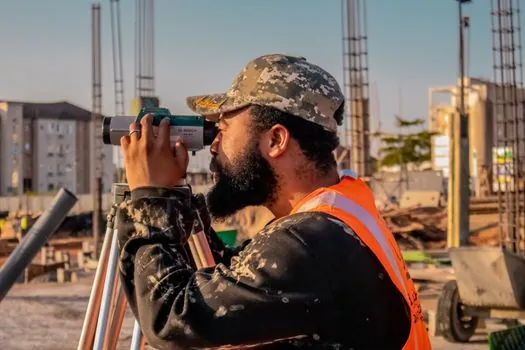
The self-leveling range is a constraint, not an accuracy spec. A unit that only self-levels inside ±5° will not save you if the tripod is set on a tilted slab or a steep embankment, and the beam will either shut off or flash an out-of-level indicator, but the operator has to know to look for it [S4]. On long sight lines, the curvature of the earth adds about 0.002 inch at 100 feet and roughly 1/8 inch at 660 feet, so the published accuracy number is only honest inside the working-range envelope of the detector [S4].
Beam visibility is a separate failure mode. Red diodes at 635 nm and green diodes at 532 nm are both common, with green typically quoted as roughly 4× brighter to the human eye, but neither is visible in direct outdoor sunlight; a laser detector is mandatory for exterior work [S1]. Most rotary lasers are Class IIIA (1 to 5 mW), which is safe for accidental eye exposure but still demands that operators avoid direct stare and use protective eyewear on long alignments [S1][S5]. Manual units dodge some of these issues with a simpler optical path, but they inherit a different failure mode: vial drift over years of use, which is why field calibration against a known benchmark is a routine maintenance step rather than an option [S2][S4].
Use-Case Recommendations
Pick manual leveling rotary when the work is interior, the runs are short (under 30 feet between setups), the budget is tight, and a second operator is already on the crew to act as the rod holder; the bubble vial workflow is well-understood and parts are cheap to replace [S2][S6]. Pick mechanical (pendulum) self-leveling for general exterior grading, deck-pour elevation work, and any site where one operator is running layout solo, the 1/8 inch per 100 feet spec covers most concrete and rough-grade tolerances and the price stays inside the mid-tier band [S1][S3].
Pick electronic (servo-motor) self-leveling for concrete screeding, machine-control reference, industrial floor flatness (FF/FL) work, and any spec written against tighter than 1/8 inch per 100 feet, the 1/16 inch per 100 feet ceiling and the shock-warning feature are what justify the price step [S1][S3]. If the jobsite routinely slopes beyond ±5°, a slope-matching or dual-axis model is the right move, not a single-axis electronic unit, because the self-leveling range is a hard physical limit, not a soft preference [S4][S8].
Buyer's Checklist Before Specifying
Verify four numbers on the data sheet before signing a PO: the leveling method (manual, mechanical, electronic), the published accuracy with distance (1/8 in @ 30 ft vs 1/8 in @ 100 ft vs 1/16 in @ 100 ft), the self-leveling range in degrees (±4°, ±5°, ±6°), and the working range with detector in diameter or radius [S1][S4]. Cross-check the laser class (Class IIIA is the rotary norm) and the diode wavelength if the work includes both interior and exterior phases [S1]. For related procurement context on instrument-grade positioning hardware, the comparison in rotary encoder vs line laser decisions walks through the same accuracy-versus-cost trade-off in a different tool category, useful when a layout crew also handles shaft alignment.
For instrument-platform buyers weighing where a rotary laser sits alongside a digital level or an optical transit, the engineering write-up in rotary laser level selection criteria covers wavelength, rotation speed (typically 100 to 1,100 RPM), and detector pairing. On the production-floor side, the same single-operator efficiency argument that drives the self-leveling rotary purchase shows up in manual pallet jack workflow design, where one-person operation is the deciding metric.
Trackable signals to watch over the next procurement cycle: green-diode price compression as 532 nm modules move down the bill of materials, and wider ±6° self-leveling windows entering the mid-tier price band, which would close the gap between manual and self-leveling on rough sites. Service bulletins on pendulum-bearing replacement intervals are also worth pulling once a year, since mechanical self-leveling units drift long before their electronics fail.
The underlying component specifications are covered under rotary encoder.