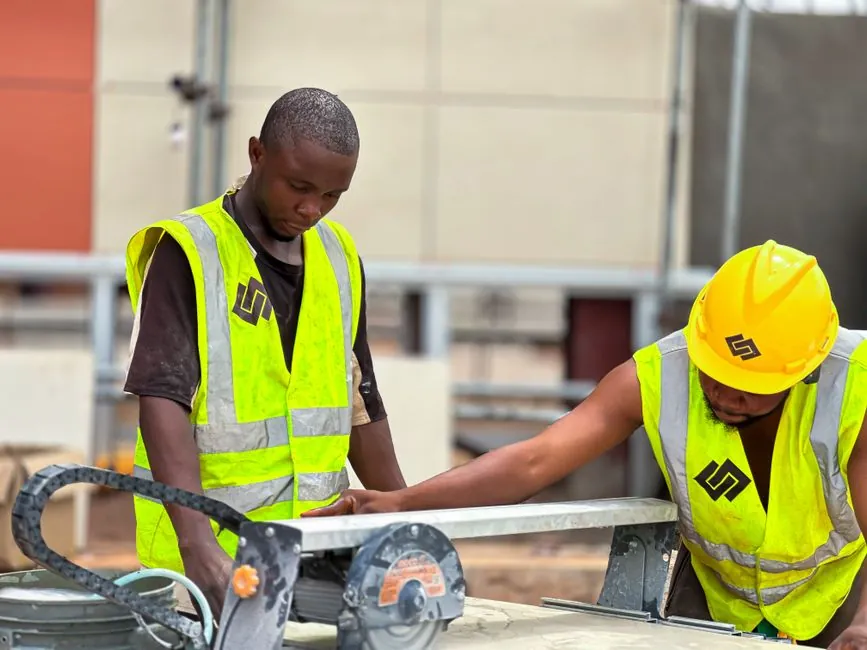
Semi-automatic cold saws with hydraulic feed control reduce operator fatigue and improve cut consistency over manual units, making them the practical middle ground for low-to-medium production cutting [S5]. Manual cold saws remain the lowest-cost option for short runs, small-batch fabrication, and detailed custom work where full automation is not justified [S7].
Selection hinges on production volume, material mix, and required cut finish, not on blade size alone. A shop running 50–1,000 cuts per month of 6061 aluminum or 303 stainless faces a different decision than a job shop handling a few custom pieces per week [S2]. For reference on sawing equipment types and terminology, the circular saw encyclopedia entry covers blade geometry and tooth geometry fundamentals relevant to cold saw selection.
Manual Cold Saw: Where It Fits and Where It Breaks
Manual cold saws are operated by hand and are best matched to short runs, small-batch fabrication, or detailed custom work where setup time per cut is acceptable [S7]. They are less expensive than their semi-automatic and fully automatic counterparts, making them a common choice for budget-conscious buyers or low-volume operations [S8].
The trade-off is operator dependence: cut pressure, feed rate, and length consistency all vary with the person running the saw. A manual machine cannot deliver the cycle-to-cycle repeatability of a semi-auto unit with hydraulic feed, and blade life suffers when feed pressure fluctuates. For a shop moving from one-off cuts to repeatable production, the manual saw becomes the bottleneck before the blade or the motor does.
Semi-Automatic Cold Saw: The Production Sweet Spot
Semi-automatic saws use hydraulic feed control with manual material loading, and the consistent cutting pressure improves results while reducing operator fatigue in production environments [S5]. This category is designed for production runs, better blade life, continuous surface finish, and to eliminate operator fatigue that accumulates with manual cold saw operation [S4].
A representative example is the Dake 350 SA, a semi-auto pivot head cold saw built for heavy duty continuous cut-off requirements on a daily basis. It features semi-auto cycling where the operator pushes a button or foot pedal while the saw does the rest, plus a head-positioning system to minimize dead-air cutting and a dove-tail slide vise for adjustable cutting geometry. The 14-inch blade runs at 20–105 rpm variable speed, and the head miter left and right up to 60° [S4]. For more on the cutting mechanics these machines share with other saw types, the cutting machine encyclopedia entry provides broader context on feed rate and chip load principles.
Full Automation: Where the ROI Argument Lives
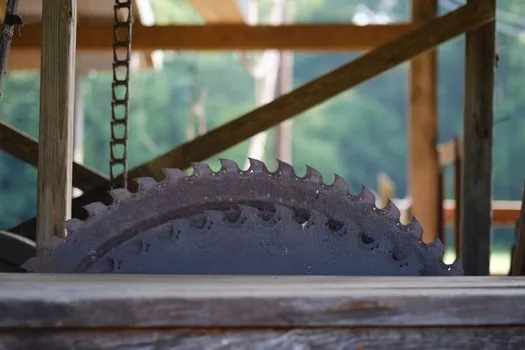
Automatic circular cold saws reduce labor costs and scrap rates significantly compared to semi-automatic units, but the capital delta is large and only closes at higher production volumes [S1]. A fully automatic saw loads, positions, indexes length, and cuts without operator intervention, while semi-automatic models still require the operator to load and set cut length for each batch [S6].
In practice, the choice between semi-auto and full-auto is driven by whether the operator's time is better spent loading parts or running another machine. For a cell where the operator is present anyway, a semi-auto saw at roughly half the capital cost delivers most of the cycle-time benefit. For unattended runs of consistent parts, the full-automatic configuration pays back through labor offset and scrap reduction.
Material and Blade Constraints: Why One Saw Rarely Does Both
Cold saws optimized for ferrous and non-ferrous materials are typically separate machines, and no single cold saw handles 2.5-inch diameter solid stainless and aluminum production efficiently within a typical mid-shop budget [S2]. The cutting physics differ: aluminum wants high surface speed, stainless and mild steel want slower speeds with different tooth geometries and coolant flow. Carbide-tipped blades for non-ferrous leave a near-mirror finish, while HSS blades for ferrous prioritize cut speed and blade life over surface quality.
For shops running both 6061 aluminum and 303 stainless in production volume, the Euromatic 370 S (ferrous) and 370 S/L (non-ferrous) from Dake illustrate the dedicated-machine approach: each is built around vertical column construction with hardened ways and cast iron gib blocks for rigidity, with unlimited mitering left and right [S4]. Stacking both saws in a cell is a common pattern for mixed-material production, and the automatic molding line encyclopedia entry, while covering a different process, illustrates the same logic of dedicated stations per material rather than one reconfigurable line.
Decision Matrix: Semi-Auto vs Manual by Production Profile
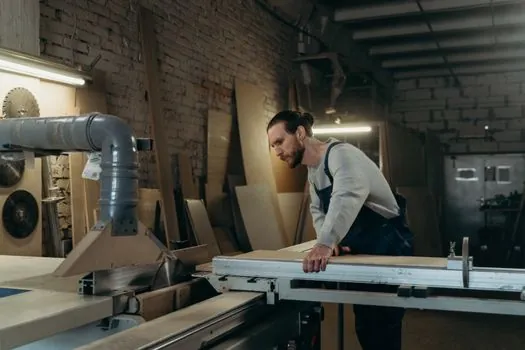
For low-to-medium production of material 4 inches and under where the operator is present or running a cell, the semi-automatic saw is the right fit; for short custom runs, repair work, and shops with no recurring cut length, the manual saw is the right fit [S4][S7]. Across four criteria the comparison is sharp:
Operator labor per cut: manual saws require the operator to control feed throughout the cut; semi-auto saws require a button press or foot pedal and then run the cycle hydraulically [S4][S5]. Cut-length repeatability: manual saws depend on the operator's measurement and stop setting; semi-auto saws repeat the same cycle every time within the machine's mechanical tolerance. Blade life: manual saws see variable feed pressure that shortens blade life; semi-auto saws hold consistent pressure and extend blade life [S4]. Capital cost: manual saws are the lowest-cost entry point, while semi-auto saws cost more but are far less expensive than full-automatic cold saws or full CNC systems [S1][S8].
Failure Modes and Limitations Buyers Should Plan For
Semi-automatic saws still require the operator to load material, set length, and unclamp between cycles, so they do not eliminate labor, they only reduce it compared to manual saws [S6]. The cut finish on a semi-auto cold saw is better than a bandsaw but rarely reaches the mirror finish of a dedicated non-ferrous saw running a fresh carbide blade; for finish-critical work, a separate non-ferrous station is the standard answer [S4].
On the practicalmachinist forum, a shop running both aluminum and stainless on the same semi-auto cold saw found blade life and cut quality compromises unavoidable, and reverted to a bandsaw for mixed-material work where finish was not critical [S2]. Cold saws also tend to be larger than equivalent-capacity horizontal bandsaws, which matters in shops with limited floor space. A shop evaluating a full-automatic cold saw at 2.5-inch solid stainless capacity will find the machine size and price both move up sharply; the forum consensus is that a single all-in-one cold saw for both aluminum and stainless production is rarely the right answer at mid-shop budget levels [S2].
Standards and Sourcing Notes for Specifiers
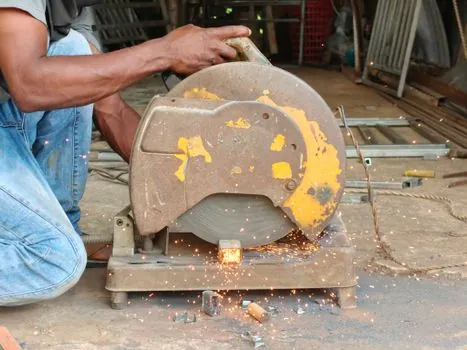
Cold saw selection does not typically invoke a specific ASTM or ISO blade standard at the procurement stage; instead, specifiers match blade diameter, bore, tooth count, and grade (HSS vs carbide-tipped) to the machine and material. Blade life and cut tolerance claims from manufacturers should be validated against the actual material hardness, coolant mix, and feed rate the shop will run, since published numbers assume ideal conditions. For a shop evaluating a move from manual to semi-automatic cutting, a useful next step is to log current cut counts per shift, current scrap rate, and current operator time per cut; that data, more than any vendor brochure, determines whether semi-auto or full-auto delivers the payback [S1][S4].
See also our earlier report, Steel Fiber vs Macro Synthetic Fiber for Slab-on-Grade Crack Control.