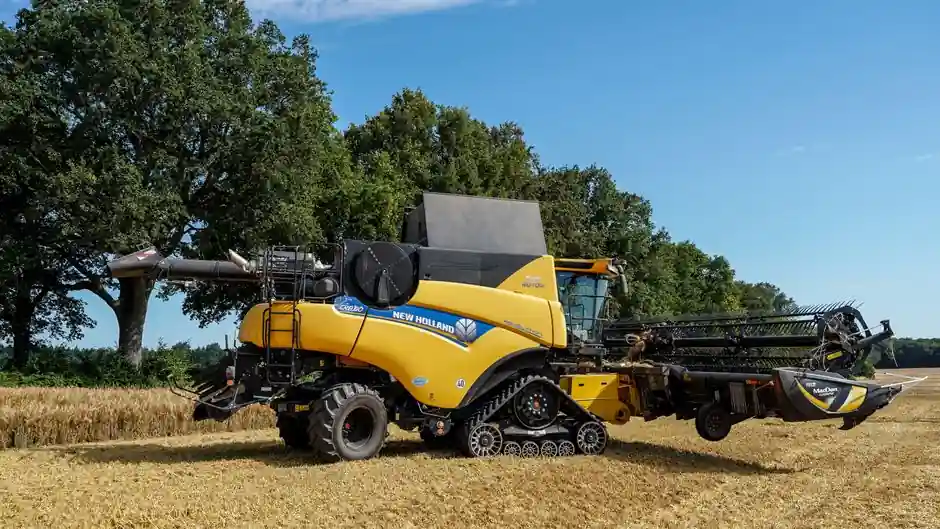
Tractor-mounted tree shakers for nut and fruit harvest are specified as heavy-duty hydraulic units with 36.8-37.0 kW diesel auxiliary power, 10-12 Hz clamp vibration frequency, and a maximum harvest diameter of 280-480 mm [S2][S3], values that anchor a 2026 orchard-equipment procurement decision.
The selection logic, however, borrows directly from foundry shakeout engineering: vibratory decks, rotary drums, and barrel-horse units are all driven by eccentric or vibrating-motor excitation at frequencies above a standard feeder, and the same drive-layout choices (above-deck vs below-deck motor mounting) reappear across both industries [S4][S5]. For agricultural applications, the casting becomes the tree, the sand mold becomes the crop cluster, and the grate becomes the operator's clamp, but the kinematic rules are nearly identical.
Agricultural Trunk Shaker Spec Range (2026 Catalog Data)
The Saloni SA-Dxygj48 trunk shaker is dimensioned at 5,750 x 1,500 x 2,200 mm with a 2,830 kg structural mass, a 1,500 mm shake-head stroke, and a 36.8 kW auxiliary diesel engine [S2]. The Pailien PLE portable harvester measures 5,400 x 1,500 x 2,200 mm at 2,230 kg net weight, offers a 2,000 mm extension stroke, and is offered with either a 16.8 kW twin-cylinder gasoline engine or a 37.0 kW four-cylinder diesel engine [S3]. Both units clamp at 10-12 Hz with a 5 cm amplitude and complete a single tree cycle in 5-10 seconds, which lines up with the high-frequency continuous shakeout logic used in green-sand foundry decks [S4].
Maximum fruit-tree diameter is the primary sizing gate: Saloni's 480 mm envelope covers mature pecan, walnut, and ginkgo trunks, while Pailien's 280 mm specification restricts the same portable frame to younger orchards or smaller nut species [S2][S3]. Assignment height of 4-5 m on the Pailien unit also constrains canopy reach, a parameter that maps to the deck length / retention time variable that foundry engineers use to tune two-mass shakeouts for fragile castings [S5].
Drive Layout: Above-Deck vs Below-Deck Motors
Foundry OEMs standardise shakeouts by motor position: below-deck drive types, such as Sinfonia's RVSO-800-1.2 / RVSO-800-1.5 prefixes, isolate eccentric weights from falling sand and tramp metal, lower headroom, and dominate high-tonnage iron and steel cells [S5]. Above-deck drives raise overall height by the motor's vertical envelope but simplify belt or chain adjustment, and tend to appear on smaller flask-handling or no-bake decks [S5].
For agricultural trunk shakers the analogue is hydraulic motor placement on the clamp head: gear-drive transmissions with a hard shaft (Saloni) or soft shaft (Pailien) sit adjacent to the rubber-lined clamping jaw, and the trade-off mirrors the foundry case, namely, easier service access versus more mass on the moving boom [S2][S3]. Buyers running orchards with abrasive dust (olive groves, almond hulls) typically prefer the isolated drive envelope; buyers doing mixed-row work across several farms value the easier field serviceability of above-deck motor placement.
Vibration Mode: Linear, Two-Mass, and Rotary Equivalents
Conventional vibratory shakeouts use eccentric excitation at higher frequency and greater vertical stroke than a feeder, which is the energy that fractures the bonded sand lump and walks the casting forward [S5]. Carrier's Delta-Phase two-mass design adds a counter-vibrating sub-frame so the operator can trim conveying speed and retention time, leaving fragile castings longer on the deck and sending robust ones out faster [S5].
Rotary drum shakers, such as Sinfonia's DRUM SHAKER line, tumble castings inside a rotating shell to polish sand off by attrition rather than percussive impact, a logic that is the right answer for thin-wall iron or brass [S5]. Agricultural equivalents: tree shakers with a horizontal-cut harvester architecture (Saloni SA-Dxygj48) apply sustained 10-12 Hz clamping rather than single-shot impacts, while backpack-type portable harvesters (Pailien PLE) trade raw impact for a softer 5 cm clamp amplitude that protects bark on younger trees [S2][S3]. For orchards, the two-mass philosophy reappears as adjustable stroke length: 1,500 mm on the heavier Saloni unit vs 2,000 mm on the lighter Pailien frame, giving the operator a tuned retention time per species.
Application-Family Match: Iron, Aluminum, No-Bake vs Trunk, Canopy, Shrub
Foundry buyers select by application family: iron and steel use heavy-duty steel-grizzly decks on a high-energy vibratory frame; aluminum foundries specify 2-inch-thick steel-back rubber decks to dampen impact and prevent brittle fracture; no-bake and flask lines use slower, fully enclosed decks sized to the flask footprint [S5]. The same logic maps cleanly to orchards: hardwood trunk species (pecan, walnut) take the high-energy rigid clamp of a 2,830 kg self-propelled unit; softer-bark fruit trees (olive, almond, ginkgo) need the rubber-lined adjustable clamp that the Saloni spec sheet calls out explicitly [S2].
The sand-to-metal ratio gate that foundry engineers use, published at 5:1 to 60:1 by Carrier, is the agricultural equivalent of crop-to-tree mass ratio: above roughly 30:1, foundry planning adds a lump-breaker or attrition mill downstream, and orchard planning with very dense canopies (high crop-to-trunk ratio) similarly benefits from a pre-shake foliar conditioner or a secondary sweep [S5]. Foundries running chemically bonded no-bake molds also face an overhead fume and dust envelope, addressed by integrated dust and fume hoods, which is the agricultural analogue of the operator-cab filtration package on a self-propelled shaker [S2][S5].
Comparison: Vibratory vs Drum vs Barrel-Horse (Foundry) and Their Orchard Equivalents
For foundries, vibratory decks suit high-tonnage iron on green sand, rotary drums suit aluminum and brass job-shops with no-bake molds where percussive impact must be avoided, and barrel-horse units sit between, vibrating a barrel-shaped deck so castings rotate as they advance on batch-style lines where directional control on a flat deck is not needed [S5]. The agricultural translation: vibratory = rigid-clamp self-propelled shakers (Saloni 2,830 kg) for mature hardwood trunks; rotary drum = sustained 10-12 Hz horizontal-cut harvesters (Pailien 2,230 kg) for medium-diameter multi-species orchards; barrel-horse = backpack portable units for small-trunk soft-bark species where a single operator walks the row.
Decision criteria a procurement engineer can score against: (1) max trunk diameter, 280 mm (Pailien) vs 480 mm (Saloni) vs unlimited (foundry deck); (2) auxiliary power, 16.8-37.0 kW diesel vs 75-150 kW electric on a foundry high-tonnage line; (3) cycle time, 5-10 s per tree vs 30-90 s per casting batch; (4) deck/clamp material, rubber-lined adjustable vs steel grizzly (iron) or 2 in steel-back rubber (aluminum) [S2][S3][S5]. The agricultural units are 5-20x lower in mass and 10-30x lower in power because trees yield their crop with a fraction of the energy that a bonded sand mold requires.
Selection Sequence and Sourcing Signals
A 2026 spec map for agricultural shakeout buyers should follow the foundry sequence: define application family (trunk species, crop density, orchard age), set drive layout (above-deck for service access, below-deck for dust isolation), pick vibration mode (rigid clamp, two-mass adjustable stroke, or sustained horizontal-cut), then size deck length and grate opening (clamp jaw geometry and bark-protection padding) [S4][S5]. Sand-to-crop ratio and downstream handling (sweeps, foliar conditioners, hulling lines) substitute for the foundry's lump-breaker and reclamation stage.
Trackable signals to watch in the next sourcing cycle: Saloni reports SGS audit coverage from 2026-04-01 through 2027-03-31 but the recorded evaluation result is 0 with no explanatory detail, and the supplier has no overseas service infrastructure (no warehouses, showrooms, or agents), which limits its suitability for buyers needing in-region spares support [S2]. Pailien, by contrast, lists four production lines, two quality inspectors, laser-cutting and CNC equipment, 20 years of manufacturing experience, an R&D team of 15, and an export footprint covering North America, South America, Europe, Asia, Africa, and Oceania [S3]. For procurement, the foundry-style next-step question is the same: confirm the supplier's audit trail, verify certification currency (QS, GMP, ISO 9001:2008, CE on Saloni; Utility Model Patent Certificate on Pailien), and lock spare-parts logistics before the harvest window opens. For buyers also managing the casting side of a foundry, the sand-handling decisions downstream of a shakeout are covered separately in the sand reclamation unit spec cut and the LED hardscape sand reclamation selection map, and the broader casting auxiliary equipment chain sits inside the wider industrial construction machinery and equipment taxonomy.
Component reference pages worth checking: coding machine.