Foundries pouring Kichler-class 12V LED hardscape bodies (16101SD27 at 0.90 W, 16103SD30 at 125 lm) cast in aluminum sand molds should size a sand reclamation unit in the 20-150 t/h return-sand band, with mechanical-attrition and pneumatic-scrubbing the two leading process families on the 2026 shortlist [S6].
For a 2-8 kg aluminum pour on these small-format lighting castings, the reclamation line must hold AFS fineness within ±5 points of the incoming bond sand and keep total LOI below 3.0% to avoid veining and erosion on the thin reflector and shroud walls [S3][S6].
Throughput Sizing for a Hardscape Fixture Line
A green-sand or chemically bonded line feeding static pressure molding machines at 600-1,500 kN clamp force typically returns 70-90% of its daily mold mass as shake-out sand, and reclamation equipment must digest that return rate in real time to keep the cooler-mixer-molder loop closed [S3][S6].
Practical sizing for a mid-pressure lighting line (800 × 600 mm to 1,000 × 800 mm flask, 15-80 kg sand per cycle at 12-18 s dry-cycle time) lands between 30 t/h and 80 t/h of compacted-sand throughput, well inside the 20-150 t/h envelope quoted for general foundry reclamation units [S3][S6]. Mechanical-attrition designs, including vibrating-fluidized-bed units from suppliers such as JÖST, dominate shake-out-to-cooler duty because the impact-and-scrub action strips clay and burnt bond without crushing the sub-angular AFS 50-70 grain that downstream static pressure molding machine lines prefer [S6].
Process Family Comparison: Mechanical, Pneumatic, and Thermal
Three process families anchor the 2026 buying shortlist: pneumatic scrubbers/blowers, mechanical-attrition (vibrating or fluidized-bed), and thermal reclamation (fluidized-bed or rotary calciner) [S6]. For aluminum hardscape bodies, thermal reclamation is almost always overspec, because the 700-800 °C calcine envelope destroys the clay-bond film that green-sand lines depend on for flowability and green strength.
Mechanical-attrition units win on energy per ton (typically 3-6 kWh/t) and tolerate the 0.5-0.7 MPa plant-air supply that already feeds the squeeze head on a static pressure line [S3][S6]. Pneumatic scrubbers handle chemically bonded resin sand better, where the binder film must be blown off rather than rubbed off, and they pair naturally with shell molding routes used for thin-wall reflectors.
Selection on three criteria lines up cleanly: mechanical-attrition leads on green-sand return and CapEx ($/t throughput typically 20-35% below pneumatic scrubbers at the same rating), pneumatic scrubbing leads on chemically bonded return and dust control, and thermal leads only on resin-rich foundries running >50% reclaimed silica in the facing layer [S6].
Sand and Binder Chemistry for LED Hardscape Castings

Aluminum hardscape fixtures (the 6 in × 3 in × 0.75 in Kichler 16101 form factor in Textured Sand finish) are thin-wall, cosmetic castings, and the reclamation loop must preserve a consistent AFS 55-70 grain with ≤0.4% total residue and ≤3.0% LOI to hold surface finish on the visible shroud [S2][S4][S6].
Sand mixers upstream of reclamation should run 22-75 kW main drives with 5-100 t/h throughput and a 30-120 s mulling window, matching binder chemistry to bench life before the compacted sand block loses plasticity [S7]. For a 2-8 kg aluminum pour, the reclaimed sand-to-pour mass ratio should sit at 4-6×, the same envelope that prevents mold deformation on a static pressure line [S3].
Resin-coated sands used in shell molding for precision reflectors push the reclamation problem into different territory: phenolic-urethane binders break down at 250-350 °C, so a foundry running 50% shell routes needs either a low-temperature (≤400 °C) indirect-fired calciner or a pneumatic scrubber rated for resin film removal without thermal burnout [S6].
Integration with Downstream Static Pressure Molding
The reclamation unit, sand cooler, mixer, and molding machine form one closed loop, and a mismatch on any one of the four devices creates a bottleneck that propagates upstream [S3][S7]. For a mid-pressure lighting line (600-1,500 kN clamp, 800 × 600 mm flask, 12-18 s dry cycle), the cooler typically lags the reclamation unit on heat removal, and the mixer lags on mulling time, so the binding constraint is almost never the reclamation device itself.
Sizing the reclamation unit to 1.2-1.5× the molding line's hourly sand consumption gives the cooler-mixer pair enough residence time to stabilize moisture at 2.8-3.2% and temper below 40 °C before the next flask fill [S3][S6]. A sand reclamation unit sized in that envelope on a 50 flask/h lighting line lands at roughly 35-60 t/h, which is mid-pack for the 20-150 t/h general foundry band.
Selection Criteria and Rejection Thresholds
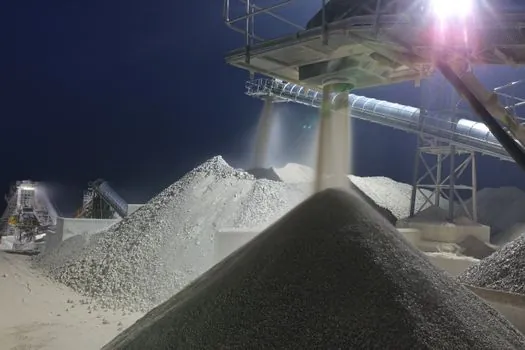
Specifying a reclamation line for hardscape fixture production should anchor on four data points: hourly return-sand throughput in t/h, AFS fineness shift (Δ AFS) across the unit, total LOI reduction, and dust emission in mg/Nm³, with the latter tied to local permitting rather than process need [S6].
Reject any quoted unit that cannot demonstrate Δ AFS within ±5 points and total LOI under 3.0% on a 72-hour continuous trial running your incoming return sand; these are the two numbers that predict surface finish on the next pour, not the nameplate throughput figure [S6]. For a sand reclamation unit feeding aluminum hardscape castings, a thermal reclamation envelope is the most common overspec, and a pneumatic-scrubber or mechanical-attrition unit at one-half to one-third the CapEx will hit the same surface-finish target on this product class [S6].
Adjacent Equipment and Process Fit
Lighting foundries that pair reclamation with shell molding for precision reflectors need a separate resin-sand cooler rated for the 150-200 °C discharge from the shell box, and a phenolic-coated sand recovery loop that the degassing unit and FRL unit on the pneumatic conveying line must be sized to handle [S6].
Coolant distribution and hydraulic power for the vibrating-fluidized-bed drive on a 60 t/h mechanical-attrition unit typically pull 45-75 kW at 0.5-0.7 MPa, and the hydraulic power unit feeding the reclamation drive should be specified with 20-30% headroom over nameplate to absorb shake-out surge loads [S6]. The lighting equipment and electric lamps plant-side, the pour cell needs 4-6 fixtures/hr at most, so a single 40-60 t/h reclamation unit can support two mirror-image static pressure molding machines on a 2-8 kg aluminum hardscape program without queueing.
Related analysis: Variable Speed Drive Selection for Steel Mills: A 2026 Spec Gate.