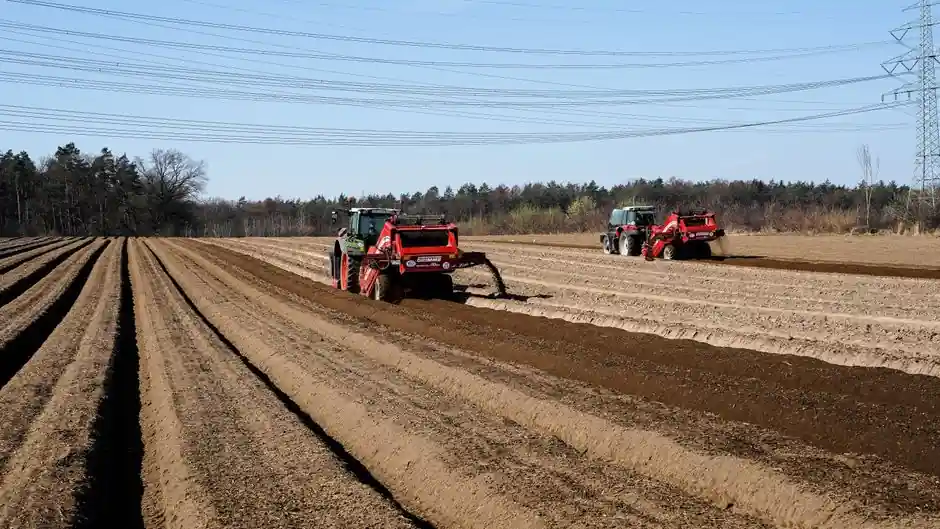
Eagle Alloy runs more than 20 shell molding machines sized from 15×20" up to 30×44" to serve agriculture, valve, and pump-housing work, backed by in-house tooling, shell coating, and MAGMASOFT casting simulation [S1]. That footprint is the practical upper bound a US-tier job shop can offer a farm-equipment OEM in 2026.
Shell molding is a resin-bonded, thin-shell variant of sand casting patented by Johannes Croning in 1943, sitting between green-sand and investment casting on the precision-to-cost axis [S2]. For agriculture machinery, that middle position is exactly what you want: better surface finish and tighter tolerances than green sand, at a fraction of investment casting's per-piece cost.
Platen size and shot volume: the first two numbers to lock
Agricultural castings cluster in a small number of geometry families, and that dictates platen size more than any marketing pitch. Eagle Alloy's 15×20" to 30×44" shell machine fleet is aimed at small-to-medium castings: sprockets, pulleys, gearbox housings, pump bodies, and wear plates for tillage and harvesting equipment [S1]. The 30×44" upper end covers most tractor axle-housing and combine-knuckle geometries without forcing a flask split.
Coated-sand shot weight, not platen area, is the real capacity lever. A typical shell molding machine operates on resin-coated silica sand that is dropped onto a heated metal pattern, cured into a 6–12 mm shell, and ejected before assembly [S2]. Buyers should ask suppliers for the rated shot weight per cycle, the number of shells per hour, and the cure temperature window, because a 20" platen on a slow-cure machine produces fewer parts per shift than a 15" platen on a fast-cure one.
Material and alloy: why grey and ductile iron dominate the farm
Grey cast iron is the most common shell-molding alloy because it is inexpensive, thermally stable, and machines easily; steel is reserved for higher-volume runs where strength or wear life justifies the extra cost [S2]. For agriculture machinery specifically, the load-bearing mix is grey iron for housings and ductile iron for knuckles, hubs, and gear blanks, with alloy iron appearing only in wear-critical parts like plough points and fertiliser-spreader vanes.
Matech's iron-foundry process control offers a representative reference chain: pig iron, scrap steel, and return material are proportioned by grade, melted in medium-frequency induction furnaces, and checked with spectrum analysis against ISO, ASTM, DIN, JIS, and GB material standards [S4]. A shell molding line bought without that upstream metallurgy discipline will reproduce inclusions and inconsistent hardness from batch to batch, regardless of how good the platen is.
Process fit: shell vs green sand vs resin sand vs investment

Shell molding delivers smoother casting surfaces and tighter tolerance control than other sand casting methods, because the resin-coated sand is cured against a heated stainless-steel pattern rather than packed as a damp mass [S3]. Practical tolerance bands sit around ±0.25 mm on small features, compared with ±0.5–1.0 mm for green-sand work, which usually removes a finish-machining pass on agriculture parts.
The trade-off is unit cost at low volume. Eagle Group explicitly positions shell molding as best suited to medium- to high-volume parts, citing specialized valves, pump housings, agricultural and construction equipment, and fluid-system components as the sweet spot [S3]. For prototype runs under a few hundred pieces, a job shop will usually route you to resin sand or 3D-printed sand patterns instead, then migrate the part to shell once the design freezes.
Tooling, cores, and what to demand from a shell core machine
Many agriculture castings need internal cavities that a single shell half cannot produce. A coated-sand shell core machine (also called a shell core shooter) is the standard solution: resin-coated sand is shot into a heated core box, cured into a thin-walled core, and bonded into the shell mold with a thermosetting adhesive [S6]. For tractor gearbox housings, the bearing bores and oil galleries are almost always made this way rather than via sand cores.
When auditing a supplier, confirm that core shooting and shell making are integrated on the same site. Shell coating is a separate in-house step that Eagle Alloy lists alongside tooling and automated sand processing [S1]; if a bidder outsources coating or core making, lead time on a 5,000-piece agriculture order will drift by one to two weeks per changeover.
Simulation, machining, and the molding line around the machine

Modern shell foundries run MAGMASOFT casting simulation before cutting any tooling, which lets the engineer predict shrinkage porosity, misrun, and hot-tear locations on the digital pattern [S1]. For agriculture parts with thin sections (3–5 mm wall) next to heavy bosses, that simulation pass usually pays for itself by eliminating one or two tooling revisions per part number.
The downstream molding line is just as important as the shell machine itself. Buyers should look for an integrated workflow: casting, heat treatment, CNC precision machining, surface finishing, and full dimensional inspection under one quality system, because split supply chains are the main source of datum-reference drift and untraceable internal defects on iron castings [S4]. For agriculture OEMs shipping into EU or North American Tier-1s, that single-supplier model is also the simplest way to keep PPAP and traceability documentation clean.
Selection criteria at a glance
The minimum spec sheet a buyer should walk into a shell-molding supplier with: platen size matched to the largest projected part footprint, shot weight per cycle, cycle time in seconds, maximum shell thickness, available alloys (grey, ductile, alloy iron, steel), in-house tooling and coating, MAGMASOFT or equivalent fill-and-solidification simulation, and integrated CNC machining plus heat treatment. Eagle Alloy's 15×20" to 30×44" fleet is a useful benchmark for the upper size limit a single US shop will quote without sub-contracting [S1].
For volume, anything below roughly 500 pieces per year is usually cheaper on resin sand; 500–5,000 is the contested middle where shell starts to win on per-piece cost once tooling is amortised; above 5,000 pieces per year shell molding is almost always the lowest-cost process that still meets agriculture tolerance and surface requirements [S2][S3].
Failure modes and constraints to plan around
Shell thickness is the hidden variable that decides whether a part runs: a 12 mm shell can hold molten iron at 1,550 °C, but dropping below about 6 mm risks burn-through, while pushing past 15 mm wastes coated sand and lengthens cure time without dimensional benefit [S2]. Pattern heating uniformity is the second constraint; cold spots on the pattern produce thin or unmoulded patches that show up as casting misruns.
Agriculture foundries also face seasonal scrap-rate swings when humidity varies, because phenolic resin-coated sand is hygroscopic and out-of-spec moisture shifts the cure window. Specifying a climate-controlled or sand-drying subsystem in the static-pressure molding machine cell is the cheapest insurance against a summer scrap spike, and most large job shops already build it in.
Where shell molding fits and where it does not
Shell molding is the right call for medium- to high-volume agriculture castings where you need ±0.25 mm tolerance, a 1.6–3.2 µm surface finish, and consistent batch-to-batch hardness on grey or ductile iron: gearboxes, sprockets, pulleys, pump housings, and wear plates [S1][S3][S4]. It is the wrong call for sub-500-piece prototype runs, for very large castings above the 30×44" platen range, and for reactive alloys that demand vacuum or inert-atmosphere casting [S2].
For prototype-to-production migration on rail castings of similar volume, the lost-foam casting line spec map for energy equipment castings and the lost foam casting line selection for rail components notes are useful comparators, since lost foam competes with shell on medium-volume iron castings. For a higher-precision peer reference, the shell molding machine spec map for aerospace castings article documents the same process family pushed to tighter aerospace tolerance bands, which is the upper benchmark an agriculture buyer should keep in mind when a Tier-1 supplier tightens the drawing.
Track two signals into Q4 2026: coated-sand phenolic resin price stability, since resin is the largest variable cost in a shell-molding batch, and the next round of MAGMASOFT releases, which are steadily closing the simulation gap between iron and steel shells. Either one moving sharply will change the per-piece economics on the next 5,000-piece agriculture run.