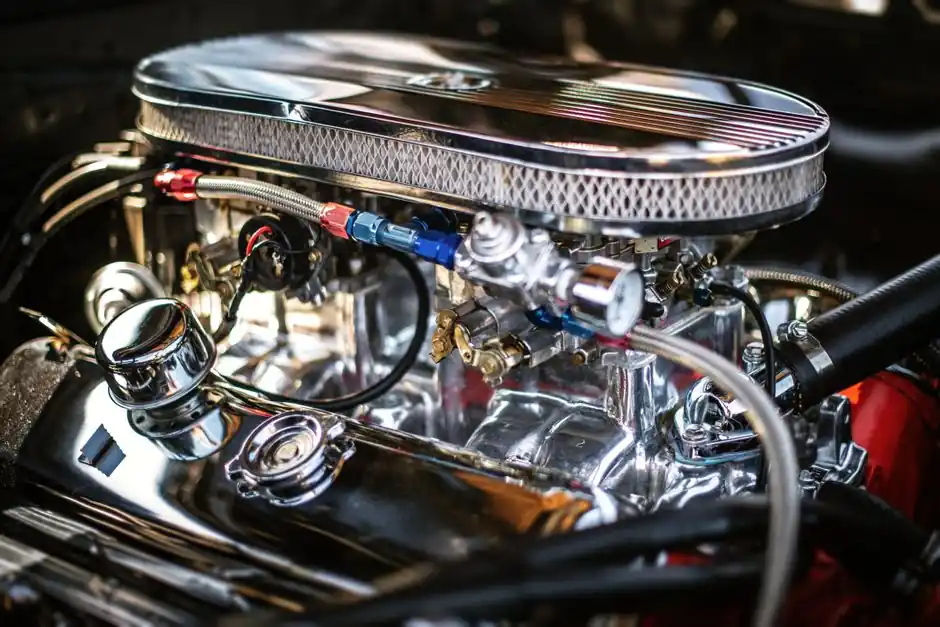
Shell molding sits between green sand and investment casting on the precision-cost curve, and on automotive lines it is typically specified for parts under 80 kg produced at volumes above 1,000 pieces, where tolerances tighter than conventional sand casting can deliver are required [S2].
For an automotive buyer evaluating a shell molding machine, the decision is governed by four hard parameters: maximum pattern size, shot weight, clamp/closing force, and resin-coated sand throughput, all driven by the part mix the line will run. The global automotive casting market was valued at approximately $89 billion in 2025 and is projected to exceed $150 billion by 2034 at a 6.9% CAGR, with over 85 million vehicles produced annually feeding that demand [S3].
Process Definition and Why It Fits Automotive
Shell molding uses thermosetting resin-coated sand applied to a heated metal pattern (typically stainless steel) to form a rigid, thin-walled ceramic-like shell, with typical shell thickness around 10-12 mm and capability to hold molten steel at 1,550 deg C while maintaining dimensional accuracy near 0.25 mm [S2][S4]. The process was patented by Johannes Croning in 1943, spread into automotive plants in the 1950s, and remains the dominant method for medium-volume precision castings such as connecting rods, lever arms, brake components, and gearbox housings [S2].
For an automotive tier-1 or tier-2 buyer, the practical consequence is that a shell molding machine selected for transmission or chassis components should be sized for part weights in the 0.5-80 kg range, ferrous and non-ferrous alloys (carbon steel, low-alloy steel, stainless steel, and certain aluminum and copper alloys), and cycle times in the 60-180 second band per shell half [S1][S2].
Selection Criteria: Four Hard Parameters
A shell molding line is not selected by pattern area alone; the static-pressure molding machine and the shell core machine that feed it must be matched to the same shot-weight and alloy envelope, otherwise the line bottlenecks at the curing station. The four binding specifications are: (1) pattern platen size, typically 600 x 500 mm up to 1,200 x 1,000 mm for automotive-class work; (2) maximum shot weight, generally 5-80 kg for steel and up to 30 kg for aluminum; (3) resin-sand dump-box capacity, normally 50-200 kg per cycle; and (4) curing temperature control between 200-280 deg C with plus or minus 5 deg C uniformity across the platen [S1][S2][S4].
Buyers should also weigh throughput per hour (a four-station rotary machine commonly delivers 30-60 shell halves per hour), pattern changeover time (target under 15 minutes for a mixed-model automotive line), and resin-coated sand consumption per part (typically 1.5-3.0 kg per kg of finished casting depending on shell thickness) [S2]. A shell core shooter matched to the main machine keeps core-set cycle time inside the molding envelope and prevents the curing oven from becoming the line's critical constraint.
Shell Molding vs Sand Casting vs Investment Casting: Decision Comparison
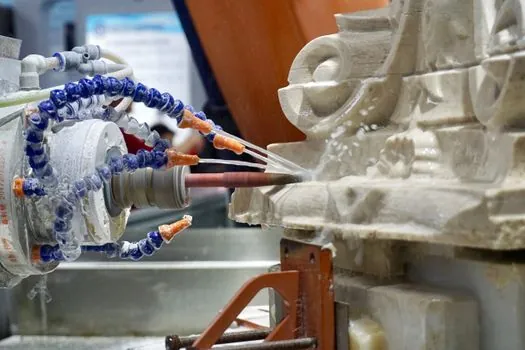
For automotive part buyers, the three processes line up on four decision criteria. On dimensional tolerance, green sand casting delivers plus or minus 1.0-1.5 mm, shell molding delivers plus or minus 0.25-0.5 mm, and investment casting (silica sol) delivers plus or minus 0.1-0.3 mm [S2].
On minimum economic volume, sand casting is viable from 100 pieces, shell molding requires above 1,000 pieces to amortize the heated metal pattern, and investment casting becomes cost-effective only above 50-100 pieces when the wax tooling is already paid off [S2]. On maximum part weight, sand casting is essentially unlimited, shell molding is practical up to about 80 kg, and investment casting rarely exceeds 30 kg per piece [S1][S2]. For an automotive buyer, this table maps directly onto the choice: engine blocks and large gearbox housings go to sand, suspension arms, levers, brackets, and precision drivetrain components go to shell molding, and turbocharger wheels and small intricate aerospace-grade parts go to investment casting [S3].
Automotive Component Fit and Real Use Cases
Shell molding is widely used for chassis and drivetrain castings in the 0.5-30 kg band, where the thin-wall, tight-tolerance envelope matches the part. Specific automotive applications include brake caliper bodies, steering knuckle adapters, differential carrier housings, shift fork levers, exhaust manifolds on certain platforms, and precision gear blanks for manual transmissions [S1][S2][S3].
Material compatibility is broad: carbon steel, low-alloy steel, stainless steel, nickel-base superalloys, and most non-ferrous alloys including certain aluminum-silicon and copper alloys can all be poured into a resin-bonded shell without modification to the basic machine setup, although pouring temperature, shell preheat, and shakeout sequencing must be re-validated per alloy family [S1][S4]. For a buyer integrating a new molding line into an existing foundry, the alloy mix on the existing line is usually the dominant constraint on which shell molding machine class can be installed without re-engineering the melt shop.
Limitations, Failure Modes, and Where Shell Molding Is the Wrong Choice
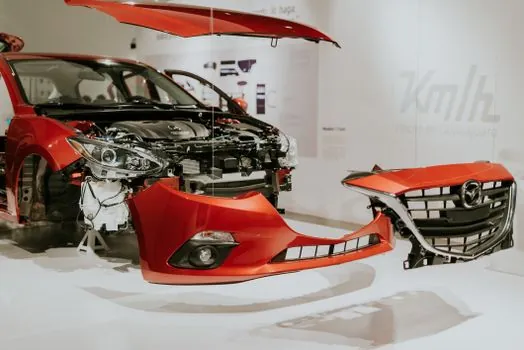
Shell molding is the wrong process when part weight exceeds approximately 80 kg, when annual volume is below 1,000 pieces (the heated metal pattern is too expensive to amortize), or when the part has extremely intricate internal geometry better served by investment casting [S1][S2]. Shell molds also have a finite shelf life; phenolic-resin-bonded shells stored in humid conditions absorb moisture and are prone to steam blows during pouring, so most foundries hold finished shells for under 72 hours before pour [S2].
Common failure modes buyers should specify guardrails against include: shell cracking during handling (controlled by shell thickness in the 10-12 mm band and resin content of 3-5% by weight), gas porosity from resin burnout (controlled by mold venting and pour temperature), and hot tears in low-alloy steel castings (controlled by riser design and shell preheat to 200-300 deg C) [S2][S4]. A molding line without controlled shell preheat typically shows 2-5% higher scrap on steel parts than a line with preheat stations, which is a measurable cost on a high-volume automotive program.
Machine Classes and Sourcing Standards
Automotive buyers should classify shell molding equipment into three tiers. Entry-level single-station machines with manual shell handling target job shops and prototype runs in the 100-500 piece band. Mid-range four-station rotary machines with semi-automatic dump-box and curing control target tier-2 automotive suppliers running 1,000-50,000 piece batches. High-end automated lines with robotic shell transfer, integrated shell core machine feeding, and closed-loop temperature control target tier-1 suppliers producing above 50,000 pieces annually per part number [S1][S2][S4].
Quality standards to specify at purchase: ISO 9001 for the machine builder, dimensional verification of finished castings to ISO 8062-3 CT8-CT10 for shell-molded ferrous parts, and material certifications per ASTM A781 for steel castings and ASTM B26 for aluminum alloy castings, both of which are referenced in mainstream automotive PPAP documentation [S3][S4]. Buyers should also confirm CE conformity for European-bound equipment and verify resin-coated sand supply chain against ISO 9001-certified phenolic resin producers, since resin batch variation is the single largest source of shell-strength drift on a running line [S2][S4].
Sourcing Signals and Trackable Next Nodes
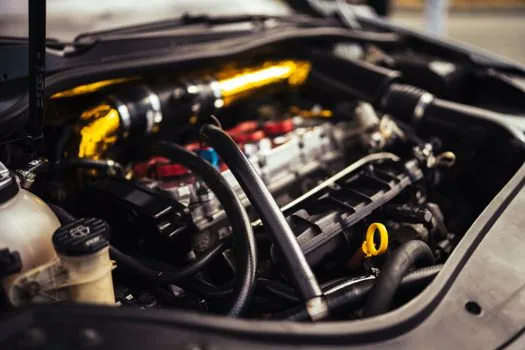
Three signals worth tracking before placing a purchase order: (1) the resin-coated sand phenolic-resin price index, which moved in 2025-2026 with oil-derived feedstock volatility and directly affects per-piece cost; (2) the lead time on stainless steel pattern tooling, typically 6-10 weeks for an automotive-class pattern; and (3) the local availability of pattern heating elements and replacement dump-box wear plates, since these are the consumables that determine a machine's effective uptime on a three-shift automotive schedule [S1][S2]. For broader casting-line context that complements shell molding decisions, see the procurement map for adjacent foundry equipment in Lost Foam Casting Line Selection for Agricultural Machinery: A Spec Map and the wider buying strategy in Machine Tool Procurement Strategy: Spec-Matched Selection for 2026 Buyers.