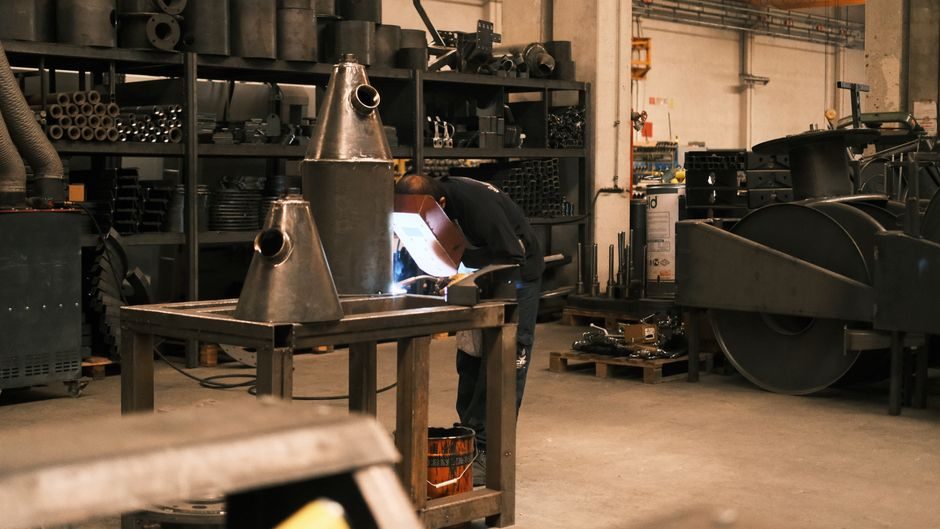
A shot blasting machine is a capital asset whose purchase price captures only 20-35% of its 10-year lifecycle cost, with abrasive media, blade/impeller replacement, and dust-collection compliance absorbing the majority of the remaining spend [S2][S5].
Total Cost of Ownership (TCO) measures the complete cost incurred over the life cycle of an asset, covering purchase, use, maintenance, support, and disposal, and is a standard technical evaluation criterion used to expose hidden costs overlooked during budget planning [S2].
Where the Money Goes: The Four-Cost-Stack Model
The lifecycle cost of an industrial shot blasting machine breaks into four cost centers: acquisition (typically 20-35% of TCO over a 10-year horizon), operating consumables (30-40%, dominated by steel shot/abrasive media and electrical power), maintenance and wear parts (20-30%, led by impeller blades, control cages, liners, and end-seal bearings), and end-of-life disposal plus regulatory compliance (5-10%, including dust-collector filter media and shot-recycle rejects) [S2][S5].
Cost-element optimization is the practical payoff of TCO analysis: identifying that abrasive consumption alone can equal 40-60% of annual operating cost on a high-throughput roller conveyor type line, for example, lets buyers prioritize media-recovery efficiency and steel-shot hardness grade over headline machine price [S5].
Driver #1 — Abrasive Media and Spare Parts
High-carbon steel shot, low-carbon steel shot, high-carbon steel grit, bearing steel grit, and steel cut-wire shot are the five mainstream abrasive families offered by Chinese suppliers, with replacement wear parts commonly bundled as blades, impellers, control cages, and liners [S5].
Impeller blades are the "heart" of the shot blasting machine and the components subject to the fastest wear, meaning blade grade and rotation-speed control directly govern both abrasive consumption and downstream surface-roughness stability [S3].
Operating cost on a tumble-belt or crawler-type line is therefore governed by the cleaning efficiency curve: the faster abrasive degrades, the higher the unit cost per square meter cleaned, and the more frequently the separator must reject spent media [S3].
Driver #2 — Energy, Dust Collection, and Compliance

Dust collectors and cartridge-style filter elements are non-negotiable TCO line items on any enclosed shot blasting line, and filter replacement intervals scale with abrasive throughput and the fines fraction in the recycled shot stream [S1].
Rotary hook type machines, used in aerospace, automotive, shipbuilding, and machinery manufacturing for batches ranging from 500 kg up to 15,000-20,000 kg per workpiece, must pair the wheel horsepower curve with a correctly sized dust-collector CFM rating or face regulatory and operator-exposure issues from day one [S3].
Wheel horsepower, ventilation CFM, and separator air-volume balance are the three energy-side variables that move the operating-cost figure most: a 10% airflow mismatch on the dust collector can lift fan electricity by 8-12% across a single shift [S3].
Selection Matrix: Matching Machine Type to TCO Profile
Hook-type units suit low-to-medium batch, high-mix work where workpiece changeover dominates, while roller conveyor type machines win on continuous throughput where abrasive recirculation and dust-collector sizing can be amortised over 8-16 hours per day [S1].
Wire mesh belt and crawler/tumble-belt machines fit small casting or forged parts at 100-500 kg batch weights, and the modular structure of steel-plate pretreatment lines from KEEJOO-style suppliers is built to shorten maintenance windows and cut blade-change downtime versus non-modular equivalents [S1][S3].
Steel pipe shot blasting machines, catenary machines, and rotary mesh table machines are specialty geometries whose TCO is dominated by fixturing cost and part-loading labour, so a 10-year spend model should be run on a per-piece-cleaned basis rather than on annualised equipment hours [S1].
Reference Comparison: Abrasive Families vs Cost Drivers

High-carbon steel shot has the highest hardness and the longest service life per kilogram, lowering media cost per ton cleaned but raising initial media purchase; low-carbon steel shot breaks down faster, raising abrasive consumption and dust-load on the collector filter [S5].
High-carbon steel grit and bearing steel grit are specified where surface-profile (anchor-pattern) consistency matters more than raw material cost, while steel cut-wire shot sits between cast shot and grit on both price and durability curves [S5].
The cheapest abrasive on the per-ton invoice is rarely the cheapest on the per-square-meter-cleaned cost line: hardness, friability, and dust-fraction generation rate are the three engineering variables that separate a 0.8-1.2 kg/m² consumption figure from a 1.8-2.5 kg/m² figure on the same workpiece [S5].
TCO Numbers vs Qualitative Driver Ranking
Across a 10-year horizon, a mid-size roller conveyor type shot blasting line typically carries an annual operating cost of 35-55% of original capital cost when abrasive, blades, liners, electrical power, and filter changes are summed — a useful planning ratio even where site-specific figures cannot be disclosed [S2][S5].
End-of-life disposal and shot-recycle rejects sit in the 5-10% slice of TCO, but they spike sharply when the abrasive stream is contaminated with oil, paint, or scale fines from upstream processes, which forces premature filter changes and media replacement [S2][S5].
For a related engineering-economic treatment of long-horizon cost stacks on a different asset class, see the Building Stone TCO: 30-50 Year Cost Stack and Selection Map reference, and for a complementary view on consumable-driven 10-year spend see Synthetic Resin Total Cost of Ownership: Cost Drivers and 10-Year Spend Stack.
For Whom This Model Works — And Where It Breaks

TCO modelling is well suited to two-shift or three-shift continuous operation where annual hours exceed roughly 2,000, because fixed-cost amortisation (dust collector, separator, control cabinets) is the dominant lever and the model can rank machines cleanly [S2].
It is less reliable on single-shift job-shop environments with frequent geometry changeover, where fixturing labour, programming time, and queue delays dominate — there, a per-piece throughput model is the better tool than an annualised hour-based TCO [S2].
For a wider view of how machine type maps to application, the Shot Blasting Machine Types: A Spec Engineer's Classification Map companion article aligns geometry-specific machines to process steps, while Shot Blasting Machine: Advantages, Limitations, and Selection Map covers the strengths and the failure modes a TCO model must price in.
Verification Signals to Track Before Quoting
Before locking a 10-year TCO number into a budget, ask the OEM for abrasive-consumption rate in kg/m², expected blade life in operating hours, filter-element service life in months, and rated wheel horsepower at the actual workpiece mass — those four data points let the operating-cost line be derived rather than guessed [S3][S5].
Cross-check any vendor quote against the published model series (for example, the HTK 10/12 through HTK 20/22 hook-type line with max workpiece diameters from 1,500 mm to 5,000 mm and shot blaster counts from 3 to 8-12) to validate that the quoted wheel count matches the stated throughput [S3].
Track the dust-collector filter pressure-drop curve monthly, log blade-change intervals by operating hours, and reconcile abrasive receipts against cleaned-area output each quarter — those three operating KPIs are the difference between a TCO projection and a TCO audit [S3][S5].
The underlying component specifications are covered under sand blasting machine, and total station.