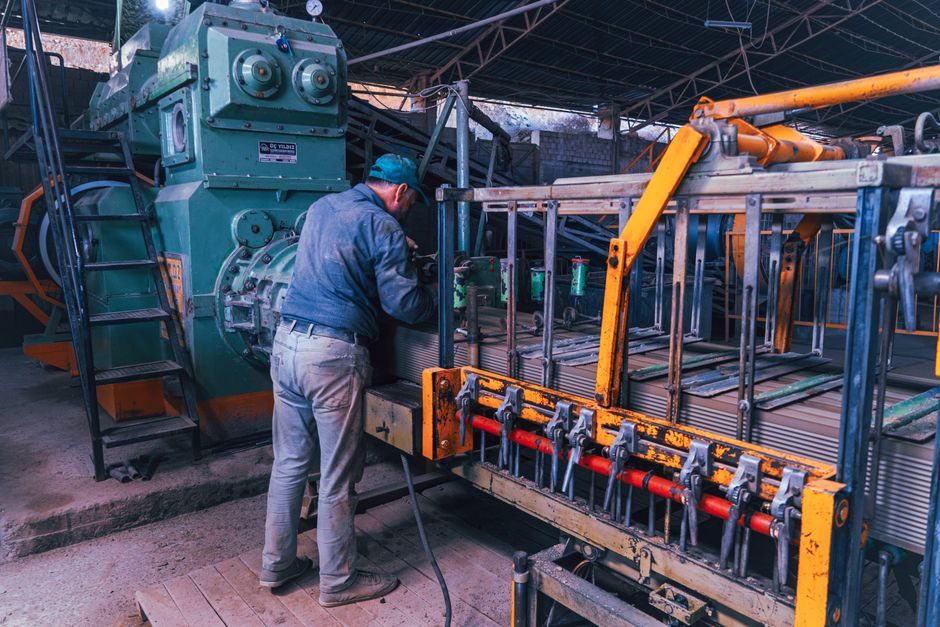
DirectIndustry's industrial index lists 47 manufacturers offering 367 shot blasting machine models, segmented into nine functional configurations that map to part geometry, batch volume, and production-line integration [S3]. The dominant drive technology remains the centrifugal (wheel) turbine; compressed-air (pressure or suction) systems hold a smaller but technically distinct niche for ID cleaning and aerospace-grade peening [S1][S2][S3].
Manufacturer line-ups mirror that split. Cym Materiales (Argentina) builds automatic overhead-conveyor and belt units in three turbine-count variants — PER R (4 turbines at 90°), PER I (4 inclined turbines), and EST (8/12/16 turbines) — sized for raw stock, welded structures, and complex spools respectively [S1]. LS Industries (USA, Kansas) supplies both manual lance-type ID pipe blasters and belt/roller conveyor lines for cylinders and storage tanks [S2]. Chinese OEM line-ups from Qingdao Foundry Machinery, Qingdao Disa, and Qingdao Qingzhu typically list 40+ series covering crawler, hook, through-type, roller conveyor, and steel-plate variants under one roof [S4][S5][S6].
Drive System: Centrifugal Wheel vs Compressed-Air Blasting
Centrifugal wheel (airless) blasting is the default for high-throughput steel work, with turbine counts of 4, 8, 12, or 16 units in a single chamber selected against part complexity and required coverage angle [S1]. Compressed-air systems (pressure or suction blast pots) dominate low-volume, precision, or peening-grade applications, where shot velocity must be tightly controlled rather than maximised [S2][S8].
Air-driven peening machines split into robotic cells, compact low-volume units, and continuous multi-table air peening machines; airless / turbine peening covers single-table, multi-table, conveyor, and tumble-blast wheel configurations [S8]. The ID Pipe Blaster 1.25-3 from LS Industries uses a mechanical-driven lance inside a sealed work area with an ASME-certified blast pot, handling 1.25″–3″ diameter pipe from 5′ to 15′ long [S2].
Configuration Map: Nine Functional Families
Working from the DirectIndustry manufacturer index and the Chinese OEM catalogues, the market resolves into nine configuration families, each tied to a part-geometry envelope [S3][S4][S5].
Tumble belt and rotary drum units handle small bulk parts in batch mode; hook (hanging chain) units process individual large castings or forgings on rotating hooks; overhead conveyor units feed long profiles, spools, and welded structures in continuous pass [S1][S3]. Roller conveyor machines process plate, section, and large steel tube outside walls; rotating table units cycle work between upper and lower chambers for uninterrupted grit flow [S3]. Crawler-type machines are specified for workpieces that cannot be hung or conveyed; manual ID lance units are dedicated to internal pipe cleaning in the 1″–6″ diameter range [S2][S5].
Two cross-cutting variants sit inside the same family: 2-wheel belt blasters for bulk metal, and rotating-table belt blasters for fixtured components [S1]. Steel-tube outside-wall shot blasting machines, in turn, sit under the roller conveyor family and target large- and medium-diameter tube surface treatment, leaving a steel-silver metallic finish [S3].
Selection Criteria by Part Geometry and Volume
Selection starts with three binary filters: part size (small bulk vs single large), batch mode (batch vs continuous in-line), and required surface condition (cleaning vs peening-grade) [S1][S3][S8]. Small bulk castings and forgings in volumes beyond a few hundred per shift default to tumble belt or rotary drum; single heavy workpieces in low volume default to hook or rotating table with fixtures [S1][S3].
Long profiles, spools, and welded structures that need to be cleaned in line with downstream painting go on overhead conveyor or roller conveyor machines; the latter can be specified for in-line painting integration to eliminate secondary handling [S1]. Internal pipe cleaning in 1.25″–3″ diameter is the dedicated domain of manual ID lance blasters, where the mechanical lance and PLC-controlled feed speed produce a consistent internal finish over pipe lengths of 5′–15′ [S2]. The shot blasting machine entry in our encyclopedia covers the underlying principle: high-speed rotating impeller throws abrasive media by centrifugal force against the workpiece.
Standards, Sourcing, and Manufacturer Concentration
DirectIndustry's verified-manufacturer index on 2026-06-24 lists 47 suppliers with 367 products, with notable concentrations in Italy (C.M. Surface Treatment, Cetingil), Spain (CMV, AB Shot Tecnics), Germany (Rump Strahlanlagen, Contec), USA (LS Industries, Hodge Clemco, Guyson, Wheelabrator), Turkey (Antai), and China (Qingdao Disa, Qingdao Qingzhu, Qingdao Foundry Machinery) [S3][S4][S5][S6].
For procurement, OEM ISO 9001 certification and ASME-certified pressure vessels (blast pots) are the two baseline checks on the spec sheet; the LS ID Pipe Blaster 1.25-3 carries both, with the blast pot certified to ASME and the machine controlled by a standard PLC [S2]. Qingdao Disa Shot Blasting Machine Group Co., Ltd. lists ISO 9001 management certification, with main products spanning shot blasting machines, shot blast machines, and sand blasting rooms [S6]. Surface treatment equipment selection criteria follow the same logic as the related sand blasting machine family in our encyclopedia: abrasive type, drive technology, and enclosure geometry.
Peening vs Cleaning: Two Different Machines
Shot peening machines and shot blasting cleaning machines share the same physics — high-velocity impact of metallic or mineral media — but diverge on intensity control, coverage verification, and workpiece handling [S8]. Air-driven peening machines (robotic cells, compact units, continuous multi-table air peening) target fatigue-life improvement on aerospace components where Almen intensity and coverage percentage must be measured and recorded [S8].
Airless / wheel peening machines (single-table, multi-table, conveyor, tumble-blast wheel) handle higher-volume peening where the intensity window is wider, often overlapping with cleaning-grade work [S8]. For cleaning-grade work in foundries and structural steel, the centrifugal-wheel shot blaster is the default; its 4-turbine minimum in the PER R configuration is set by coverage angle (90°), with complex welded structures requiring 8–16 turbines and dual-pass routing to hit all surfaces [S1]. Internal pipe cleaning — a niche within shot blasting machine configurations — uses compressed-air lance systems, not wheels, because ID access is too narrow for a turbine.
Limitations and Failure Modes
Centrifugal-wheel systems lose coverage on concave or deep-cavity parts: the wheel throws media in a flat fan, so hollow sections need either dual-pass routing (PER I configuration) or escalation to the 8–16 turbine EST model [S1]. Manual ID lance blasters are limited to small-bore pipe (1.25″–3″ on the LS unit) and require TrueTrack-style anti-walk fixtures to keep the pipe centred during rotation [S2].
Compressed-air systems are throughput-limited by pot pressure and nozzle diameter; they are not economic above roughly 100–200 kg/h media flow on continuous duty [S2][S8]. For an adjacent decision matrix on dynamic balancing versus vibration analysis, see the dynamic balancing machine vs vibration meter spec map. The broader foundry-equipment cost stack — including abrasive consumption, dust-collector sizing, and reject rates — is documented in the shell core shooter TCO analysis, which uses comparable 5–15 year cost-driver logic for adjacent foundry equipment.
Who Should Specify What
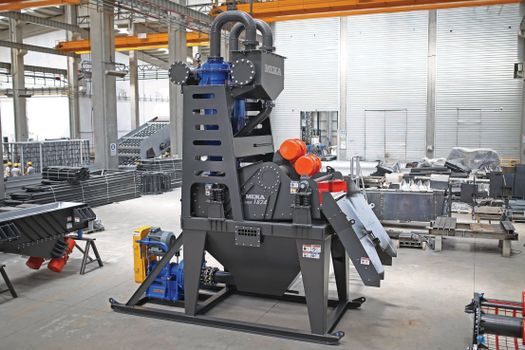
Process engineers running structural-steel fab shops, foundries, and plate-processing lines should default to centrifugal-wheel belt, hook, or roller conveyor machines sized at 4–16 turbines against the largest part envelope [S1][S3]. ID pipe cleaning in oilfield services and small-bore heat-exchanger tube work is the manual lance blaster's domain, with PLC-controlled feed speed and ASME-certified blast pot as baseline spec [S2].
Aerospace and spring manufacturers running peening-grade work — where Almen intensity and coverage must be measured — should specify air-driven or wheel peening machines from dedicated peening lines, not general-purpose cleaning blasters [S8]. Foundries that need to match crawler-type shot blasting machines to abrasive consumption budgets will find the wider abrasive-blaster taxonomy covered in the shot blasting machine reference page, which lines up wheel, air, and wet-slurry variants on the same axes. Two trackable signals for the next cycle: DirectIndustry's verified-manufacturer count (47 on 2026-06-24) and the next IMTS 2026 exhibition window (14–19 Sep 2026, Chicago), where LS Industries is exhibiting stand 135688 [S2][S3].
For the relevant spec sheets and selection criteria, see shot sleeve.