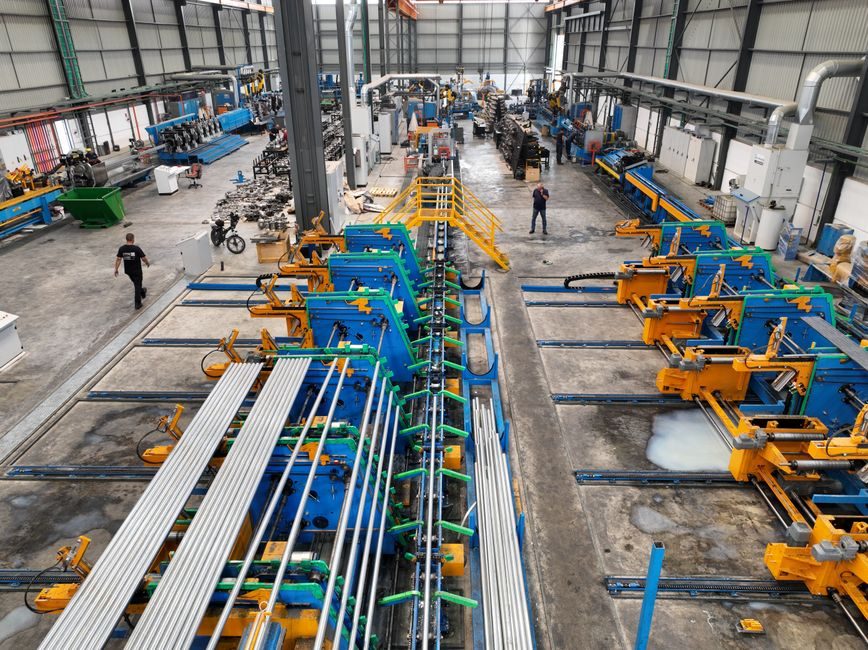
A shot sleeve is a consumable/refurbishable component seated in the cold-chamber injection unit of a magnesium die casting machine; the sleeve does not replace the machine, it defines part of its injection performance window [S1][S3].
Magnesium cold-chamber cells typically run 180 t to 8800 t clamping force, with the Haitian HDC line covering that full range and Shibaura's DC-R series positioned at the small/medium end of the cold-chamber market [S1][S3]. Sleeve bore, length-to-bore (L/D) and material must be matched to that machine's shot weight and injection profile, not chosen in isolation [S2].
Function split: sleeve meters Mg, machine supplies force and cycle
The cold-chamber shot sleeve sits between the launder and the shot well; molten magnesium at roughly 680-710 °C is dosed into its bore, then a hydraulic or servo-driven plunger pushes the charge through the gate at velocities typically in the 2-6 m/s band for structural Mg parts [S3]. The sleeve therefore controls the volumetric accuracy of the shot, the temperature drop during dwell, and the gas/air entrapment profile that drives porosity [S2].
The die casting machine around the sleeve supplies the clamping tonnage, the platen rigidity, the injection booster circuit, the intensification pressure, the die-height stroke and the closed-loop shot-end control. On Haitian HDC cold-chamber models, clamping force is published from 180 t up to 8800 t with servo-driven energy-saving injection and high-rigidity cast tie bars [S3]. Choosing a sleeve without confirming that the machine's intensification pressure and shot-end window match the sleeve bore is the most common cause of cold-shut and porosity defects in Mg structural parts [S1][S3].
Spec dimensions that actually couple sleeve to machine
Three sleeve numbers must agree with three machine numbers before a cell can quote a cycle time. Sleeve bore (mm) must fit the projected shot weight (g) at the alloy's casting density — magnesium at ~1.74 g/cm³ needs roughly 1.7× the volume of the same mass in aluminum (2.70 g/cm³) [S4]. Sleeve length-to-bore ratio (L/D) typically sits in the 1.2:1 to 2.0:1 window for magnesium cold-chamber work, where shorter L/D reduces heat loss and gas pickup but raises injection-end pressure demand on the machine [S2].
On the machine side, the published shot weight (kg), the maximum injection stroke (mm) and the intensification pressure (bar) must all envelope the sleeve's filled volume at the target injection velocity. Yizumi's die-casting product line, refreshed in May 2026, continues to publish cold-chamber cells whose servo-valve injection control is the actual interface to sleeve-side fill behavior [S2]. Shibaura Machine's DC-R series, in production since 2025, targets the small and medium machine class where sleeve selection dominates defect budgets because intensification headroom is constrained [S1].
Materials, lube and wear: where sleeve cost lives

Sleeve life is rated in shots-to-refurbish, and a typical ductile-iron Mg sleeve in structural work lands in the 50,000-150,000 shot range before bore wear pushes shot-weight variation out of the SPC window, though exact values depend on alloy, lube flow and injection velocity [S2][S4].
Lubricant selection is more aggressive on Mg than on Al: a water-based or solvent-based die lube is metered onto the sleeve bore and the plunger tip, and lube pooling at the sleeve mouth is a primary source of hydrogen and gas porosity in Mg castings [S4]. Chinese magnesium-alloy cell builders such as Lanson Imm explicitly frame machine design around stable lube delivery and inert-gas cover (typically SF6/N2 or a newer fluorinated cover gas) at the sleeve mouth, because Mg melt oxidation at the sleeve entry sets the upper bound on safe dwell time [S4].
When the sleeve is the bottleneck, and when the machine is
If a magnesium cell is hitting porosity, cold-shut or short-shot defects at otherwise normal machine settings, sleeve-side causes dominate: bore wear, lube excess, low L/D ratio, or excessive dwell time between dosing and injection [S2][S4]. If the same cell is flashing at the die parting line, hitting tie-bar stretch limits, or losing intensification pressure at the shot end, the bottleneck has moved to the die casting machine — clamping tonnage, platen rigidity or hydraulic capacity [S1][S3]. Haitian's HDC line lists high-rigidity machine body construction and high-repeatability clamping specifically as the response to flash and platen-flex failure modes at the 180-8800 t band [S3].
A practical decision rule: budget the sleeve at roughly 3-8% of cell cost over a 12-month campaign in structural Mg work, and treat machine intensification/platen stiffness as the locked-in 80%+ of capex. Sleeve choice is a maintenance and defect lever, not a machine-replacement lever [S1][S3]. For a side-by-side read on the aluminum die casting machine class that shares the same cold-chamber architecture, the sleeve selection logic carries over with the density and temperature numbers shifted for Al alloys.
Standards, safety and sourcing reality in mid-2026

Magnesium cell safety is governed by cover-gas handling (typically SF6 with N2 carrier, or one of the newer low-GWP cover gases that several suppliers have rolled out through 2025) and by die-lube flash-point discipline at the sleeve mouth [S4]. Machine-side safety references typically cite IEC/EN 60204-1 for the electrical package, ISO 12100 for risk assessment on the injection unit, and ISO 9001 quality systems for OEM build, with ATEX zone classification applied to the Mg melt-handling envelope around the sleeve mouth — operators should confirm the exact zone and gas-detection scope with the machine OEM before commissioning [S1][S3].
On sourcing, the 2026 Mg machine market is a three-block structure: Japanese OEMs (Shibaura Machine with the DC-R small/medium cold-chamber line) [S1]; Chinese OEMs (Yizumi, Haitian's HDC cold-chamber family at 180-8800 t, Lanson Imm targeting magnesium-alloy cells) [S2][S3][S4]; and European rebuilders/integrators handling retrofits. Sleeves are typically sourced either OEM-matched or from independent refractory/metal shops, with the OEM match preferred when the machine's shot-end control firmware is closed-loop calibrated to a specific sleeve L/D [S1][S2].
What to lock in before quoting a Mg cell
Five numbers must be on the RFQ: target shot weight (g) at Mg density 1.74 g/cm³, required clamping tonnage (t), minimum intensification pressure (bar), sleeve bore and L/D, and cover-gas/cover-gas-rate spec for the Mg melt at the sleeve mouth [S1][S3][S4]. Without those, machine OEMs cannot quote a compatible sleeve envelope, and sleeve shops cannot quote a bore size, so the cell ends up specced from brochure numbers rather than from fill behavior [S2].
For a magnesium structural part running in 2026, the published Yizumi refresh (May 2026) and the Shibaura DC-R (2025 production start) are the two cold-chamber references most likely to bracket a new cell; the Haitian HDC range (180-8800 t) is the published envelope for both small and very large Mg structural castings [S1][S2][S3]. If the application is large thin-wall structural Mg — instrument panel beams, seat frames, battery housings — plan on a sleeve change-out budget scaled to the published shot count, not to calendar time, because Mg sleeve wear is shot-count-driven, not day-driven [S1][S2][S4]. For a deeper read on cost envelopes across tonnage, see the die casting machine price and cost guide 2026; for the class/shot-weight/clamp-force decision logic that drives machine selection, the die casting machine buying guide 2026 covers the gating choices. As a maintenance note, sleeve refurbishment is typically scheduled at the same interval as plunger-tip replacement, and both should be logged against the machine's shot counter rather than against operating hours.