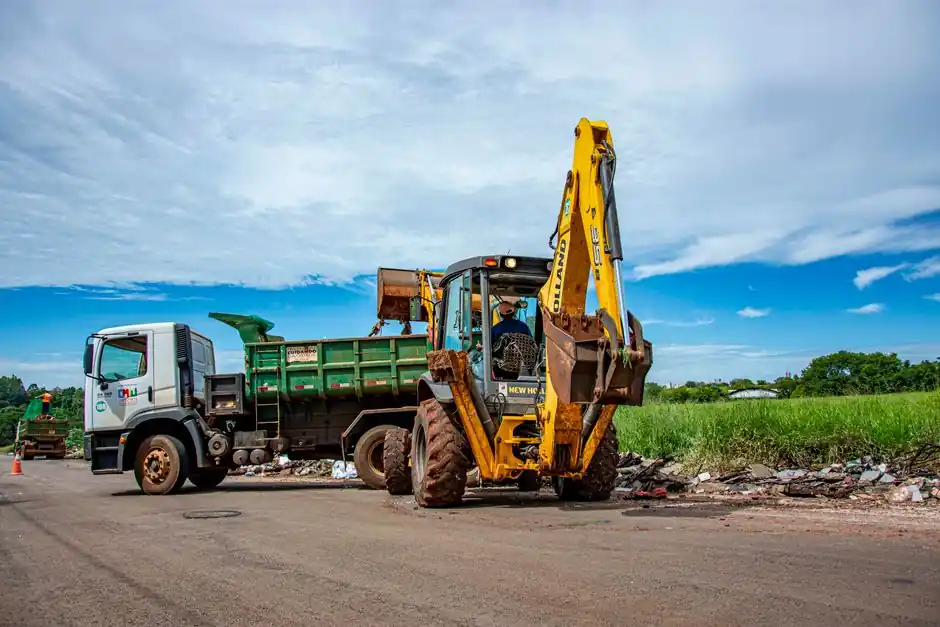
Side dump trailers carry a measurably lower tip-over risk than end dump trailers because the tub pivots laterally on hydraulic rams instead of hoisting the load skyward, keeping the center of gravity low through the entire dump cycle [S2][S3][S4].
End dump trailers, by contrast, raise the front of the box to roughly a 45 degree angle and empty out the rear, which lifts and rearward-shifts a heavy load at the moment the trailer is most vulnerable: on soft, crowned, or sloped ground [S4][S6]. This geometry difference is what fleet owners, dealer literature, and operator forums all cite as the primary reason side dumps are the safer of the two for routine aggregate hauling.
Why the side dump geometry resists rollover
A side dump trailer uses one or two hydraulic rams to tilt the entire tub to the right or left, so the load slides out laterally while the box itself stays at a low angle of elevation [S2]. Because the tub never hoists above the chassis, the center of gravity of the loaded trailer barely moves during the dump, which is the single biggest reason rollover events on side dumps are rare compared to end dumps [S3]. Side dump trailers are also frequently built longer than end dump trailers, giving them a wider wheelbase footprint and a larger stabilizing base when fully loaded [S3].
The practical consequence is that operators can unload on uneven, soft, or crowned ground without first scouting for a level pad, and a side dump can be emptied while creeping forward to spread the load, which keeps the load centered under the axle group the entire time [S2][S4]. For an engineer comparing dump truck configurations, that combination of low CG retention and on-the-move dumping is the core safety differentiator, not operator skill alone.
Why end dumps are the rollover reference case
An end dump trailer unloads by lifting the front of the box on a hydraulic ram and pivoting the load out the rear gate, which concentrates mass high and behind the rear axle at peak extension [S2][S4]. The highest tip-over risk on any dump configuration is during the raised-box phase, and end dumps spend the longest time in that phase, which is why dealer and operator literature consistently rank end dumps as the highest rollover risk of the three common dump types (belly, side, end) [S4].
End dumps are also more sensitive to operator behavior: drivers are repeatedly told to keep the trailer straight, dump on flat ground, and dump into the wind to keep the raised load from catching a gust or shifting off the high centerline [S6]. Material shifting inside the tub during the lift is the classic initiating event for an end-dump tip, and a half-loaded end dump with sticky or bridging material is the worst-case combination. Within the mining dump truck and heavy-haul end-dump class, the same geometry rule applies at larger scale, which is why rigid-frame off-highway end dumps are usually restricted to level, prepared dump points.
Side-by-side comparison on the criteria that drive tip-overs
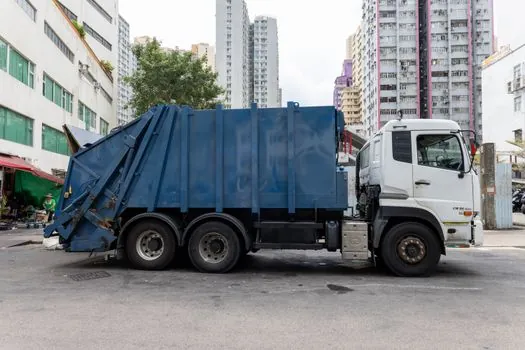
Stability is not a single number; it is a function of four operator-controllable variables, and side dumps win on all four against end dumps. [S2]
First, center-of-gravity travel: side dump CG stays within roughly the loaded tub envelope the whole cycle, while end-dump CG rises 4 to 6 feet and shifts rearward as the box pivots up [S2][S3]. Second, allowable dump surface: side dumps can dump on soft or uneven ground without scouting, while end dumps need level, firm footing, because a raised box on a side slope is the textbook tip condition [S2][S4][S5]. Third, ability to dump on the move: side dumps can creep forward to spread and keep the load centered, while end dumps must be stationary with the box raised, which freezes the rig in its most vulnerable attitude [S4]. Fourth, sensitivity to load shift: a side-dump load slides laterally into the lowered tub wall, whereas an end-dump load can surge rearward into the gate as the box lifts, which is the initiating event for many tip-overs [S3][S6].
Where the side dump advantage is real, and where it is not
Side dumps are clearly the better stability choice on tight or uneven sites, on jobs where the dump point cannot be graded flat, and on haul profiles with frequent on-the-move spreading such as riprap placement, shoulder aggregate, and asphalt runs [S2][S4]. They are also the safer pick for less-experienced operators, because the rollover margin is built into the geometry rather than dependent on the driver picking a level pad every cycle [S2].
Side dumps are not the right tool when the job calls for the maximum single-dump volume, when the material is heavy demolition debris or shot rock that end dumps handle with their taller sidewalls, or when the site geometry makes a side-discharge pattern awkward (long narrow trenches, against a wall, confined urban pits) [S2][S4]. End dumps also win on raw cubic capacity per drop, which is why aggregate yards and demolition contractors still run them despite the higher rollover exposure [S2][S4]. For mixed fleets, the practical split is end dump for heavy rock and demolition on level ground, side dump for everything else, and that decision is usually made on the dump-point geometry, not the haul-road geometry.
Operator-side rules that close the remaining gap
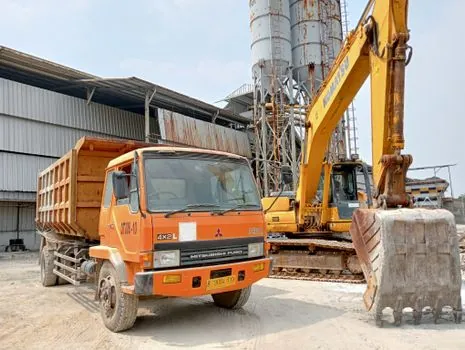
Even on a side dump, sloppy operation can defeat the geometry advantage. The widely cited do-and-don't list is short: stay on ground the trailer can sit level on or within a few degrees of level, dump into the wind when gusts are nontrivial, do not exceed the posted side-dump angle rating on the tub decal, and never dump with the trailer parked across a steep cross-slope [S5][S6]. A side dump can dump on uneven ground relative to an end dump, but "uneven" still has limits: a steep cross-slope under a tilted tub is a tip event waiting on a load shift [S5].
For end dump operators, the compensating controls are stricter: mandatory level pad, straight trailer alignment before lift, dump into the prevailing wind, and partial-load discipline to keep the load from surging rearward as the box rises [S6]. These are exactly the failure modes a side dump largely sidesteps by geometry. The two aerial work truck-class references in the dump-trailer literature actually use the same lesson: when the load leaves the chassis, the tip moment scales with how high and how far the center of mass moves, and the safest configuration is always the one that minimizes both.
What this means for spec'ing a new trailer
For a buyer choosing between a side dump and an end dump for a 2026-spec purchase, the rollover question usually decides the bid. Side dumps from the major U.S. builders (SmithCo SX3 through SX6, for example) currently price in the $87,900 to $142,900 band, comparable to similarly configured end dumps, so the stability argument is not a cost argument anymore, it is a risk argument [S4]. If the haul profile includes uneven dump points, cross-sloped shoulders, or frequent on-the-move spreading, spec the side dump and treat the rollover delta as built-in safety margin rather than operator heroics.
Trackable signals for the next refresh: any 2026-2027 dealer update lowering the recommended maximum side-dump cross-slope angle (currently specified per OEM decal), any SmithCo or Midland bulletin tightening the dump-while-creeping speed limit, and any insurance-rate differential between side and end dump fleets that quantifies the rollover advantage in dollars. The geometric case is already closed; the open data is the underwriting number.
See also our earlier report, Hydraulic vs Rope Luffing Tower Cranes: 2026 Spec Comparison.