
Sintered and reaction-bonded silicon carbide (SiC) grades are now standard in marine engineering where 316L stainless and nickel-aluminum bronze fail under sand-laden seawater, with CeramaSil-C (sintered SiC) reporting density 3.1 g/cm³, hardness 28 GPa, flexural strength 410 MPa, thermal conductivity 102.6 W/m·K, and CTE 4.02×10⁻⁶/K (25–400°C) [S2].
Marine use cases concentrate on mechanical seal faces, propeller-shaft bearings, rudder bearings, pump liners, desalinator valve plates, and wear plates on anchor pockets, where the combination of Mohs 9.0 hardness, 4.0–4.5×10⁻⁶/K thermal expansion, and inertness to NaCl brine outclasses metals [S3][S4].
Material Property Floor: Why SiC Beats 316L and Bronze
Ceramic-grade SiC delivers flexural strength ≥350 MPa, compressive strength ≥2,400 MPa, and density 3.10–3.22 g/cm³, putting specific strength above any cast 316L equivalent [S3]. Maximum continuous use in inert atmosphere reaches 1900°C for sintered SiC, while in air 1400–1600°C is the working ceiling before oxidation kinetics accelerate [S2][S8].
Thermal conductivity of 120–270 W/m·K, roughly four to eight times that of 92% alumina, lets SiC seal faces dump frictional heat into the process fluid, which is the reason SiC/SiC pairings tolerate dry-run excursions that would score a silicon-carbide-versus-carbon face [S3]. The CTE band of 4.0–4.5×10⁻⁶/K keeps SiC dimensionally stable across the −20°C to +80°C splash-zone band typical of North Sea and tropical duty [S3][S8].
Grade Map: SSiC, RBSiC, N-SiC, R-SiC
Four commercial SiC families compete for marine slots: sintered SiC (SSiC) for premium seal faces and bearings, reaction-bonded SiC (RBSiC) for large pump liners, nitride-bonded SiC (N-SiC) for cost-driven wear parts rated to 1600°C, and recrystallized SiC (R-SiC) for the highest-purity work up to 1700°C [S1][S3].
The Marine & Nautical application notes for barges and naval platforms flag hardness, chemical inertness in saltwater, and high-temperature strength as the deciding factors, which is where the SSiC/RBSiC pair (full density, no free silicon) outperforms the N-SiC/R-SiC pair (bonded, trace porosity) for wetted, load-bearing service [S5]. For a cross-grade comparison see the silicon carbide material map: the practical selector is chloride pitting risk (favor SSiC), cavitation intensity (favor SSiC or dense RBSiC), unit cost (favor N-SiC), and thermal-shock severity (favor RBSiC for thick sections) [S2][S10].
Decision Criteria: When to Pick SiC and When Not To
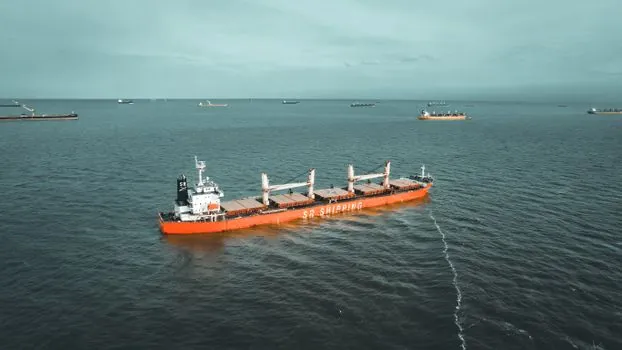
Specify SiC when at least two of the following are true: chloride pitting on 316L above 0.1 mm/yr, sand or silt content above 50 mg/L in the service fluid, dry-run or starved-lubrication risk on seal faces, or operating temperature above 200°C where bronze loses hardness [S4][S10]. In these regimes SiC seal faces and wear plates routinely extend MTBF beyond 18,000 hours versus 6,000–8,000 hours for hard-faced metallic pairs.
Do not pick monolithic SiC when impact loading is the dominant failure mode, when the part is larger than roughly 600×600×50 mm and a single-piece dense SSiC geometry is not manufacturable, or when basic-oxide chemical attack (pH above 12 with CaO/MgO present) is expected, because SiC is attacked by basic oxides at high temperature [S1]. In those cases engineers fall back to alumina ceramic (92–99.5% Al₂O₃) for impact tolerance, ceramic-filled epoxies such as Belzona 1321 for field-repairable erosion patches, or fiber-reinforced polymer for large structural panels [S6].
Service-Specific Specs: Seals, Bearings, Pump Liners, Desalination
Mechanical seal faces in marine pumps are the highest-value SiC application: SSIC/SSiC or SSiC/graphite pairings dominate, with face flatness held to 0.0002–0.0005 mm and surface roughness 0.05–0.1 µm Ra to keep the fluid film stable at 8–25 m/s sliding speed [S2][S3]. Reaction-bonded SiC (SiSiC) is the default for slurry pump liners and hydrocyclone cones where the 20% sinter-shrinkage constraint of SSiC drives manufacturers toward near-net-shape RBSiC bodies [S2].
Propeller-shaft and rudder bearings take the corrosion-resistance and weight-reduction story directly: a SiC journal bearing removes the galvanic-couple risk that bronze brings against a stainless shaft and cuts routine grease-out intervals [S4]. In seawater reverse-osmosis and multi-stage flash desalination, SiC valve seats and pump impellers are replacing duplex 2205 because the chloride pitting rate of 2205 in 65°C, 6% Cl⁻ brine is roughly 0.3–0.8 mm/yr versus negligible for dense SSiC [S10].
Standards, Sourcing, and Failure Modes

Marine SiC parts are typically released against ISO 9001:2015 / GB/T 19001-2016 quality systems with material traceability to ASTM C799 (chemical analysis of SiC refractories) and dimensional checks against ISO 2768-m or tighter, depending on seal-face class [S3]. For class-approval work (DNV, Lloyd's, ABS), the SSiC or RBSiC body is paired with elastomer or PTFE secondary seals and the assembly tested to the relevant marine class pump or valve protocol rather than to a SiC-specific standard.
Two failure modes dominate field returns: impact fracture from solid-object ingestion (a hydrodynamic problem, not a material problem), and surface oxidation above 1600°C in air, which produces a SiO₂ layer that accelerates wear in subsequent cycles; both are documented in the kiln-furniture guidance that also applies to marine heat-exchanger internals [S1]. Trackable signals to watch over the next procurement cycle: (1) whether your vendor can ship SSiC seal faces with ≤0.0005 mm flatness out-of-the-box without hand-lapping, and (2) whether the silicon carbide supply chain is delivering traceable ASTM C799 mill certs rather than generic COAs, which is the single biggest difference between premium and commodity marine SiC in 2026 [S3][S10].
Component reference pages worth checking: engineering plastic.