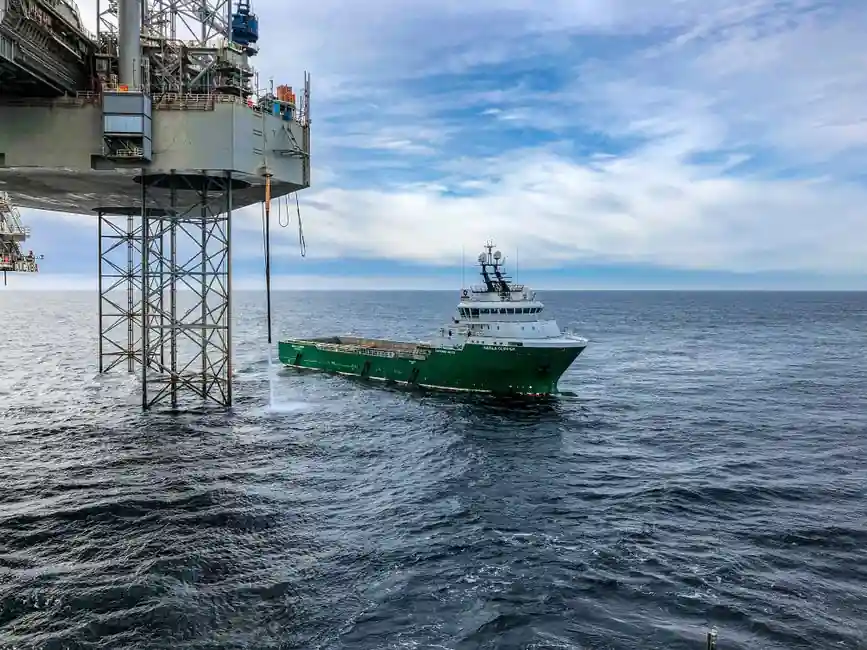
Hot-pressed Si3N4 is the dominant grade specified for marine pump sleeves, mechanical seal faces, and hybrid ceramic bearings, with flexural strength of 700-900 MPa, density 3.2-3.3 g/cm3, and a maximum working temperature of 1300 °C [S2]. Gas-pressure-sintered Si3N4 (GPSN) sits one notch below on strength (700 MPa, 1100 °C cap) but is the more common choice for larger geometry blocks where press-die cost rules out HPSN [S2][S6].
Marine duty is the acid test for any wear couple: continuous saltwater exposure, intermittent dry running, and 50-200 kPa differential pressure across seal faces. Si3N4 passes the corrosion gate cleanly: it is inert to all inorganic acids except hydrofluoric acid, and it does not react with seawater brines within the 4-10 pH window a shipboard pump actually sees [S1][S3][S5].
Material Family: Si3N4 vs SiC vs Alumina for Seawater Service
Si3N4 density of 3.2-3.25 g/cm3 is roughly 60% of a steel bearing ring, a 40% mass saving on a 200 mm shaft that matters for high-rpm propeller-shaft intermediate supports [S2][S3]. Compared with silicon carbide, Si3N4 has lower thermal conductivity (15-34 W/m·K vs 90-120 W/m·K for SiC) but a 2-3x higher fracture toughness (6-8 vs 3-4 MPa·m^1/2), which is the real argument in marine duty where impact loading from a rope or debris strike is a documented failure mode [S2][S4].
Silicon nitride is also the standard substrate for hybrid ceramic ball bearings where electrical insulation (volume resistivity 10^14 Ω·cm for HPSN) is needed to defeat shaft-induced eddy currents in electric-driven propulsion [S2][S3].
Sintering Route Comparison: GPSN vs HPSN vs HIP-Si3N4
The three sinter routes are not interchangeable. The data in the table below is straight from the manufacturer datasheets cited at [S2] and [S3].
GPSN (gas-pressure sintered): density 3.2 g/cm3, flexural strength 700 MPa, hardness 15 GPa, fracture toughness 5-7 MPa·m^1/2, maximum working temperature 1100 °C, thermal conductivity 15-20 W/m·K. This is the production-grade workhorse and the lowest-cost marine option [S2].
HPSN (hot-pressed): density 3.3 g/cm3, flexural strength 900 MPa, hardness 16 GPa, fracture toughness 6-8 MPa·m^1/2, maximum working temperature 1300 °C, thermal conductivity 34 W/m·K. Pressed in a die so geometry is limited, but HPSN is the default for thrust-bearing rings and high-load seal faces [S2][S6].
High-thermal-conductivity Si3N4: density 3.25 g/cm3, flexural strength 600-800 MPa, hardness 15 GPa, fracture toughness 6-7 MPa·m^1/2, maximum working temperature 1100 °C. Used where the engineer needs a thermal conductivity closer to 80 W/m·K to pull frictional heat out of a starved-lubrication seal face [S2].
For the marine buyer the rule is simple: specify HPSN or HIP-Si3N4 for any part smaller than roughly 200 mm that sees Hertzian contact stress above 1.5 GPa (hybrid bearings, thrust pads), and specify GPSN for housings, sleeves, and large structural blocks where you need 100 mm+ dimensions at lower unit cost [S2][S4][S6].
Corrosion Envelope and Chemistry Limits in Seawater
Si3N4 is functionally inert in seawater. The exception list is short and well-defined: hydrofluoric acid attacks the Si-N bond, and concentrated hot caustic (>30% NaOH above 200 °C) will etch the surface over time. For ballast, bilge, and cooling-loop chemistry, Si3N4 holds without coating [S1][S3][S5].
Operating temperature window: continuous service up to 1100 °C in air for GPSN, 1300 °C for HPSN, with no oxidation-driven weight gain below 1200 °C per the manufacturer data [S2][S3]. Thermal shock resistance is a standout: Si3N4 crucible stock survives heating to over 1000 °C followed by sharp water quench without chipping, which translates directly to marine seal faces that see cold-water ingress on startup [S3].
Thermal expansion coefficient sits at 3.1-3.4 x 10^-6/K, very close to that of ductile cast iron and silicon carbide, which is why Si3N4-SiC or Si3N4-steel shrink-fit assemblies survive thermal cycling without galling the joint [S3][S4].
Where It Is Specified, and Where It Is the Wrong Choice
Si3N4 ceramic is commonly used for pump sleeves, mechanical seal rings, and bearings, where its wear and corrosion resistance are advantageous [S2][S3]. Chemical-machinery and food-processing marine auxiliaries (e.g., seawater-cooled heat exchangers in fish-processing ships) also use Si3N4 because the material is non-wetting to common process fluids and does not contaminate product [S9].
Si3N4 is the wrong call for: large flat plates over 300 mm where the press-die cost of HPSN becomes prohibitive, structural frames where ZrO2 or SiC composite would be cheaper per stiffness unit, and any application where a defined coefficient of friction above 0.3 is required (Si3N4 runs at 0.15 unlubricated, so it is not a friction-material) [S4]. For structural alumina blocks where the duty is non-impact and the budget is tight, alumina ceramic remains the better pick; see the alumina-grade spec map for the trade-off [S2].
Marine-Spec Component Geometry and Tolerance

Standard Si3N4 marine parts are produced in the 0.5 mm to 100 mm dimensional envelope, with surface roughness down to 0.1 µm achievable on polished seal faces and U-grooved blocks [S4]. Machining services typically include cutting, punching, and moulding, and tolerances below ±0.01 mm are routine on small-dimension bearing balls [S4].
Bending strength above 750 MPa and dielectric strength of 18-20 kV/mm are quoted for a typical Si3N4 structural block rated to a 1400-1650 °C working envelope in industrial-heater service, but the same stock is the input material for marine pump sleeves where the design stress is held below 400 MPa to keep the safety factor above 2x on the Weibull modulus of 12-15 [S3][S4].
Procurement and Supply Reality (2026)
Standard Si3N4 marine components are quoted at 30-day delivery with 1 USD-class unit pricing on small lots and 1,000,000-piece monthly supply ability from major Chinese Si3N4 suppliers, with carton or pallet packaging and FOB terms [S9]. For buyers sourcing ceramic bearing balls and seal rings for shipboard pumps, the price gap between GPSN and HPSN is typically 2-4x per kg, and that gap is the dominant lever in total cost of ownership.
Quality reference for procurement audits: ISO 9001:2015 / GB/T 19001-2016 certification is the baseline cited by the Chinese marine-ceramic OEM set, with material certification per batch and traceability to the sintering lot [S10]. Buyers should require a Weibull modulus report, a fracture-toughness test per ASTM C1421, and a HIP-cycle record if the service case is dynamic-loaded (per ISO 26602 for ceramic rolling bearing balls).
Cross-Reference to Adjacent Spec Maps

For the electric-propulsion and hybrid-bearing angle, the silicon-nitride substrate spec map and the silicon-nitride automotive spec map cover the electronics and driveline duty cycles that overlap with marine hybrid propulsion. The silicon nitride selection for automotive manufacturing spec map is a useful cross-read because hybrid marine drives share the same HPSN vs GPSN decision tree, and the silicon nitride ceramic for electronics selection specs and 2026 substrate trade-offs page covers the substrate thermal-conductivity story that is relevant to insulated marine propulsion shafts. [S6]
For shipboard process systems outside the wear-and-seal envelope (e.g., electric ball valve pros, cons, and spec boundaries for B2B buyers), Si3N4 trim is one option among several; the valve spec map covers the actuator and body-side decision tree that a marine buyer will run in parallel.
Track for the next buying cycle: (1) any new HPSN or HIP-Si3N4 grade with Weibull modulus above 20 and fracture toughness above 9 MPa·m^1/2, which would push Si3N4 into larger marine structural parts currently locked to GPSN, and (2) marine-class certification updates for Si3N4 hybrid bearings under the latest ISO 26602 and any DNV/ABS-type approval listings for Si3N4 pump-sleeve assemblies on LNG-fuelled vessels [S1][S2][S3][S9].