
Single-wall stainless spiral duct is a single lockseam helically wound shell, the default spec for low- to medium-pressure HVAC where external insulation wrap is acceptable. Double-wall stainless spiral duct is two concentric spiral lockseam pipes separated by factory-installed fiberglass insulation (commonly 1 in, 2 in, or 3 in), and it carries a straight-section material cost roughly 3x single-wall per the HVAC trade [S6].
Both constructions share the same round-spiral airflow advantage over rectangular duct, including lower corner friction loss, longer unsupported runs, and fewer joints, but the inner/outer concentric geometry of double-wall is what unlocks factory-controlled thermal and acoustic performance. Material options typically include galvanized steel, stainless steel (often 304/316 grades), aluminized steel, aluminum, and PCD-coated steel for corrosive or hygiene-sensitive service.
Construction Details and Materials
Single-wall spiral duct is a single sheet, helically wound into a round pipe with a lockseam or grooved seam; the seam is the structural member and the wall is the pressure boundary. Double-wall spiral duct is fabricated as two concentric spiral lockseam shells, an outer pressure shell and an inner liner, with insulation sandwiched between them [S2].
McGill AirFlow ships double-wall round duct in three outer-shell constructions: spiral lockseam, spiral lockseam with a standing rib, and longitudinal seam, with double-wall flat oval also available in spiral lockseam and longitudinal seam [S2]. Standard insulation is fiberglass; ACOUSTI-LINE coated fiberglass is offered for erosion and microbial resistance, and a perforated metal inner liner is the acoustic default while fittings typically use a solid metal inner liner [S2]. TCG publishes the same construction envelope in stainless steel, galvanized, galvanneal, aluminum, and PCD with 1 in (0.27 Btu/hr·ft²·°F), 2 in (0.13), and 3 in (0.09) insulation grades [S3].
Acoustic and Thermal Performance Numbers
Double-wall reduces radiated noise by 25 dB or more versus fiberglass duct board when using TCG's 1 in insulation build, per the manufacturer's published insertion-loss data [S3]. Spiral Manufacturing's Sonic XP duct liner (Knauf) used inside dual-wall pipe is rated to 6000 fpm air velocity per ASTM C 1071 and 250°F service temperature per ASTM C 411, with anti-microbial surface treatment per ASTM C 1338 / G21 and non-corrosive per ASTM C 665 [S1].
Mineral wool insulation upgrades raise the dual-wall service ceiling to 1000°F for hot-gas or industrial exhaust, per Spiral Manufacturing's published high-temperature dual-wall offering [S1]. Single-wall spiral carries no factory acoustic or thermal rating; any noise or R-value is supplied by external wrap or by an internal duct liner such as Johns Manville Spiracoustic Plus, which is pre-kerfed and Permacoate-coated to fit round spiral interiors down to 6 in diameter [S5].
Leakage, Erosion, and Hygiene
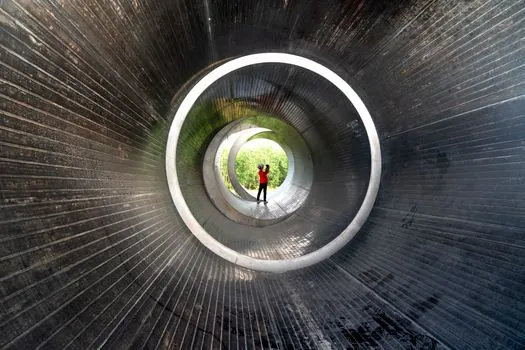
Double-wall spiral locks the insulation behind a metal inner liner, eliminating on-site wrap labor and four common failure modes: jobsite damage, wrap errors, in-service erosion from turbulent high-pressure airflow, and condensation that feeds mold [S1][S3]. The inner-liner geometry also keeps fiberglass out of the airstream, which is why McGill positions the product for hospitals, laboratories, food and pharmaceutical plants, and corrosive industrial areas [S2].
Single-wall spiral depends on the slip-joint or flange connection class for leakage class, and any insulation is added externally where it is exposed to damage and condensation. Where the duct conveys cool air through a warm plenum, external wrap on single-wall must be continuous vapor barrier; any gap becomes a condensation site, while factory-installed insulation inside double-wall has no such vulnerability [S1].
Pressure Rating, Joining, and Standards
Round spiral lockseam duct is the higher-pressure branch of the family; rectangular ductwork uses different gauge tables and is not directly pressure-comparable. Dual-wall spiral retains the same male/female slip-joint geometry as single-wall, with the inner-liner connectors extended to mate inner liners before the outer shells engage, allowing the same installation crew workflow in light-commercial service [S3]. For higher-pressure and larger-diameter runs, both constructions shift to flanged connections; Spiral Manufacturing and McGill publish flange options on their dual-wall product lines [S1][S2].
SMACNA is the governing fabrication standard for HVAC duct construction in North America, and TCG publishes that all of its double-wall spiral and fittings meet or exceed the 3rd Edition 2005 SMACNA standards [S3]. When stainless is specified for food/pharma or corrosive exhaust, grade selection between 304 and 316 (and the closely watched nickel differential versus 201) is a separate decision from wall count; see the 304/316 vs 201 stainless spec discussion for the corrosion-cost trade-off that often drives dual-wall upgrade on stainless builds.
Decision Matrix: When to Specify Which
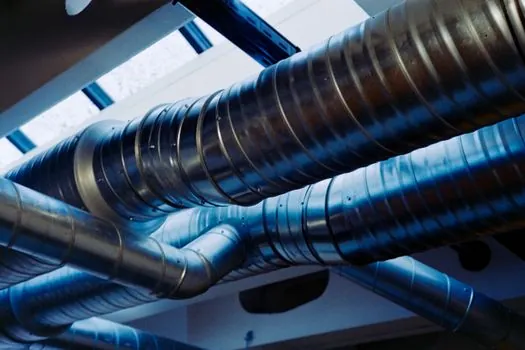
For general comfort HVAC in office, retail, or warehouse space, single-wall spiral duct with external fiberglass wrap, or single-wall with an internal Spiracoustic Plus liner, is the cost-rational default [S5]. Trade feedback consistently flags double-wall as roughly 3x the cost of single-wall on a per-straight-foot basis, with fittings pushing the multiplier higher because of the dual male/female inner-and-outer jointing [S6].
Spec double-wall when any of the following are written into the project: (a) hygienic or cleanroom service where insulation cannot be exposed (food, pharma, semiconductor); (b) acoustic-critical rooms such as call centers, help desks, or hospitals where 25 dB+ attenuation is needed; (c) high-pressure or high-velocity (to 6000 fpm) systems where erosion of bare fiberglass is a real failure mode; (d) high-temperature exhaust to 1000°F with mineral wool; (e) architecturally exposed duct where a clean outer shell is desired over external wrap [S1][S2][S3]. For budget-constrained retrofit or non-critical exhaust, a single-wall spiral with a kerfed internal liner usually wins the cost/performance equation [S5].
Limitations and Failure Modes to Watch
Double-wall spiral's three known weaknesses are weight, diameter growth, and fitting cost: each fitting becomes a multi-piece inner/outer assembly, so a system with many elbows and branches can see multipliers well above 3x even before stainless upgrade is applied [S6]. Johns Manville's product manager Cassie Todtenhagen has publicly framed double-wall as "expensive and time consuming…welding the inner and outer metal pieces together and very heavy," and pitched the Spiracoustic Plus internal liner as a faster, lighter single-wall alternative where the spec allows it [S5].
Single-wall spiral is not without failure modes either: external wrap is jobsite-vulnerable, any breach in the vapor barrier becomes a condensation point, and acoustic performance is entirely dependent on wrap density or an internal liner that must be correctly kerfed and coated. For projects on the boundary (mid-pressure, moderate acoustic need, tight budget), the design choice is rarely "either/or" and more often a hybrid where the first 20–40 ft off the air handler is double-wall for attenuation and the bulk run is single-wall with internal liner [S1][S5].
Sourcing and Specification Checklist
Confirm three things before releasing a double-wall PO: insulation thickness and density (1 in at 1.5 PCF or 2.0 PCF is the common baseline, with 2 in and 3 in available for tighter U-values) [S1][S3]; inner-liner type (perforated acoustic vs solid thermal) and whether the insulation is coated with an anti-microbial, anti-erosion acrylic; and the SMACNA edition plus leakage class being met [S2][S3]. For stainless, lock the alloy (304 vs 316) and finish (2B, BA, or grain), and confirm whether the outer shell, inner liner, or both are upgraded from the galvanized default [S2].
Trackable signals for the next spec cycle: whether SMACNA publishes a revised leakage-class table that tightens single-wall targets (which would push more projects toward factory-sealed double-wall), and whether more OEM stocking programs add Spiracoustic Plus-kerfed single-wall spiral as a stocked SKU in 8 in–24 in diameters, since that is the size band most often specified for retrofit and light-commercial. Both moves would compress the cost gap that currently puts double-wall at roughly 3x single-wall on a per-foot basis [S5][S6].
Detailed specification references: single girder crane.