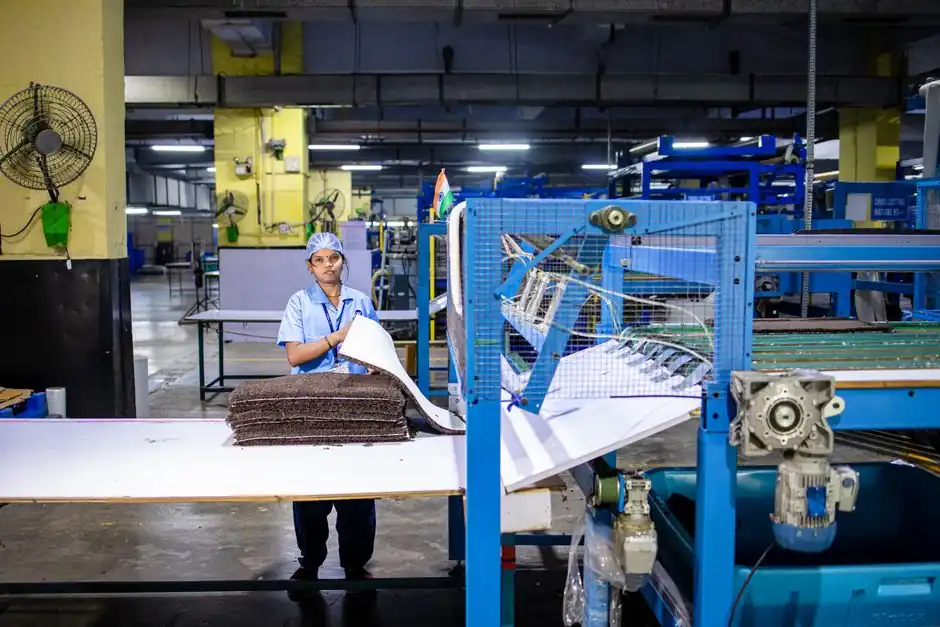
The hard fact on a conveyor sorting line: the sorter almost never limits throughput. Induction does. The Fives SOLI-Modular paired singulator and induction line is rated to feed an automatic sorter at more than 4,000 parcels per hour, given singulated, gapped, and successfully read items at the merge [S1][S2].
The 4,000 pph figure is the most defensible data point on a modern small-parcel sorting system. The body of evidence in 2026 from integrator pages and engineering write-ups keeps saying the same thing: rated sorter speeds assume the induction stage has already done its job, and the rated speed on the spec sheet is rarely the realised speed on the floor [S2][S3].
Why induction is the bottleneck on a conveyor line
The singulator breaks a bulk stream into single file, gapped parcels; the induction conveyor then times each parcel into the sorter's carrier pitch [S3]. Where the singulator is undersized or the gap set too tight, parcels arrive in pairs or with closure under the scanner read window, and the sorter's rated speed is never reached even though the loop itself is running flat out [S2].
Skewed-roller merges, multi-speed belts, and cascade release from accumulation zones are the three control techniques that re-establish a single file on the way in, per Cisco-Eagle's 2023 reference, which is still the field standard for the singulation step in 2026 [S3]. Cross-belt sorters sit at the top of the rate band, and they are the only sorter family where induction is harder than divert, because each carrier must receive exactly one parcel inside a fixed pitch window [S2].
Singulator-induction versus sorter-only throughput
The numbers line up cleanly when the system is sized as three stages rather than one. SOLI-Modular publishes a paired singulator-plus-induction rate of more than 4,000 parcels per hour into an automatic sorter, with the singulator effectively setting the floor for the loop [S1]. Cross-belt sorters are described as "generally the highest throughput option" by LVP Automation in 2026, with their realised rate gated by the induction merge ahead of them [S2].
The engineering point: the conveyor sorting line is only as fast as the slowest stage, and induction is almost always it. A pusher or pop-up diverter on a plain belt may only move "a handful of diverts an hour" relative to a loop sorter at several thousand per hour, and the same loop sorter drops to pusher-class throughput the moment the induction merge feeds it doubles [S2].
Selection criteria that actually move the rate
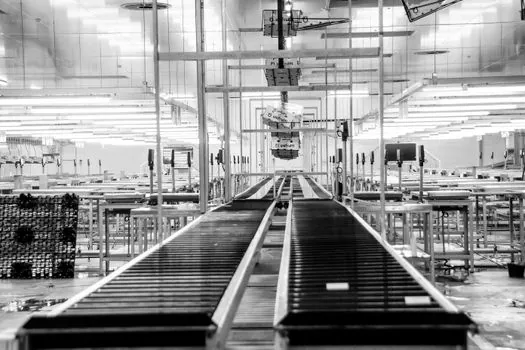
Three criteria separate a build that hits 4,000 pph from one that does not. First, peak rate measured in a realistic window, not averaged across a shift, because the induction merge is the part that fails first at peak rather than at mean throughput [S2]. Second, parcel dimensional range at the merge: skewed-roller singulation is fine for regular cartons but fails on flats and polybags, which is why high-rate singulators like the SOLI-Modular are designed specifically to handle the long-tail mix [S3][S1].
Third, scan and read reliability: every parcel that passes the scanner unread takes a slot on the loop and silently halves the local rate, so vision-and-barcode overlap at the induction conveyor is now baseline rather than optional [S2]. For builds that mix small, light, and irregular items, cross-belt carriers are the better discharge sink because they drive the parcel off rather than tip it, and that is the geometry used in most 4,000 pph-class small-parcel hubs [S2].
Who the singulator-induction spec is for, and who it is not for
The spec is for operations with parcel volumes in the low thousands per hour per sorter, mixed product shapes, and a destination count that justifies a loop rather than a pusher [S2]. It is also for sites that already have a Warehouse Control System, because the merge timing and the WCS need to talk to each other or the induction rate collapses regardless of hardware.
The spec is not for low-rate operations with a handful of lanes, where a pop-up or pusher on a flat belt is the cheaper and more reliable answer [S2]. It is also not for sticky, very light, or awkwardly shaped items that will not slide off a tilting tray, where the discharge method itself must be re-chosen even if the induction rate is technically achievable [S2].
Limits and failure modes on real lines
The three failure modes that show up in 2026 integrator write-ups are predictable. Side-by-side drift past a merge point, where two cartons ride the conveyor sorting line together and the singulator never gets a chance to separate them [S3]. Jumbled flow from running a belt too fast, which is the most common way an integrator burns the rated rate on a new install [S3]. And read failures at the scanner, which leave the sorter with a parcel it cannot divert and the only safe action is to discharge it to exception, costing one slot per failure [S2].
For related material-flow decision context, the comparison in Channel vs Coreless Induction Furnace: Design, Application, Trade-Offs follows the same criteria-based structure that applies to sorter type selection, and the Chain Conveyor vs Telescopic Fork on Pallet Stacker Cranes article covers a related throughput-versus-gate question upstream of the sorter.
Standards, sourcing, and how to verify a rated rate
No ISO or IEC standard governs induction throughput directly; the practice is to verify the rated sorter speed with a measured induction rate, not the loop speed, and to confirm the WCS supports per-carrier tracking at the same pitch the induction merge is feeding [S2]. Sorter OEMs publish paired-singulator-plus-induction rates as a single number (4,000 pph is the Fives SOLI-Modular figure) precisely because the two stages cannot be quoted separately in the field [S1].
For engineers specifying a new build, the verification path is straightforward: request the induction rate with item mix, request the read-rate at the scanner with the same mix, and request the divert accuracy with the same mix. The lowest of the three is the real line rate, and on most 2026-vintage sorting system projects that lowest number is the induction rate, not the sorter's loop speed [S2][S3].
Watch through 2026-Q4 for integrators publishing paired singulator-and-induction curves for the long-tail of polybags and flats, which is the one product class where SOLI-Modular-class hardware still loses rate to side-by-side drift [S3]. Also watch for Warehouse Control System releases that expose induction-pitch tuning as a per-line parameter, since that is the lever most likely to close the gap between the rated 4,000 pph and realised throughput on the floor [S2].
For component-level specifications, see induction furnace.