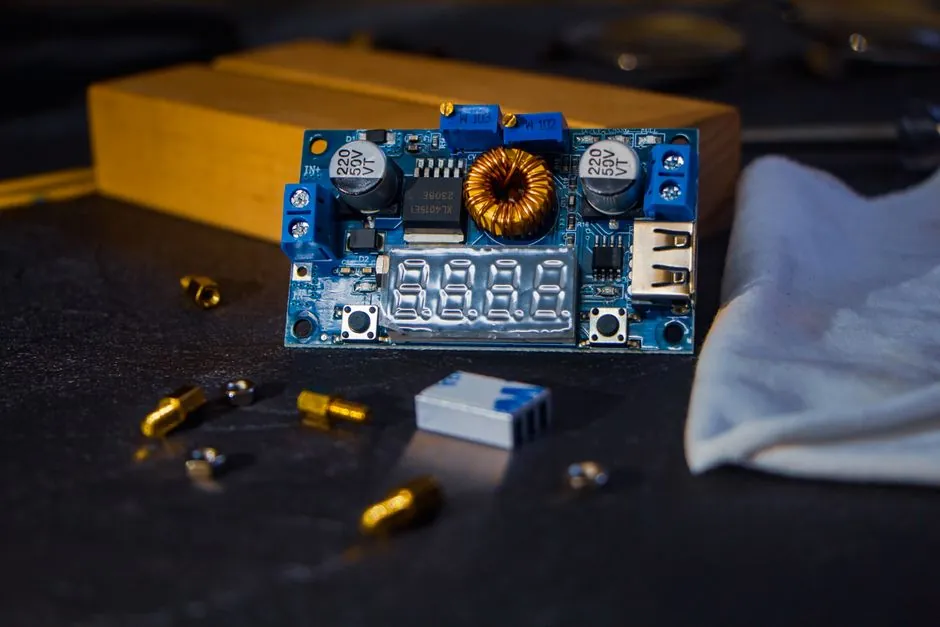
A switching power supply with a 2 A steady-state AC input and a 25.65 A, 2-3 ms cold-start inrush pulse is correctly protected by a 4 A time-delay fuse, because the fuse's melting I2t at the inrush pulse width is roughly an order of magnitude above the pulse energy [S3]. The derating formula widely applied to DC-DC input fuses sets rated current at 1.5 to 2 times the converter's maximum continuous current, multiplied by a 0.75 to 0.9 temperature derating factor when ambient exceeds 25 C [S5]. For a 24 V DC output stage sized at 2.5 A, line-side fusing at 3 to 4 A slow-blow covers inrush while still opening on sustained overload [S4].
The I2t (ampere-squared-seconds) value is the integral of current squared over time, and it is the single number that determines whether a fuse survives a transient surge [S6]. Two fuses with identical amp rating can behave very differently: a fast-acting type F may open at roughly 30 A for a 10 ms pulse, while a slow-blow type T holds well past 70 A over the same window [S3]. That ratio is why every major DC power supply maker's application note pairs a modest amp rating with an explicit "time delay" or "T" label.
What the inrush pulse actually looks like on a SMPS input
Most modern AC-DC switching power supply modules include an NTC thermistor in series with the line that starts at high resistance when cold and drops once self-heated, limiting the bulk of the inrush to a few milliseconds [S3]. A 115 V input measured at the worst-case voltage peak shows a 25.65 A pulse lasting 2-3 ms at room-temperature cold start, and a sub-200 microsecond spike from X-capacitor charging rides on top of it but carries negligible energy [S3]. Manufacturers usually exclude the X-cap spike from the inrush spec because it will not trip a breaker or open a fuse [S3]. For a typical 2 A steady-state input, the 25.65 A pulse represents roughly 12.8 times the running current, a ratio that no fast-acting fuse of similar amp rating can survive.
Why I2t is the right number to compare, not peak amps
A fuse's melting I2t is the energy required to bring the element to its melting point, and the higher the value, the longer the fuse holds before opening at a given current [S6]. When a short transient overcurrent is expected, the fuse's melting I2t must exceed the pulse I2t (current squared times pulse width) by a comfortable margin, typically a factor of 3 or more for line-side input fusing [S5]. For a fuse to handle inrush current, it needs a sufficiently high I²t rating, which means using a time-delay or slow-blow type [S1]. Working in I2t instead of peak amps lets the engineer match fuse to pulse without depending on the exact time-current curve shape.
Voltage, current, and derating rules of thumb
Fuse voltage rating must equal or exceed the maximum operating voltage of the power supply, per the Advanced Energy selection guide AN-G005 [S2]. The fuse current rating should sit at 1.5 to 2 times the circuit's maximum continuous current, then drop by a 0.75 to 0.9 derating factor once the local ambient climbs above 25 C [S5]. CTC's worked example for a 19.05 A calculated minimum lands on the next standard rating, a 20 A fuse, rather than rounding down [S5]. Voltage derating follows the same conservatism: a 12 V system typically takes a 32 V-rated fuse to absorb transients and pass dielectric withstand [S5]. The industrial UPS community applies the same envelope, since the charger input sees identical inrush behavior from a DC bus capacitor bank.
Fast-acting vs time-delay: a side-by-side at 10 ms
For a 4 A fuse carrying a 25.65 A, 3 ms cold-start pulse, the time-delay type T needs roughly 70 A at 10 ms to open, leaving about a 2.7 times margin in I2t space, while the fast-acting type F opens near 30 A, which is inside the inrush envelope and will nuisance-blow on every cold start [S3]. Sizing a 24 V DC supply at 2.5 A output, the 125 to 150 percent rule yields a 3-4 A slow-blow, which sits in the same family of T-rated parts [S4]. Across the 1.5-2x current rule, the 0.75-0.9 temperature derating, and the I2t margin, the three selection criteria consistently point at the same part: a time-delay fuse one or two standard steps above running current [S5].
Where the slow-blow choice breaks down
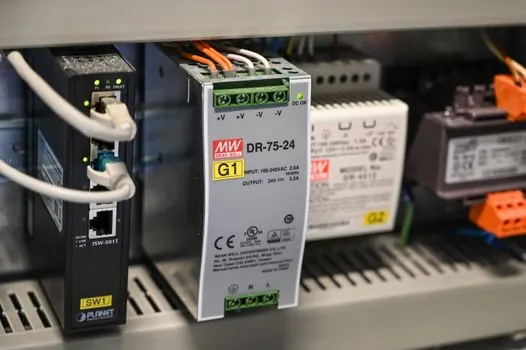
Time-delay fuses are not a free lunch. They hold through longer overloads than a fast-acting fuse of the same rating, so a sustained 200 percent overload can sit on the circuit for seconds before the fuse opens [S6]. For circuits where the load itself is sensitive or where a fire risk escalates quickly, the slower curve trades nuisance-trip avoidance for a higher let-through energy during faults. The voltage rating also has to be respected on DC, because DC interrupt ratings are typically lower than AC at the same fuse, and a 250 VAC part may not clear a 125 V DC fault [S2]. On high-inrush capacitor banks beyond a few thousand microfarads, even a T-rated fuse can struggle, and an inrush limiter or PTC thermistor is added in parallel with the fuse path.
Standards and sourcing to anchor the spec
The Advanced Energy SL Power white paper AN-G005 codifies the voltage-equals-or-exceeds-max rule and walks through the steady-state and inrush calculations [S2]. The Littlefuse time-current curves cited in the TDK-Lambda application blog are the public reference for the 70 A at 10 ms number on a 4 A T fuse [S3]. A fuse selection on the line side of a converter should always be cross-checked against the converter's own datasheet inrush spec, and the derating recomputed for the actual enclosure ambient rather than the 25 C lab condition [S5].
For a high voltage tester or any capacitive-load instrument, the same I2t arithmetic applies: take the worst-case inrush I2t, multiply by a 3 times margin, and pick the smallest standard T-rated fuse that clears that bar. Track the converter's published inrush spec revision date and the actual X-capacitor value, since either one shifts the cold-start pulse energy enough to push the fuse selection up one standard step.
See also our earlier report, How heat crosses the crucible wall in a fuel-fired crucible furnace.