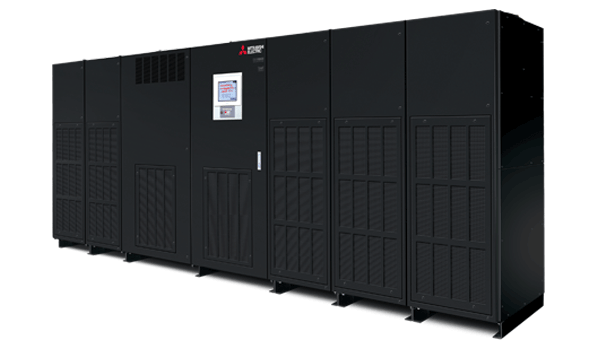
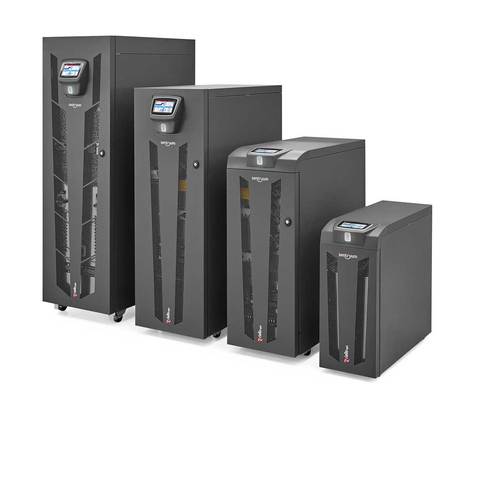
An industrial uninterruptible power supply (UPS) holds up the power feed to critical equipment when the mains supply sags, surges or fails, bridging the gap until the load is either restored, transferred to a generator, or safely shut down. Unlike a desktop UPS, an industrial UPS is engineered for continuous duty in harsh thermal, vibration and electrical-noise environments, and is built around stored energy in batteries or ultracapacitors plus power-electronic conversion stages.
Industrial UPS systems split into two broad families: three-phase and single-phase AC UPS that back up the line voltage (230/400 V) for whole machines, control rooms and process loads, and DIN-rail DC UPS that buffer the 24 V DC control bus feeding PLCs, I/O and instrumentation. Both are classified and tested under the same parent standard series, IEC 62040.
This guide is written for industrial purchasing engineers and design engineers. It covers six chapters from what a UPS is, through the VFI/VI/VFD topology classification, conversion and battery technologies, sizing and runtime, and spec-sheet decoding, to a selection decision sequence, with seven selection FAQs and manufacturer comparisons. All parameters reference the IEC/EN 62040 series, UL 1778, and published manufacturer datasheets.
Chapter 1 / 06
What is an Industrial UPS
An uninterruptible power supply is a device that supplies stored electrical energy to a load when the normal input source is interrupted or falls outside acceptable limits. The defining property is the word "uninterruptible": where a standby generator may need 5 to 15 seconds to start and accept load, a UPS bridges that gap from stored energy with a transfer time measured in milliseconds, or no transfer at all. In a typical critical installation the UPS rides through short dips and momentary outages on its own, and hands over to a diesel or gas generator only when the outage extends beyond the battery autonomy.
An industrial UPS differs from a consumer or IT-closet UPS in duty rather than principle. It is specified for continuous operation, wide ambient temperature (often -10 to +40 degrees Celsius and beyond with derating), high short-circuit and inrush tolerance, electrical-noise immunity, and a service life of 10 to 15 years for the power electronics. It is frequently installed in a process plant, substation, rail trackside cabinet, marine vessel or oil and gas facility, where a loss of control power can mean an unsafe shutdown, lost batch, or a safety-instrumented trip. For that reason industrial UPS selection treats availability and serviceability as first-class requirements alongside raw capacity.
Functionally, every static UPS contains four building blocks. A rectifier or charger converts incoming AC to DC and keeps the battery charged. A battery or other energy store holds the reserve. An inverter converts DC back to a regulated AC output (in AC UPS) or a DC-DC stage holds the output bus (in DC UPS). A static bypass switch can transfer the load directly to raw mains for maintenance or on inverter overload. How these blocks are wired together, and whether the inverter runs continuously or only on demand, is exactly what the topology classification in Chapter 2 captures.
The history of the static UPS tracks the history of power electronics. Early systems in the 1960s used rotary motor-generator sets and later thyristor (SCR) rectifiers and inverters with bulky transformers. The commercial arrival of the insulated-gate bipolar transistor (IGBT) in the early 1980s and the maturation of higher-power, rugged devices through the 1990s allowed transformerless, high-frequency PWM inverters that cut size, weight and losses dramatically. More recently, lithium iron phosphate batteries, wide-bandgap semiconductors and high-efficiency operating modes have pushed double-conversion efficiency from the historic 90 to 92 percent range up toward 97 percent, and into the 98 to 99 percent band in advanced energy-saving modes.
In scale terms, industrial UPS spans an enormous range. A single DIN-rail DC UPS module may buffer a few amps at 24 V, a handful of watts of control power. A single-phase tower UPS covers a few hundred VA to perhaps 20 kVA. Three-phase units run from roughly 10 kVA to several hundred kVA in a single cabinet, and parallel or modular systems reach into the megawatts for data centers, utilities and large process plants. There is no single "industrial UPS": the engineering task is matching the duty, the criticality and the environment to a specific topology, energy store and capacity.
Chapter 2 / 06
Topologies and IEC 62040-3 Classification
The international standard IEC/EN 62040-3 classifies static UPS by a three-part code that captures how independent the output is from the input, the output waveform, and the dynamic performance. The three commercial topologies map onto the three output-dependency codes: VFI (online double conversion), VI (line-interactive), and VFD (offline/standby). Understanding this code is the single most useful skill in UPS selection, because the marketing names "online", "line-interactive" and "offline" all trace back to it. The table below compares the three families.
VFI, online double conversion is the workhorse of industrial and critical power. Incoming AC is fully rectified to DC, then re-inverted to a fresh, regulated AC output, so the load is permanently fed from the inverter and never sees the raw mains except during a deliberate bypass. Because the output is synthesised from DC, input voltage sags, swells, frequency drift and waveform distortion are all filtered out, and on a mains failure the transfer time is effectively zero: the inverter simply keeps running from the battery. The cost is the continuous double-conversion loss, historically around 8 to 10 percent and now often under 4 percent in modern transformerless designs.
VI, line-interactive normally passes filtered mains to the load and uses an automatic voltage regulator (AVR), commonly a tapped autotransformer or buck-boost stage, to correct moderate over- and under-voltage without drawing on the battery. The inverter runs only when the mains fails, giving a short transfer of a few milliseconds. Line-interactive units are more efficient than double conversion because they avoid the continuous DC conversion, and they protect well against the most common disturbances (brownouts and sags), but they do not regenerate the waveform or correct frequency, so they are not classed VFI.
VFD, offline or standby is the simplest and least expensive. Under normal conditions raw mains passes straight to the load through a filter, and the inverter and battery sit idle. Only when the input goes out of tolerance does a transfer switch connect the inverter, with a transfer time long enough (5 to 20 ms) that only equipment with its own internal hold-up tolerates it well. Offline units are common in small point-of-use roles but are rarely used for genuine industrial control loads.
The second and third parts of the IEC 62040-3 code refine the picture. The waveform code is two letters: the first for normal mode, the second for stored-energy (battery) mode, where S is sinusoidal, X is sinusoidal under linear load only, and Y is non-sinusoidal. SS therefore means a clean sine wave in both modes. The final three digits grade dynamic output performance for an output-mode change, a linear load step and a non-linear load step, on a scale where 1 is the tightest tolerance band. A unit declared VFI-SS-111 is the top class: fully independent output, sinusoidal in both modes, and best-in-class dynamic response. The label only carries meaning when the full code is quoted, so always ask the vendor for the complete classification rather than just the word "online".
Chapter 3 / 06
Conversion and Battery Technologies
Two technology choices dominate the engineering of a UPS: the semiconductor conversion stage and the energy-storage chemistry. The conversion stage sets efficiency, size and power quality; the energy store sets autonomy, footprint, lifetime and maintenance. They are largely independent, so a given topology can be paired with different batteries depending on the duty.
On the conversion side, modern AC UPS are built around IGBT-based, high-frequency PWM rectifiers and inverters. A controlled IGBT rectifier draws near-sinusoidal current at the input, holding input current distortion (THDi) at or below 5 percent and input power factor above 0.99, which means the UPS no longer pollutes the upstream supply or oversizes the generator the way old thyristor front ends did. Transformerless designs remove the heavy 50/60 Hz output transformer, cutting weight and loss; transformer-based designs are still chosen where galvanic isolation or a very high short-circuit contribution is required. The trade-off across operating modes is summarised below.
Operating mode
Typical efficiency
Transfer on fault
Output power quality
Best for
Double conversion (VFI)
94 to 97%
0 ms
Highest, fully regenerated
Sensitive process and critical loads
Classic ECO / standby bypass
98 to 99%
2 to 10 ms
Reduced, raw mains in normal mode
Tolerant loads, energy saving
High-efficiency hybrid mode
98.5 to 99%
near 0 ms
Near double-conversion
Data center, large process plant
Classic ECO mode lets the unit feed the load through the static bypass under good mains, lifting efficiency toward 99 percent, but it drops the effective protection to VI behaviour with a short transfer on failure. Newer high-efficiency modes, sold under names such as eConversion (Schneider), S-ECO (Huawei) and Dynamic Online (Vertiv), keep the inverter in standby with active filtering engaged, so they recover most of the energy saving while preserving near double-conversion power quality and near-zero transfer. For tolerant loads the saving is worthwhile; for safety-critical control, full VFI or a certified high-efficiency mode is the safe default.
On the energy-storage side, the long-standing default is the valve-regulated lead-acid (VRLA) battery, an absorbed-glass-mat or gel sealed block that needs no electrolyte top-up. VRLA is cheap and proven but bulky, heavy, and temperature-sensitive: design life is rated around 10 years at the EUROBAT "long life" class but real float life is commonly 3 to 6 years, and roughly halves for every 10 degrees Celsius of sustained temperature rise above the 20 to 25 degrees Celsius reference. Lithium iron phosphate (LiFePO4) has become the high-performance alternative, offering 8 to 15 year design life, several thousand cycles, a much smaller footprint and weight, faster recharge, and a built-in battery management system (BMS) that monitors cell voltage, temperature and state of charge. The chemistry comparison is below.
Property
VRLA (lead-acid)
LiFePO4 (lithium)
Design life
3 to 10 years
8 to 15 years
Cycle life
200 to 500 cycles
3,000 to 6,000 cycles
Energy density
Lower (large footprint)
Higher (compact, light)
Temperature tolerance
Sensitive, life halves per +10°C
Wider, BMS-managed
Recharge time
6 to 12 h typical
1 to 4 h typical
Up-front cost
Lower
Higher (lower lifecycle cost)
Management
External monitoring
Integrated BMS required
For very short autonomy, a third option exists: ultracapacitor (supercapacitor) storage, used mainly in DIN-rail DC UPS. An ultracapacitor module delivers seconds to a few minutes of hold-up, is maintenance-free, tolerates a wide temperature range, and survives hundreds of thousands of charge cycles. Siemens publishes that its SITOP ultracapacitor modules still hold about 80 percent of rated capacity after 8 years at 50 degrees Celsius ambient. Ultracapacitors suit ride-through and controlled-shutdown duty where minutes, not hours, of backup are needed.
Chapter 4 / 06
Standards, Sizing and Runtime
Industrial UPS sit under a well-defined standards umbrella. The IEC/EN 62040 series is the backbone: part 1 sets general and safety requirements, part 2 covers electromagnetic compatibility (EMC), part 3 defines performance, test methods and the VFI/VI/VFD classification used in Chapter 2, and part 4 addresses environmental aspects. In North America the safety standard is UL 1778. Functional safety, where the UPS forms part of a shutdown or safety-instrumented loop, references IEC 61508 and its safety integrity levels (SIL). The battery installation has its own rules: IEC 62485-2 governs the safety and ventilation of secondary battery installations, while battery selection references IEC 60896 for stationary lead-acid and IEC 62619 for industrial lithium cells.
Sizing begins with the load, not the UPS. List every device, sum the real power in watts (kW) and the apparent power in volt-amps (kVA), and note the worst-case inrush. Add 20 to 25 percent design margin so the system normally runs at roughly 50 to 80 percent of rated capacity, which leaves headroom for growth and keeps the unit in its high-efficiency band. Two limits then apply at once: the kW (real power) rating and the kVA (apparent power) rating, linked by the output power factor. Older UPS were rated at 0.8 output power factor, so a 100 kVA unit delivered only 80 kW; most current units are unity power factor where kVA equals kW. The selection table below shows the logic.
Quantity
Symbol / unit
How to derive it
Real (active) power
kW
Sum of device watts, plus design margin
Apparent power
kVA
kVA = kW / output power factor
Output power factor
0.8 to 1.0
Read from the UPS datasheet
Loading target
50 to 80%
Normal load / rated capacity
Battery autonomy
min or h
Set by ride-through or shutdown need
Runtime, or battery autonomy, is sized separately. A practical estimate is runtime equals usable battery energy divided by load power, where usable energy is the battery amp-hours times nominal voltage times inverter efficiency times the permitted depth of discharge. Because lead-acid capacity falls sharply at high discharge rates (the Peukert effect), a short, high-rate UPS discharge yields fewer effective amp-hours than the 10- or 20-hour rating printed on the block, which is why battery sizing for UPS uses constant-power discharge tables published per block rather than a simple amp-hour division. Typical industrial autonomy targets are 5 to 15 minutes where a generator backs up the site (long enough to start and accept load), and 30 minutes to several hours where no generator exists and the goal is a graceful shutdown or sustained operation.
Two further sizing checks are easy to miss. First, the recharge current adds to the load on the input side: after a deep discharge the charger draws extra current to refill the battery, so the upstream breaker, cabling and any generator must carry load plus recharge. Second, non-linear and motor loads stress the inverter: confirm the crest factor and short-term overload the UPS tolerates, and for motor starting verify the unit can supply the inrush without transferring to bypass or tripping.
Chapter 5 / 06
Key Specification Parameters
A UPS datasheet can list 30 or more lines, but a manageable set of parameters drives almost every selection decision. Each is explained below, grouped as output, input, battery and environment.
Output rating is given as kVA and kW (or A at the rated DC voltage for a DC UPS). Always read both AC numbers and the stated output power factor; a unity-pf unit and a 0.8-pf unit of the same kVA deliver very different real power. Output voltage and frequency regulation (for example plus-or-minus 1 percent voltage, plus-or-minus 0.1 Hz frequency) and the output voltage total harmonic distortion (THDv, typically below 2 to 3 percent on linear load) define how clean the supply is. Overload capability states how long the inverter can deliver, say, 125 percent or 150 percent before transferring to bypass, which matters for motor and transformer inrush.
Transfer time is the time to switch the load between sources. For a true VFI unit this is zero on mains failure (the inverter never stops); the figure that matters is the static-bypass transfer time, often under 4 ms, used during overload or maintenance. For VI and VFD units the mains-to-battery transfer time (2 to 20 ms) is the headline number. Efficiency should be read at the actual expected load point and operating mode, not just the peak figure: double conversion is typically 94 to 97 percent, high-efficiency modes 98 to 99 percent.
Input parameters include the input voltage and frequency window over which the UPS stays online without drawing on the battery (a wider window means fewer needless battery cycles), the input current distortion (THDi, 5 percent or less in modern designs), and input power factor (above 0.99). A clean input keeps the upstream supply and any generator from being oversized.
Battery parameters cover chemistry (VRLA or lithium), nominal DC bus voltage and number of blocks, design life, rated autonomy at the design load, and recharge time. For lithium, the BMS communication and the battery safety certification (for example IEC 62619 and UN 38.3 transport) belong here. Environmental and mechanical parameters include the operating temperature range and derating curve, altitude derating, ingress protection (IP) rating of the enclosure, audible noise, dimensions and weight, and the cooling method. The key spec checklist below collects the load-bearing figures.
Parameter
Typical value / range
Why it matters
Output power factor
0.8 to 1.0
Sets real kW per rated kVA
Double-conversion efficiency
94 to 97%
Drives energy and cooling cost
Output voltage THDv
< 2 to 3%
Cleanliness of supply to load
Input THDi
≤ 5%
Upstream and generator compatibility
Input power factor
> 0.99
Avoids oversizing the source
Static bypass transfer
< 4 ms
Overload and maintenance handover
Overload before bypass
125% / 10 min, 150% / 30 s
Inrush and motor-start tolerance
Operating temperature
0 to +40°C (derate above)
Battery life and capacity derating
Chapter 6 / 06
Selection Decision Factors
To turn the preceding five chapters into a specific model, follow the decision sequence below. Most selection mistakes come not from a single wrong figure but from deciding capacity before the duty and topology are settled. These steps double as a fixed RFQ template.
Define the criticality and duty: Decide first whether the load can tolerate a few-millisecond transfer or needs zero-break power. Safety-instrumented, process-control and most data loads call for VFI online double conversion; tolerant IT and light loads may accept VI line-interactive. This choice precedes everything else.
Choose AC or DC architecture: If only the 24 V control bus must ride through, a DIN-rail DC UPS is smaller, lighter and maintenance-light. If whole machines, motors or a control room must be backed up, an AC UPS is required. Some plants use both: an AC UPS for the room and DC UPS modules in individual cabinets.
Size kW and kVA with margin: Sum real and apparent power, add 20 to 25 percent, and target 50 to 80 percent loading. Confirm the output power factor and the inrush and crest factor the unit tolerates, then pick the rated capacity.
Set the autonomy and battery technology: Decide runtime from the backup strategy (generator ride-through of 5 to 15 minutes, or 30 minutes to hours for shutdown or no-generator sites), then choose VRLA for lowest up-front cost or lithium for longest life, smallest footprint and lowest lifecycle cost. Verify battery-room ventilation per IEC 62485-2.
Confirm standards and certifications: Require the full IEC 62040-3 classification (for example VFI-SS-111), the IEC 62040-1 or UL 1778 safety mark, EMC per IEC 62040-2, any required SIL level per IEC 61508, and sector approvals (marine, rail, hazardous-area) where applicable.
Check the environment and installation: Verify the operating temperature and derating curve against the actual cabinet or room conditions, altitude derating, IP rating, audible noise limit, footprint, weight and cooling. Confirm input breaker and cabling carry load plus recharge current.
Plan communication and monitoring: Specify the monitoring interface (dry contacts, SNMP, Modbus, PROFINET, OPC UA) and remote-shutdown signalling so the UPS integrates with the DCS, SCADA or building management system and can command an orderly shutdown before the battery is exhausted.
Evaluate parallel and redundancy needs: For high availability decide between N+1 redundancy, parallel capacity, or a modular UPS with hot-swappable power modules, and confirm the maker supports the chosen configuration with a tested control scheme.
One dimension that is easy to underweight at purchase but decisive over a 10- to 15-year life is manufacturer serviceability: local spare-parts stock, field service and battery-replacement coverage, firmware support, and the availability of a tested parallel or modular upgrade path. For three-phase AC UPS, established makers include Schneider Electric (APC), Vertiv (Liebert), Eaton, ABB, Riello, Mitsubishi Electric, Huawei and Delta. For DIN-rail 24 V DC UPS, the automation suppliers dominate: Phoenix Contact (QUINT-UPS/24DC/24DC family in 5, 10, 20 and 40 A versions), Siemens (SITOP UPS500S/UPS501S with ultracapacitor storage and battery modules), Puls, Weidmuller and Wago. For heavy-industry, utility and hazardous-area duty, specialists such as AEG Power Solutions, Gutor (Schneider), Borri and Piller are the usual references. All of these maintain service and spare-parts coverage in major industrial markets, which is what makes them defensible choices for long-life projects.
FAQ
What is the difference between an online (VFI) and a line-interactive (VI) industrial UPS?
An online double-conversion UPS (classified VFI under IEC 62040-3) continuously rectifies incoming AC to DC and re-inverts it back to a clean AC output, so the load is permanently fed from the inverter and the transfer time on mains failure is effectively zero. A line-interactive UPS (classified VI) normally passes filtered mains straight to the load and uses an autotransformer or buck-boost AVR to correct moderate voltage swings, switching to battery only on deeper events with a typical transfer time of 2 to 10 ms. VFI gives complete isolation from input voltage and frequency disturbances and is the standard for process control and critical loads; VI is cheaper, runs at higher efficiency, and suits less sensitive equipment.
What does the IEC 62040-3 code VFI-SS-111 mean?
IEC 62040-3 classifies a static UPS with a three-part code. The first part is output dependency: VFI (voltage and frequency independent), VI (voltage independent) or VFD (voltage and frequency dependent). The second part is the output voltage waveform in normal and stored-energy mode, written as two letters where S means sinusoidal, so SS means sinusoidal in both modes. The third part is three digits describing dynamic output performance during mode changes and linear/non-linear load steps, where 1 is the most stringent class. VFI-SS-111 is therefore the highest classification: independent output, sinusoidal waveform in both modes, and best-in-class dynamic response. It is achieved only by true online double-conversion designs.
How do I size an industrial UPS in kVA and kW?
Size both the apparent power (kVA) and the real power (kW), because modern UPS units are limited by whichever is reached first. Start from the connected load: sum the real power draw in watts, add 20 to 25 percent headroom for future expansion and so the unit normally runs at 50 to 80 percent of rated capacity. Convert to apparent power with kVA = kW / power factor. Older UPS were rated at 0.8 pf output, so a 100 kVA unit delivered only 80 kW; most current models are unity power factor (kVA equals kW). Always check the output power factor on the datasheet, verify the inrush and crest factor the UPS tolerates for motor or switch-mode loads, and confirm the input breaker and cable can carry the recharge current on top of the load.
How long do industrial UPS batteries last and when should they be replaced?
Valve-regulated lead-acid (VRLA) blocks carry a nominal design life of about 10 years at the EUROBAT classification level, but real float life is typically 3 to 6 years and halves for roughly every 10 degrees Celsius above the 20 to 25 degrees Celsius reference temperature. Lithium iron phosphate (LiFePO4) packs are rated for 8 to 15 years and several thousand cycles, with an integrated battery management system. Replace a VRLA string when a discharge or impedance test shows capacity has fallen below 80 percent of rated, when individual block float voltages diverge, or when case swelling or terminal corrosion appears. Always replace a whole string together, never mix old and new blocks, and recommission with a timed discharge test.
What is a DIN-rail DC UPS and when is it used instead of an AC UPS?
A DIN-rail DC UPS buffers the 24 V DC control bus directly rather than the 230/400 V AC supply. It sits between a switch-mode power supply and the PLC, I/O, HMI and instrumentation, and on input loss it draws from a battery module or an ultracapacitor to hold 24 V for a defined buffer time, from a few seconds for a controlled shutdown up to hours. Real examples include the Phoenix Contact QUINT-UPS/24DC/24DC family in 5, 10, 20 and 40 A versions with IQ battery management, and the Siemens SITOP UPS500S with maintenance-free ultracapacitor storage. Use a DC UPS when only the control electronics must ride through a brief dip or stay alive long enough to park the machine safely; it is smaller, maintenance-light and avoids inverter losses compared with backing up the whole AC feed.
Does running a UPS in ECO mode reduce protection?
In classic ECO mode the UPS bypasses the rectifier and inverter under normal conditions and feeds the load through a static bypass, so efficiency rises to about 98 to 99 percent versus roughly 94 to 97 percent in double-conversion mode, but the output is no longer fully conditioned and there is a short transfer when mains fails. That trade-off can drop the unit from VFI to VI behaviour while in ECO. Newer high-efficiency modes (marketed as eConversion, S-ECO, Dynamic Online and similar) keep the inverter in standby and active power filtering engaged, delivering near double-conversion power quality and near-zero transfer while still reaching about 98.5 to 99 percent efficiency. For tolerant loads ECO mode saves energy; for sensitive process control, keep the unit in full VFI double-conversion or a certified high-efficiency mode.
What standards apply to industrial UPS systems?
The core series is IEC/EN 62040: part 1 covers general and safety requirements, part 2 covers electromagnetic compatibility (EMC), part 3 defines performance, test methods and the VFI/VI/VFD classification, and part 4 covers environmental aspects. In North America the safety standard is UL 1778. Functional safety for shutdown loops references IEC 61508 (SIL). Battery rooms follow IEC 62485-2 for ventilation and installation, and stationary battery selection references IEC 60896 (lead-acid) or IEC 62619 (lithium). Marine, rail, oil and gas and other sectors add their own type-approval and hazardous-area requirements. Always confirm the standard edition and the certificate scope, because a CE mark alone does not state which classification or SIL level was achieved.
Industrial UPS Manufacturers
Source-backed product routes. Open a company dossier for procurement scope and cited evidence.