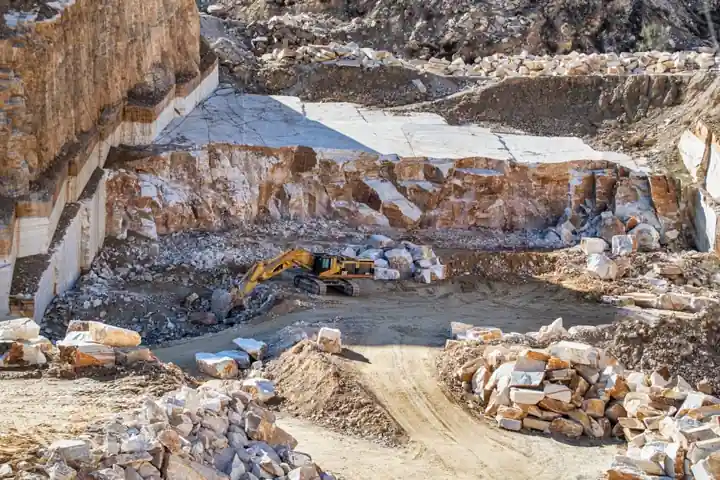
Quarry duty is a worst-case loading profile for a skid-steer loader: abrasive fines, shot-rock impacts, steep bench faces, and tight haul-road radii all sit on the same shift. The class envelope that survives this regime is 2,000-3,400 lb rated operating capacity (ROC) at 7,000-9,100 lb operating weight, paired with 68-84 hp gross and at least 18.5 gpm standard hydraulic flow [S2].
Below that band, the bucket does not break out of a face pile; above it, the chassis starts to overstress axle, tyre, and chain drives on unpaved haul roads. The data shown here is drawn from manufacturer spec guides and aggregate-industry sourcing [S1][S2][S3].
Why the Large-Frame 2,000-3,400 lb ROC Band Fits Quarry Duty
ROC, not engine horsepower, is the binding constraint when loading 1-2 inch crushed stone or run-of-quarry feed into a feeder or truck [S3]. CASE Tier 4 Final SR270 runs 2,700 lb ROC at 8,117 lb operating weight and 84 hp, with 8,677 lb breakout force and 24.2 gpm standard flow [S2]. That combination is the floor for sustained face loading; smaller SR/SV 130-185 units at 1,300-1,850 lb ROC are documented as landscaping/utility class, not aggregate face work [S2][S4].
Compact track loader variants of the same size class, including Bobcat-style tracked chassis, add flotation on soft quarry floors but trade top travel speed and steel-tracks cost [S7]. For a full class background see the skid steer loader reference.
Operating Weight, Breakout Force, and Hinge-Pin Height: the Three Numbers That Decide
Quarry loaders spend more time pushing into a pile than carrying, so breakout force per pound of ROC is the right efficiency metric. CASE SV300 posts 8,776 lb breakout at 3,000 lb ROC, a ratio of roughly 2.9:1, while CASE SR210B posts 7,270 lb breakout at 2,100 lb ROC for a 3.5:1 ratio on smaller feed [S2][S4]. Higher ratio suits tight-face rehandling; lower ratio suits high-volume truck loading where lift height matters more.
Hinge-pin height gates whether the bucket clears a 12 ft sideboard or a 14 ft high-lip dump body. The CASE SR/SV 210-340 series sit at 123-130 in hinge pin, the Yanmar S220R-1 reaches 123 in at 2,200 lb ROC, and the V270/V330 GEN:2 radial-lift models reach 130.3-131.2 in [S2]. A 130 in pin at 2,700-3,300 lb ROC is the practical sweet spot for loading standard quarry trucks without a high-lift option.
Tyre and Undercarriage Spec: the Hidden 30-40% of Lifecycle Cost
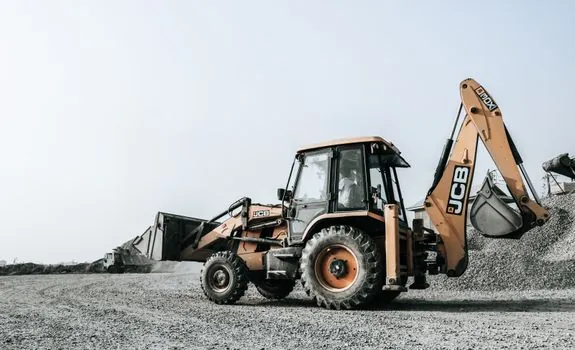
On quarry haul roads, a skid-steer typically consumes a set of tyres in 1,500-3,000 hours versus 4,000+ hours on finished concrete sites, and chains, sprockets, and idlers scale with the same wear curve [S3]. CEAT Specialty sizes the relevant quarry-loader tyres in the 18.00-25, 750/60R46, 800/65R32, 900/60R32, and 460/85R38 ranges, all of which map to larger payload classes but inform the ply rating and tread compound needed for a skid-steer running on the same ground [S3].
For tracked variants, the same source notes the original skid-steer industry split into wheeled and compact-track categories specifically because tracks delivered flotation on soft pit floors, an advantage that holds in muddy or freshly-blasted zones [S7]. A quarry operation running more than 30% of shifts on wet, fragmented ground should budget for a tracked undercarriage even at a 10-15% acquisition premium [S5][S7].
Hydraulic Flow and Attachment Strategy for Quarry Tasks
Quarry attachments are high-flow: rock buckets, hydraulic breakers, and sweeper/collector heads all want 23-30 gpm at 3,000+ psi. Standard flow on large-frame SSLs is 18.5-24.2 gpm; CASE SV300 and SV340 both ship 24.2 gpm, while Gehl R220/R260 hit 23.5 gpm [S2]. A high-flow auxiliary option at 30-40 gpm is required to drive a hydraulic breaker productively; without it, the breaker cycles too slowly to be economic.
Common quarry attachments and their flow class: standard bucket (any flow), toothed rock bucket (standard or high flow), hydraulic breaker (high flow required), sweeper collector (mid-flow acceptable), and grapple/brush (standard) [S6]. Specifying a machine with both standard and high-flow capability at purchase is cheaper than retrofitting circuits later [S2][S6].
Comparison: Wheeled vs Tracked Skid-Steer for Quarry Floors
On four decision criteria, the choice narrows quickly. First, flotation on soft/fragmented ground: tracked wins (lower ground pressure, larger contact patch). Second, top travel speed between faces: wheeled wins (typically 7-12 mph vs 5-8 mph for tracks). Third, hourly operating cost on abrasive gravel: roughly even, with tracks shifting cost from tyres to sprockets/rollers. Fourth, daily cleanout and undercarriage inspection: wheeled is faster, and quarry dust accelerates track-pin wear if not washed daily [S5][S7].
For a 2,700-3,300 lb ROC quarry unit, the practical rule is: tracked for the pit floor and primary face, wheeled for the clean load-out zone and yard work. Many operations run a mixed fleet, with the compact track loader handling blast patterns and the wheeled SSL handling truck loading.
Selection Criteria and Sourcing Standards
A defensible quarry SSL spec should lock ROC, operating weight, breakout force, hinge-pin height, and standard hydraulic flow as binding PO terms, with tyre size, ply rating, and undercarriage type as separate line items [S1][S2]. The 7,000-9,100 lb operating weight band and 68-84 hp band together rule out both compact and oversize chassis for face work [S1][S2].
For matching ancillary equipment, the wheel loader reference covers higher-capacity options when payload exceeds 4,000 lb, and the backhoe loader reference is the right cross-reference when the site also needs below-grade trenching. For an adjacent decision tree covering demolition rather than quarrying, see the SSL selection for demolition map; for the mining cab-safety and fire-suppression layer that often attaches to quarry SSLs, see the mining spec map.
Trackable signals for the next planning cycle: OEM publication of Tier 5 / Stage VI horsepower curves on large-frame SSLs, and any CEAT or Bridgestone update to 460/85R38 and 800/65R32 quarry-loader SKUs targeting skid-steer fitments [S3].