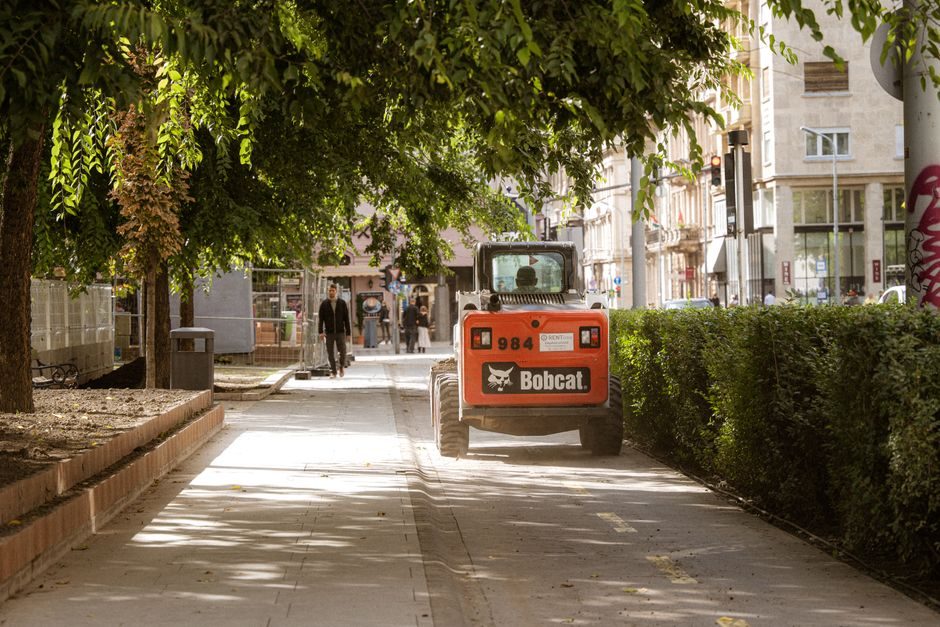
Concrete product data published in mid-2026 confirms the spread: the Gehl 5640E lands at 998 kg (2,200.2 lb) for landscaping-scale work [S1], while the WOLF WS1500T sits at 4,153 × 2,045 × 3,786 mm with a Changchai 4G33TC engine rated 70 kW for heavier construction duty [S2].
For a process-engineer buyer the first gate is matching the machine class to the job envelope — a yard with palletised aggregate and a 1.5 m gate is a different spec than a quarry face loading 3 m³ hoppers. The Gehl 5640E and Bobcat S16 (S-series, compact class) target the former; the WOLF WS800–WS1300VA range covers 36.7–70 kW with operating weights implied by the 3,410 × 1,800 × 2,825 mm envelope for the WS line [S2][S3].
Operating Weight Class and ROC Bands
Operating weight below 1,100 kg defines the small-frame skid steer, dominated by 25–37 kW diesels and ROC figures typically in the 340–450 kg range — the 5640E at 998 kg sits in this band [S1]. Mid-frame machines (1,100–2,700 kg) push ROC to 680–900 kg and engine power to 45–55 kW; the WOLF ZJ25–ZJ100 series spans 18.4–103 kW and dimensions 3,867 × 1,000 × 1,185 mm, an unusually narrow footprint for trench-side work [S2].
Large-frame skid steers and dedicated compact track loader (CTL) variants exceed 3,400 kg operating weight and clear 1,500 kg ROC. The WOLF WS1500T at 4,153 × 2,045 × 3,786 mm and 70 kW is a representative example for bulk-earthmoving [S2]. For buyers comparing against a skid steer loader spec sheet, the right column to fix first is ROC at 50% tipping, not bare operating weight.
Engine Power, Hydraulic Flow and Attachment Match-Up
Engine power alone does not size a skid steer — hydraulic flow at the auxiliary coupler is what dictates attachment productivity. High-flow circuits (typically ≥30 gpm / 114 L/min) are required to run hydraulic breakers, planers and cold planers; standard flow (≈18–23 gpm) covers buckets, augers and pallet forks. The Caterpillar skid-steer bucket catalogue (2026-05-28 snapshot) shows the attachment breadth that depends on this flow split: toothed, smooth, light-material and multipurpose buckets all sit in the same product family. [S1]
The Changchai 4G33TC powering the WS1500T is a turbocharged 4-cylinder industrial diesel at 70 kW — a common Chinese-OEM fitment for the 3.5–4.5 tonne class [S2]. Buyers in regulated markets should still cross-check the engine against the destination region's emissions tier (EPA Tier 4 Final, EU Stage V) before locking the spec; the 70 kW WS1500T data sheet does not state the emissions level in the public listing [S2].
Tyres, Tracks and Ground Pressure Trade-Off
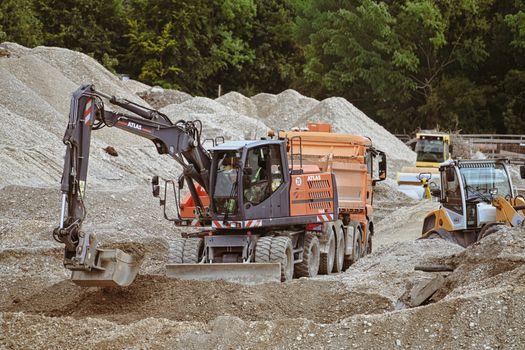
Pneumatic tyres are the default for finished surfaces; solid tyres such as the 33×12-20, 30×10-16, 36×14-20 and 23×8.5-12 SKUs supplied by Shandong Zhangchi Rubber eliminate flats on demolition sites [S5]. For soft soils, a compact track loader (CTL) variant — the tracked sibling of the skid steer — drops ground pressure from roughly 35–45 kPa (tyred) to 18–25 kPa, but sacrifices 8–12 km/h roading speed.
The Bobcat S16 is positioned for tight spaces where both turning radius and low ground disturbance matter; the OEM's 2026 product page frames it as a compact, high-power unit for narrow work zones [S3]. When comparing tyred versus tracked for landscaping vs. concrete-pour yards, the decision is rarely about engine power — it is about puncture risk and turf damage.
Cost, Sourcing and Aftermarket Spare Parts
Entry-level small-frame skid steers from Chinese OEMs cluster in the USD 8,000–14,000 ex-works band when sourced direct; mid-frame units typically land at USD 18,000–32,000; large-frame and CTL variants exceed USD 45,000. Buyer-side supply channels documented on Made-in-China (XCMG, Zoomlion, Liugong, Lonking, XGMA via direct-trade listings) and on WOLF's Qingdao export operation (CHANGCHAI engine fitment, 0086-532-66739791 phone, +8613589171650 WeChat) confirm the cluster of available factory-direct suppliers in 2026 [S2][S6].
For total cost of ownership, three items are routinely under-counted: hydraulic filter cycle (500 h), track or tyre replacement (1,500–2,500 h for tracks, 800–1,200 h for solid tyres), and the cost of an emissions-compliant diesel exhaust fluid (DEF) loop on Tier 4 / Stage V units. A buyer comparing a wheel loader and a skid steer on the same yard should weight these line items against the skid steer's lower purchase price and tighter turning radius.
Standards Governing ROC and Tip-Over Testing
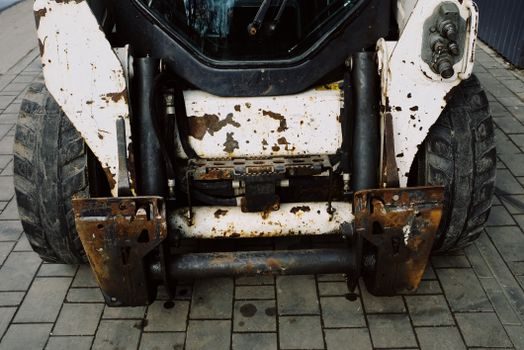
Lift-arm and tilt-cylinder hydraulic relief pressures are also nameplate values, but the ROC is the figure that determines what attachment you can safely lift. [S2]
Buyers who skim a Chinese-OEM datasheet should confirm three line items before signing a PO: ROC at 50% tipping load (with cab/ROPS mass stated), hydraulic auxiliary flow at rated engine RPM (L/min), and tipping load on tyres vs. tracks where both configurations exist. The 998 kg / 2,200.2 lb operating weight figure for the Gehl 5640E is presented with both metric and imperial units, which is the level of disclosure a skid steer loader data sheet should meet [S1].
Limitations and Failure Modes Buyers Underweight
Three failure modes dominate 2024–2026 field reports on small skid steers: hydraulic hose blowouts on the lift-arm circuit (typically at 2,000–3,500 h), cab-door interlock failures triggering ISO 3471 ROPS warnings, and diesel particulate filter (DPF) regeneration faults on Tier 4 Final units in intermittent-duty landscaping fleets. The first is mitigated by specifying SAE 100R2 hose assemblies; the second by ordering the OEM's factory ROPS audit; the third by agreeing a DPF-clean cycle with the dealer at handover. [S3]
For yard work where the unit will also serve as a stand-in for a backhoe loader on shallow trenching, a skid steer with an auxiliary backhoe attachment is cheaper to buy but slower in clay than a purpose-built backhoe — buyers should not over-rate the skid steer's trenching productivity on the strength of brochure footage alone.
Trackable signals to watch over the next two quarters: the LECTURA Press product-launch feed for March 2026 (Bobcat T650 track loader and next-generation mini excavators) signals continued OEM investment in the tracked side of this segment [S4]; emissions-tier compliance documentation on Chinese-OEM datasheets (currently spotty) is the second lever that will reshape the export market once EU Stage V enforcement tightens.
For related coverage, see Stud Welder Suppliers 2026: Drawn-Arc, CD and Hand-Gun Source Map.