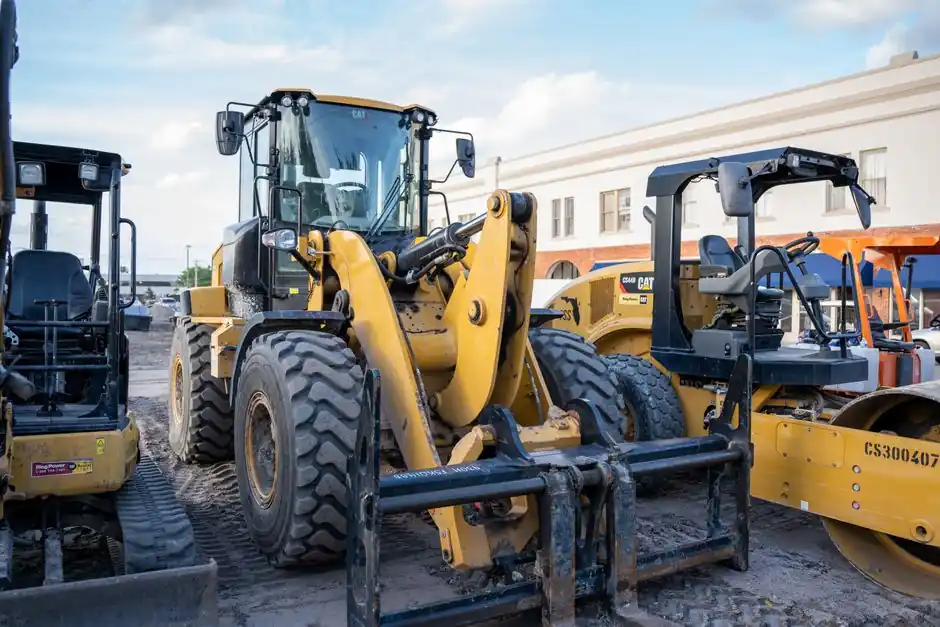
Skid steer concrete attachments group into four functional categories: concrete buckets for transporting and placing, hydraulic screeds for striking off, mixer buckets for on-site batching, and concrete claws for slab removal [S2]. Rental entry points start at roughly $193 per month for basic pouring gear, while high-capacity hydraulic buckets with 5/8 yd³ hoppers and 28″ chutes sit at the upper end of the small-attachement price band [S2][S3].
The common thread is the host machine's quick-attach interface and auxiliary hydraulic flow. A standard skid steer loader plate paired with 15–25 GPM auxiliary flow handles buckets, mixers, and vibratory screeds without modification [S2]. For crews moving from a wheeled carrier, the same attachment family also fits compact wheel loader and backhoe loader mounts via adapter plates, expanding fleet utilization on mixed concrete pours [S2].
Concrete Bucket Geometry: Hopper, Chute, and Cylinder Sizing
Concrete bucket capacity on the small-attachment market clusters around two points: 1/2 yd³ and 5/8 yd³ hopper volume [S3][S5]. The Erskine 1/2 yd³ industrial pour bucket weighs 345 lb with a universal skid steer mounting plate and a 2-year factory warranty, sized for sidewalk and driveway work [S5]. The Skid Pro 5/8 yd³ bucket weighs 542 lb, ships at 62 × 48 × 34 in, and adds a 28″ chute plus a removable XL spout for controlled placement [S3].
Chute diameter is the spec most operators underestimate: a 28″ chute gates roughly 2.2× the cross-sectional area of a typical 18″ wheelbarrow opening, which directly reduces pour-cycle time on formwork [S3]. Hydraulic vs gravity discharge is the other decision point. Skid Pro offers both a hydraulic industrial-grade cylinder version and a non-hydraulic option for fleets without reliable auxiliary flow [S3]. For site safety and reduced manual hand-pouring, a hydraulic gate cuts labor on repetitive sidewalk pours [S5].
Vibratory Screeds: Offset, Inline, and Pivot Geometry
The Dragon Screed attachment runs either offset to either side of the skid steer loader or inline directly in front of the machine, with a hydraulic pivot that follows pitched or uneven subgrade [S1]. Offset mounting is the configuration most slab contractors choose because it lets the operator see the leading edge of wet concrete while driving parallel to the form.
Vibratory screed sizing is governed by subgrade regularity and pour width. A hydraulic pivot compensates for crown changes of 1–3 in across the screed length, which is the typical tolerance band on a hand-prepared subgrade [S1]. For pours wider than the screed board, contractors stage multiple passes; for narrow sidewalks (3–4 ft), a single inline pass usually finishes the strike-off in one direction. The screed runs off the host's standard auxiliary hydraulic circuit, so no separate power pack is required when the skid steer is already equipped with continuous-flow hydraulics [S1].
Concrete Mixer, Pump, and Hopper Attachments
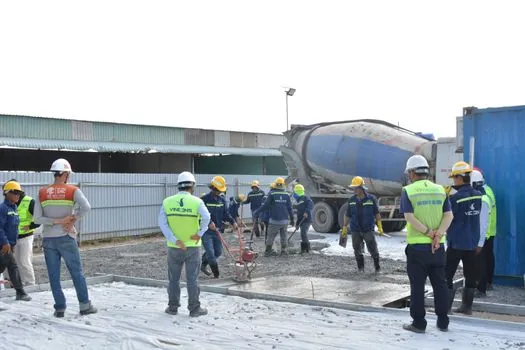
Beyond buckets and screeds, the concrete-attachment category extends to mixer buckets, concrete pumps, and telehandler-mounted hoppers, all visible in the same Skid Steers Direct catalog tree [S2]. Mixer attachments batch concrete on-site, eliminating the wait time for ready-mix trucks on small pours and remote sites. Concrete pump attachments move mixed material through a hose to forms that the skid steer cannot drive next to, which is common on foundation walls and pier caps.
For telehandler-class hosts, concrete hoppers and trash hoppers extend the same placing function to longer-reach machines, allowing concrete to be placed at the top of wall forms or into deep foundation shafts [S2]. A key spec line on all hydraulic placing attachments is required GPM: mixers typically need 12–18 GPM, while concrete pumps often demand 20+ GPM at 2,500–3,000 PSI. Spec the host machine's high-flow hydraulic option before ordering a pump attachment, since standard-flow skid steers will not cycle the pump cylinder fast enough to maintain a continuous pour [S2].
Concrete Claw and Breaker Attachments for Slab Removal
The concrete claw attachment is the standard tool for breaking, removing, and loading existing concrete slabs during demo work, and it mounts on the same quick-attach plate used for placing attachments [S4]. On a typical demo sequence, the operator uses a construction machinery and equipment hammer attachment to fracture the slab, then switches to the concrete claw to pick and load the broken sections directly into a dump truck, eliminating the need for a separate excavator on small-to-medium slab removal jobs.
Concrete breakers pair with the same host interface and run on standard auxiliary flow, with operating weights typically between 400 and 1,200 lb depending on hammer size [S2][S4]. Selection pivots on three criteria: host ROC (rated operating capacity), breaker impact energy class, and chisel bit geometry. A 500–700 lb breaker suits 4–6 in slab demolition; thicker industrial slabs (8 in and up) need a 1,000+ lb hammer. The concrete claw then handles the fragmented pieces that the breaker loosens, with jaw opening and pin geometry matched to typical slab-break dimensions.
Selection Criteria: ROC, Hydraulic Flow, and Pour Type
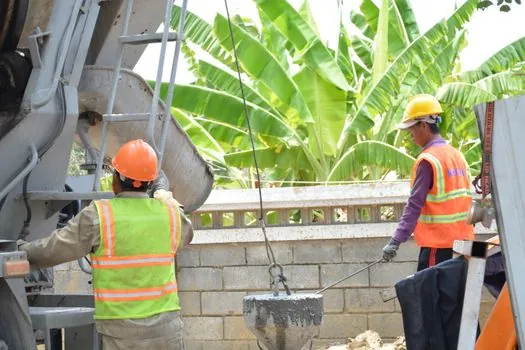
Four criteria drive the right attachment choice for a concrete pour: host rated operating capacity (ROC), auxiliary hydraulic flow in GPM, pour volume per cycle, and form access geometry. The 5/8 yd³ hydraulic bucket pushes that requirement to roughly 1,800–2,000 lb ROC [S3].
Comparison across the main concrete-placement attachments, scored on four decision criteria:
1) Concrete bucket (1/2 yd³, gravity): low cost, no hydraulics needed, manual gate, best for short-haul sidewalk pours under 50 ft [S5].
2) Concrete bucket (5/8 yd³, hydraulic): higher capacity, 28″ chute with removable spout, requires auxiliary hydraulic, best for repetitive driveway and slab pours [S3].
3) Vibratory screed: handles strike-off and consolidation in one pass, offset or inline mounting, hydraulic pivot for uneven subgrade, best for slabs wider than 6 ft [S1].
4) Concrete pump attachment: places concrete into forms the skid steer cannot reach, requires 20+ GPM high-flow hydraulics, best for wall and foundation pours [S2].
Limitations, Failure Modes, and Sourcing Standards
The main failure mode on hydraulic concrete buckets is chute clogging when the mix exceeds a 6 in slump or when aggregate size exceeds the chute's minimum clear opening [S3]. Operators counter this by batching at 4–5 in slump for bucket placement, which also reduces segregation during transport. The removable XL spout on the Skid Pro 5/8 yd³ bucket is specifically a clean-out feature for when the mix does go stiff in the chute [S3].
For screed work, the primary constraint is subgrade preparation tolerance: a hydraulic pivot compensates for 1–3 in of crown variation, but anything beyond that needs a land leveler or grading beam pass first [S1]. Mixer attachments share the same hydraulic-flow ceiling as pumps, so a standard-flow skid steer will underspec both. For all placing attachments, the relevant operator-side standard is the host machine's quick-attach interface (ISO 24410 for the global standard quick-attach geometry), and for hydraulic hoses, ISO 7241-1 Series A on the quick-disconnect couplings. None of these standards appear by revision date in the research, so cite the requirement without pinning a revision year.
Trackable signals to watch: vendor price-list updates on 5/8 yd³ hydraulic bucket SKUs (Skid Pro's current SKU is listed as N/A, suggesting a catalog refresh is in progress) [S3], and any new ISO 24410 interface revision that would affect quick-attach compatibility across mixed skid steer fleets. For deeper comparison of host-machine undercarriage choices that affect concrete-handling stability, the single grouser vs triple grouser track shoe selection guide covers the ground-pressure tradeoffs that apply to skid steers working on fresh subgrade beside formwork.