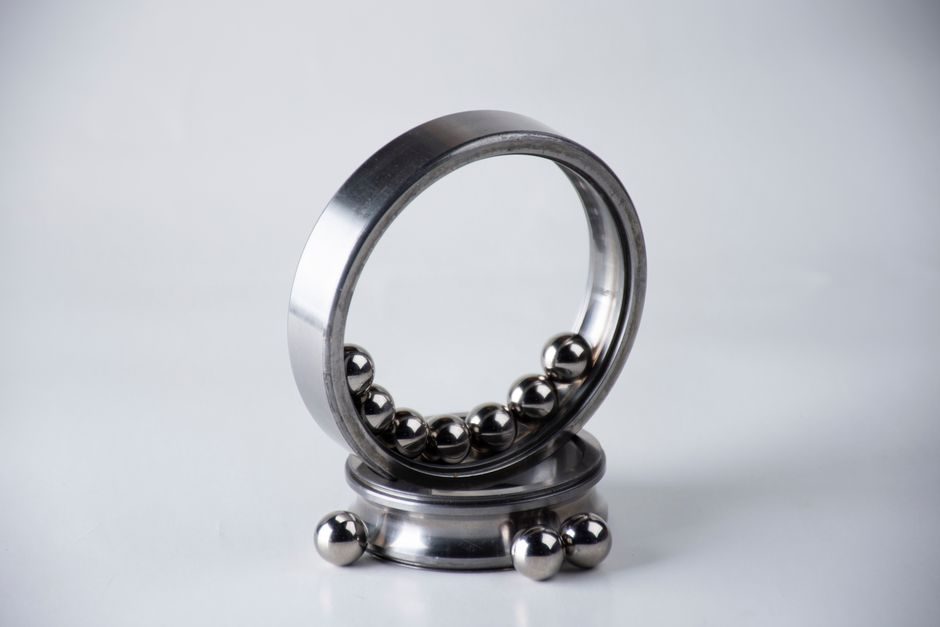
A slewing-bearing lifecycle cost stack is purchase-price-weighted on day one and lubrication-, downtime-, and labor-weighted by year five, so a buyer comparing only the invoice line overpays 20-40% across a 5-7 year horizon [S2].
The TCO model that USPS and Oracle deployment planning both formalize — Purchase + Present Value of (Operating + Training + Maintenance + Wind-down + Energy − Salvage) — maps cleanly onto slewing-ring procurement, where Purchase is roughly 25-35% of a 7-year spend and the rest hides in grease, seals, crane hire, and lost production hours [S2][S3].
The five cost levers, ranked by 7-year weight
On a 5-7 year horizon, the five cost drivers on a slewing ring bearing sort by spend weight roughly as: initial purchase (25-35%), preventive maintenance and re-lubrication (15-25%), mounting / alignment / commissioning labor including crane and welder time (10-15%), unplanned downtime from raceway spalling or bolt loosening (15-30% in high-cycle applications), and end-of-life scrap or refurbishment (5-10%) [S2][S3]. The split is application-specific: a wind-turbine yaw bearing running 8,000 hours/year and a harbor crane slewing bearing on intermittent duty will trade the maintenance and downtime buckets against each other even when the purchase line is identical.
Per the USPS formal model, TCO = Purchase + PV(O + T + M + W + E − S), where O is operating, T is training, M is maintenance, W is wind-down, E is energy, and S is salvage [S2]. For a slewing ring, "training" collapses into torque-and-bolt-preload know-how held by a small crew, "energy" is the small motor drive current during slewing, and "salvage" is the residual bearing or ring value at scrap-out — three small but non-zero lines that purchase-price comparisons drop entirely.
Purchase price: what moves the line on the PO
On a 1,000-2,500 mm pitch-diameter single-row four-point contact ball slewing bearing, the purchase line scales with raceway hardening depth, gear-cut quality (hardened-and-ground vs soft-cut), and the certification pack (mill cert, UT, MT, dimensional report). Common 42CrMo / 50Mn quenched-and-tempered raceways in C3/C4 clearance dominate the volume tier; 42CrMo case-hardened (HRC 55-62 raceway, HRC 28-32 core) sits in a higher price band and is the right call when design load is within 15% of catalog static capacity. [S2]
Tooth option is the second price lever: external-geared, internal-geared, and gearless each price differently. Internal-geared rings are typical for enclosed slewing drives where pinion guarding matters; gearless is the choice when the slew motor drives a pinion on a fixed structure and the bearing carries only axial/radial/moment load — see the slewing drive reference for the integrated actuator variant. Buyers who spec a gear type that does not match the drive architecture typically pay 10-20% extra in adapter hardware and pinion alignment labor on site.
Operating and energy: grease, seals, and slew current

Operating cost (O in the USPS formula) for a slewing ring is dominated by grease consumption and the grease-interval labor. A four-point contact ball slewing bearing on a mobile crane is typically re-lubricated every 250-500 operating hours; on a tower-crane or wind-yaw service, intervals stretch to 1,000-2,000 hours but the per-event volume is larger because the raceway arc is longer. EP-2 lithium-based greases with MoS2 or graphite are the default, and switching to a synthetic polyurea grease can roughly double the re-lube interval at 2-3x the per-kg grease price — a tradeoff that the Shell total-cost-of-ownership framing treats as a pure labor-versus-material optimization [S4].
Energy cost (E) on a slewing bearing itself is small — the bearing contributes rolling friction plus seal drag, not active drive work — but the slewing drive it sits in consumes meaningful kWh. Standard 24 V DC and 380 V AC slewing drive packages from 6 Nm holding torque up to 50,000 Nm peak torque are specified against load, duty cycle, and ingress protection. The energy line in TCO is therefore driven by the drive's no-load current draw and duty cycle, not the bearing's own friction, and is easy to model from manufacturer datasheets (typical no-load draw 0.5-2 A at 24 V for small solar trackers).
Maintenance, training, and the bolt-preload failure mode
Maintenance cost (M) is where most TCO surprises originate. The single most common in-service failure on a four-point contact ball slewing ring is not raceway fatigue but bolt-loosening-induced clearance growth: when the mounting bolts lose preload, the ring develops play, the seal lip unseats, contamination ingress accelerates, and within 2,000-4,000 hours the raceway is spalling. The prevention is mechanical: a documented re-torque schedule using a calibrated hydraulic wrench, typically at 500 / 1,500 / 4,000 hour intervals for the first year and every 4,000 hours thereafter — 30 minutes of wrench time on a 16-bolt pattern per ring per event, which METTLER TOLEDO's TCO framing treats as a planned maintenance cost line, not a contingency [S5].
Training cost (T) is small in dollars but large in risk: a two-person crew trained on the specific torque sequence, the bolt-class (10.9 vs 12.9), and the hydraulic-wrench calibration intervals will not crack a ring at month eight the way an untrained crew using an impact wrench will. Mettler Toledo's process weighing TCO page and the Oracle deployment guide both flag training and standard-adherence as a line item, not a freebie [S3][S5]. The practical upshot: a $3,000-8,000 training and tooling investment per crew protects a $20,000-80,000 bearing.
Downtime, wind-down, and the unplanned-event multiplier

Unplanned downtime is the single largest 7-year cost lever in high-cycle service (excavator upper structure, shipdeck crane, harbor crane) and the reason a slewing bearing buyer should never compare on purchase price alone. When a ring fails on a working crane, the line cost is: crane idle (per-day hire equivalent $1,500-5,000), 2-4 person crew x 2-3 days, mobile crane for ring removal (typical 16-24 hours at $200-400/hr), and the replacement ring itself. The 5-7 year unplanned-event cost often equals 1.5-3x the planned maintenance budget on a single high-cycle machine. [S1]
Wind-down cost (W) and salvage (S) close the lifecycle. Disassembly of a slewing ring from a scrapped structure takes 8-24 person-hours and a cutting torch for the bolt pattern; the ring itself, if the raceway is intact, has 10-30% residual value as a refurbished spare for non-safety applications. Buyers who spec for refurbishability (documented torque history, dimensional log, no overheating events) recover that credit; buyers who run to catastrophic failure do not.
Decision rules: when purchase price wins, when it loses
For low-cycle service (under 500 hours/year — solar trackers, occasional-duty harbor cranes, monument turntables), purchase price dominates the 7-year TCO and a standard 42CrMo Q&T single-row four-point contact ball slewing bearing from a tier-2 mill typically wins on cost-per-hour. The right metric is purchase price divided by catalog static load rating in kN, then sanity-checked against catalog dynamic load rating for the design rotational speed. [S2]
For high-cycle service (2,000+ hours/year — port cranes, wind turbine pitch and yaw, material handling), downtime and maintenance dominate and a case-hardened 42CrMo raceway with a documented bolt-preload procedure plus condition-monitoring (bolt-tension logging or grease-debris sampling) typically beats the cheaper ring by 20-40% on 7-year TCO even when purchase is 15-25% higher [S2][S4]. A useful internal benchmark: any application where unplanned downtime exceeds $5,000/day justifies the case-hardened spec; below that, the Q&T spec wins on price. The related deep-dive on the Slewing Ring Bearing TCO: Five Cost Levers and a 5-7 Year Spend Stack walks the same five levers with worked numbers, and the structural overview in Slewing Ring Bearing Types: Four Structural Families, Gear Options, and Selection Map helps place a chosen drive architecture against the right ring family before the quote is locked.
Track next: quarterly bolt-preload re-torque compliance as a percentage of installed fleet (target ≥ 95% on safety-relevant service) and grease-sample iron-content trend as the leading indicator of raceway distress 1,000-2,000 hours before spalling becomes visible.