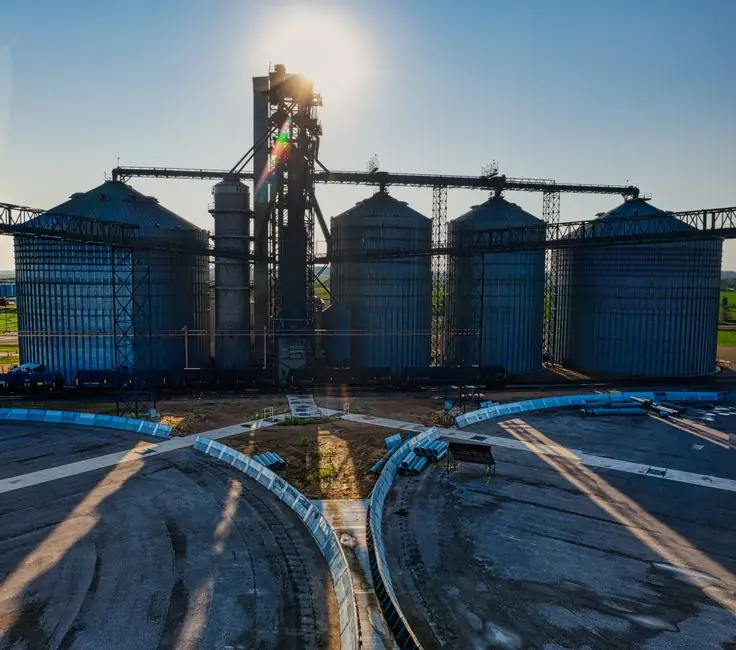
Cement-plant slewing ring bearings sit in some of the harshest rotary equipment in bulk-materials handling: preheater towers, kiln hoods, coolers, stacker-reclaimers, and crusher slewing rings, where axial load, radial load, and a sustained tilting moment all act on one raceway [S1][S2].
Selection is driven by four concrete criteria: combined load envelope (axial + radial + moment, with moment typically 3–5× the average rolling-element load due to non-uniform distribution), raceway sealing against alkaline cement dust, gearing type (internal vs. external), and static/dynamic load rating matched to L10 life at expected rpm [S2][S3][S4].
Load Envelope and Tilting-Moment Calculation
A slewing ring bearing must simultaneously carry axial, radial, and overturning-moment loads; the moment is the product of an off-center force and its lever arm, and at cement-plant scale this term dominates the design [S2][S3]. Per published slewing-bearing references, the most-loaded rolling element can carry 3–5× the average element load under a tilting moment, because the resultant no longer passes through the geometric center and one raceway side is heavily compressed while the opposite side sees tension relief [S2].
For a representative preheater or stacker-reclaimer slewing drive, a 10 t payload at 5 m outreach produces roughly 490 kN·m of static tilting moment before any amplification from boom deflection, wind on the boom, or slewing inertia; large-diameter slewing rings (over 4,000 mm) are routinely rated above 50,000 kN·m of moment capacity, and crossed-roller or three-row roller geometries are the typical path to reach that band [S2][S4]. Engineers should add at least 5–15% to the calculated static moment to cover dynamic boom/tower deflection in lattice-style structures, a rule of thumb stated explicitly for slewing-bearing applications [S2].
Raceway Type vs. Cement-Plant Duty
Four raceway geometries cover virtually all cement-plant slewing service, and the right choice is a function of moment share, rotational accuracy, and available space: single-row four-point contact ball, double-row ball, crossed-roller, and three-row roller [S4][S5].
A practical comparison for cement-plant specifiers:
1) Single-row four-point contact ball: compact axial envelope, moderate moment capacity, lowest cost. Common in light stacker-reclaimer booms and small crusher slewing rings where overturning moment is the secondary load and rotational accuracy of ~0.1° is acceptable [S4][S5].
Used on mid-size preheater and cooler applications [S5].
3) Crossed-roller: cylindrical rollers crossed at 90° give the highest stiffness-to-size ratio and the best rotational accuracy (typically arc-second class), making them the default for kiln-hood and precision stacker slewing rings where deflection under moment must stay below a defined threshold [S4][S5]. Reference crossed-roller slewing ring XU160405 has a 41 mm ring height, 450 mm pitch-circle diameter on the outer ring, and 30 fixing holes, the kind of geometry used in heavy-duty slewing service [S6].
4) Three-row roller: separate raceways for axial, radial, and moment loads; the highest moment capacity of the four options, at the cost of larger cross-section, higher mass, and tighter mounting tolerances. Specified for the largest rotary kilns, heavy mining stacker-reclaimers, and large harbor cranes; this is the geometry to default to when the calculated tilting moment exceeds the rating curve of a crossed-roller ring at the available pitch diameter [S4][S5].
Sealing and Lubrication Against Cement Dust

Cement dust is alkaline, abrasive, and hygroscopic, so seal and lubricant choice is as decisive as the load calculation; industry guidance groups bearing materials and seal systems with the contamination and moisture level in mind, a direct match for preheater and cooler service [S1]. Multi-stage lip seals plus an O-ring face seal on each ring face are now the cement-plant default, with grease nipples routed to each raceway and re-lubrication intervals tied to operating hours rather than calendar time [S4][S5].
For a deeper look at elastomer choices that share the same contamination exposure, the FKM fluororubber selection map for rail industry covers temperature and media limits that read across to kiln-hood seals, and the O-ring reference page documents the gland-fit tolerances that these face seals inherit. Where the slewing ring sits in a wash-down or wet-process area, the seal stack should include a wiper lip and a grease-relief port so that water ingress cannot pressurize the raceway cavity.
Gearing: Internal vs. External for Cement Slew Drives
Most cement-plant slewing rings integrate a gear on the inner or outer ring to accept a pinion driven by a planetary gearbox and a hydraulic or electric motor, eliminating the king-post and slew-drive bearing stack that older machines used [S4][S5]. External gearing is easier to inspect, service, and shim, and is preferred on stacker-reclaimers where teeth wear from abrasive dust is the dominant failure mode [S4]. Internal gearing protects the teeth from falling debris and direct dust impingement, at the cost of a larger pinion-shaft envelope and more complex backlash adjustment, which is why it dominates preheater and kiln-hood service [S5].
The slewing drive reference page covers the gearbox side of this stack, including the typical ratio range (low, single-stage planetary) and torque margins. The slewing bearing page, in turn, documents the bolt-circle and gear-mesh interface dimensions that tie the bearing to the slew drive housing. For higher torque, lower-speed applications such as rotary kiln support rollers, a separate slewing ring bearing can be specified without integral gearing and driven by a peripheral pinion mounted on the structure.
Static Rating, Dynamic Life, and Safety Factor
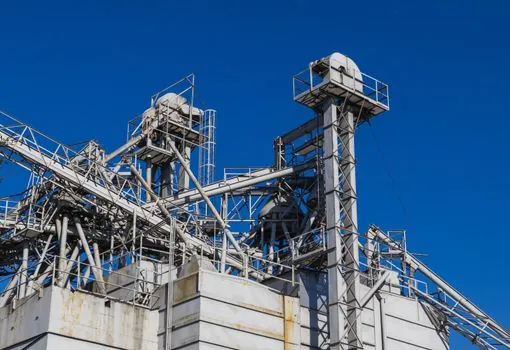
Selection closes with two checks: the static load rating (C0) must exceed the maximum combined load under stall or wind gust, and the dynamic load rating (C) must deliver the target L10 life at the duty-cycle rpm [S4]. Cement-plant slewing rings are slow-turning (typically 0.1–2 rpm) but run continuously, so the L10 hours are usually sized to 50,000–100,000 h, and the tilting moment is the controlling input in the equivalent load calculation [S2][S4].
For precast and on-site concrete placing, the related laser screed selection guide for FF/FL floors covers the flatness side of the same concrete spec chain. The right bearing choice upstream, sealed, geared, and moment-rated for the dust and load profile above, is what keeps the rest of the line from unplanned stops. Watch the next 60–90 days for OEM-published curves of three-row roller moment capacity at the 3,000–4,500 mm pitch-diameter band and for revised re-greasing intervals tied to dust-load sensors rather than fixed hours.