Textile-mill slewing rings sit in a narrow but unforgiving spec window: combined axial-radial load, slow to moderate rotation, continuous duty, and an environment loaded with fibre lint, oil mist, and 60-90% relative humidity [S3]. Bearings stocked for this segment are typically sealed on both sides, with a 30-50mm section height and a static axial load rating C0a of 300,000-630,000 N to absorb frame weight, yarn tension reaction, and traverse-carriage offsets without deflection [S2].
Selection in this segment is dominated by three product families: crossed-roller slewing rings (no gear teeth), four-point contact ball slewing rings, and double-row angular-contact roller slewing rings. Each maps to a different duty profile inside a spinning, weaving, or dyeing cell, and the wrong choice shows up fast as raceway brinelling, seal failure, or premature grease washout [S3][S4].
What the Bearing Must Survive in a Textile Cell
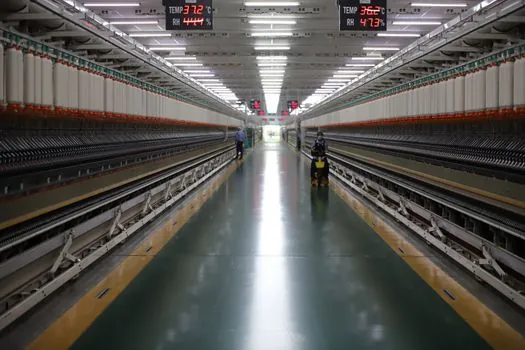
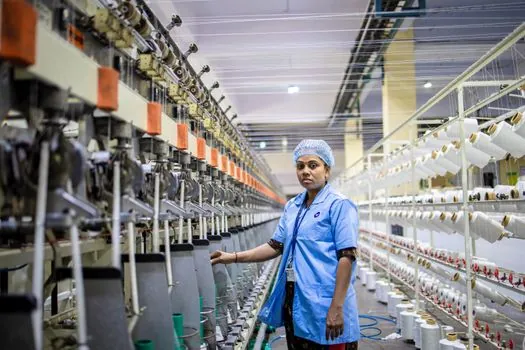
Textile-mill bearing duty is defined as much by contamination as by load. Mills run high-speed spindles, ring frames, draw frames, and looms, and the slewing ring inside the machine's rotating sub-assembly (creel turret, can coiler, fabric take-up, dye-bath reel) sits in an atmosphere of airborne lint, lubricating oil mist, and humidity swings between 40% and 90% RH across a shift [S3].
That environment rules out open-bearing architectures in most cases. Standard sealed slewing rings in the 400-500mm OD class, such as the Schaeffler XU160405 (d_i 336mm, D_a 474mm, H 46mm, weight 24.1kg, sealed both sides), carry a basic dynamic axial load rating C_a of 250,000 N and a static axial rating C_0a of 630,000 N, with a 30-bolt fixing pattern on each ring and an operating temperature range of -30 to +80 deg C [S2]. Those numbers set the working envelope most textile OEMs size against.
Selection Criteria: Load, Speed, Misalignment, Seal
Four criteria drive the decision, in this order: combined load magnitude, rotational speed, expected static misalignment of the mating structure, and sealing integrity. A 60mm bore comparison illustrates the underlying bearing-physics logic: a self-aligning ball bearing (1212) delivers 25.5 kN dynamic / 10.0 kN static at a 7,500 rpm reference speed, while a spherical roller bearing (22212E) at the same bore delivers 120 kN dynamic / 105 kN static at 4,300 rpm, roughly 4.7x the dynamic capacity at less than 60% of the speed [S1].
For slewing rings specifically, the equivalent trade is between four-point contact ball slewing rings (higher speed, lower load, typical misalignment tolerance +/-1 deg) and crossed-roller or double-row angular-contact roller slewing rings (lower speed, 3-5x the line-contact load capacity, typical tolerance +/-0.5 deg) [S2][S4]. Textile traverse and take-up duties normally run below 30 rpm, so the slower, higher-capacity roller family is almost always correct; the ball slewing ring only wins on very high-speed creel indexing above roughly 50 rpm. Refer to the slewing bearing reference page for the geometry-level differences between the two families.
Comparison: Crossed-Roller vs Four-Point Ball vs Double-Row Angular-Contact Slewing Rings
A criteria-based comparison lines the three mainstream options against the four decision points above. Values are drawn from manufacturer datasheets published in 2026 and should be read as typical bands for the 400-500mm OD class, not as universal constants.
Crossed-roller slewing ring (e.g. XU series, no gear teeth, sealed both sides): combined axial-radial load capacity is high (C_a 250,000 N, C_0a 630,000 N for the XU160405 example), rotational speed limited to roughly 30 rpm continuous, misalignment tolerance narrow at +/-0.5 deg because the rollers are preloaded against both raceways, and sealing is integral on both rings. Best fit for can-coiler turrets, fabric take-up reels, and dye-bath reels where load is the dominant constraint and indexing is slow [S2].
Four-point contact ball slewing ring: load capacity roughly 30-40% of a same-size crossed-roller unit, speed capability up to 100-150 rpm in greased configurations, misalignment tolerance wider at +/-1 to +/-1.5 deg because the ball-raceway geometry permits tilt, and sealing is usually a single lip on each ring. Best fit for high-speed creel indexing, light-package yarn feeders, and packaging-machine conversions inside textile lines [S1][S3].
Double-row angular-contact roller slewing ring (e.g. Franke type LVG aluminium-raced design with integrated bearing elements): the highest radial capacity per kg in this class, speed capability intermediate at 40-60 rpm, misalignment tolerance approximately +/-0.5 deg, and a corrosion-resistant aluminium raceway that is genuinely useful in dye-house humidity. The trade is higher cost and a narrower supplier base, justified where downtime cost dominates the spec [S4]. Background on the wider slewing ring bearing family and the LVG architecture is on the linked reference page.
Who This Bearing Family Is For, and Who It Is Not For
Slewing rings in this size class are for textile OEMs and rebuild shops specifying on can coilers, creel turrets, fabric take-up and let-off stands, dye-bath reels, stenters, and tenter-frame chain returns. They are also for the slewing drive assemblies that drive many of those same turrets, where the bearing's combined load capacity matters as much as the worm-gear ratio. [S1]
They are not for high-speed spindles, drafting rollers, or loom-shuttle drives. Those duties run at 5,000-25,000 rpm and belong to deep-groove ball bearings, angular-contact spindle bearings, and specialised high-speed cylindrical roller bearings, not to slewing rings of any kind. Putting a 400mm slewing ring on a ring-frame spindle would be a 10-30x cost mistake with no performance upside. For the deep-groove ball architecture that actually fits spindle duty, see the ball bearing reference page.
Real Failure Modes in Textile Service
Three failure modes account for most textile-mill slewing-ring replacements. First, seal failure and grease washout: oil mist and humid air migrate past single-lip seals, emulsify the lithium or polyurea grease, and strip it off the raceway. The fix is double-sealed units with a secondary V-ring or O-ring dust lip, and grease relubrication intervals shortened from 12 months to 6 months in dye-house cells [S2][S3].
Second, brinelling from static overload: when a creel is loaded with full packages, the resultant axial force can exceed C_0a during slow rotation, especially if the machine sits idle under load for hours. The static safety factor should be kept at 1.5-2.0 for continuous-loaded textile service, not the 1.0-1.2 used in general mechanical engineering. Third, raceway corrosion in dye-house cells: standard 42CrMo or 50Mn raceways need a surface treatment or a sealed-with-stainless option when chloride-based dye chemistry is present. Where retaining ring fasteners or O-ring seals are part of the same rebuild, material compatibility against the dye bath should be reviewed in the same drawing release.
Sourcing and Standards Backbone
The dominant 2026 supply lines for textile-class slewing rings are Schaeffler (XU/XS series, INA-branded crossed-roller), Franke (LVA-LVG wire-race and aluminium-race families), SKF (Ball and Roller slew range), NSK (DT and HT series), and a growing set of Indian and Chinese OEMs serving the domestic textile machinery market [S2][S3][S4].
For related-article cross-reference, the slewing ring bearing selection for material handling spec map covers the heavier, slower, higher-shock-load end of the same product family and is a useful read alongside this one for engineers standardising bearing policy across a mill. Lead time on the 400-500mm crossed-roller class from European mills has remained in the 10-14 week range through 2026, while Indian and Chinese equivalents quote 4-6 weeks at a typical 20-30% price discount against published European list.
These are the spec-level changes that move the selection map.