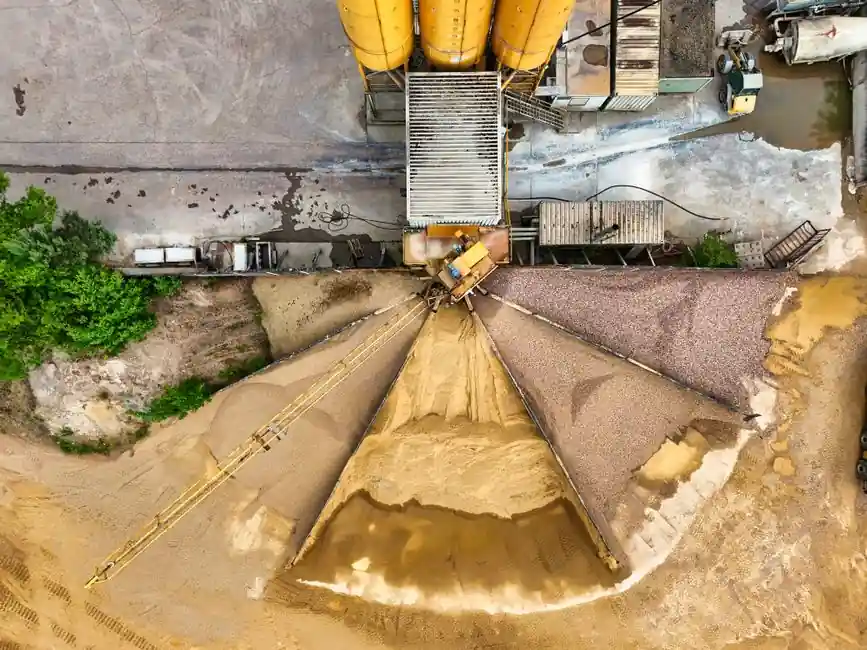
Slewing ring bearings for material handling equipment span bore diameters of roughly 200–6,000 mm, with specialty offshore-crane units exceeding 8,000 mm, and must simultaneously carry axial, radial, and overturning-moment loads in a single raceway [S1][S4].
Across the four main structural families (four-point contact ball, crossed roller, three-row roller, and double-row ball) the material-handling use case cross-cuts every type because the load envelope, not the geometry, defines the decision [S2][S5].
Load Envelope: Why Three Loads at Once Drive the Spec
A slewing ring bearing is engineered to handle axial, radial, and tilting-moment loads simultaneously, which is the core differentiator from a standard deep-groove ball bearing and the reason a single row can replace what would otherwise be a stack of separate bearings [S1][S3].
Material-handling machines concentrate all three load types in one joint: the boom weight and lifted load contribute axial and moment loads, side wind or slewing acceleration adds radial force, and boom deflection drives a reversing tilting moment. LILY Bearing documents the consequence: a slewing bearing failure on a mobile crane costs an average of $50,000–$200,000 in downtime and replacement [S1]. A single mobile-crane slewing ring is also commonly rated for service life beyond 8,000 operating hours when correctly specified [S2].
Engineers should treat diameter as a packaging constraint, not a sizing constraint. Selection begins with the equivalent dynamic load calculated from the three components, then applies a service factor of 1.0–1.5 for steady lifts and 1.5–2.5 for impact-loaded or reversing duty [S1].
The Four Structural Types, Compared on Decision Criteria
Four-point contact ball slewing rings are the most common general-purpose choice for moderate, balanced loads in cranes, excavators, and aerial work platforms, because each ball contacts the raceway at four points and a single row handles axial, radial, and moment loads simultaneously [S1][S3].
Crossed roller slewing rings replace balls with cylindrical rollers arranged alternately at 90°, which delivers line contact, higher rigidity, and ISO tolerance class P5 or better; they are preferred where positional accuracy is critical, such as robotics, radar, and precision indexers [S1][S2]. Three-row roller slewing rings separate the three load paths into dedicated roller rows and are the standard for large excavators, offshore cranes, shipyard cranes, bucket-wheel reclaimers, and ladle turrets because of their very high load capacity in a compact cross-section [S1][S2].
Double-row ball slewing rings double the contact points over a single-row four-point design, delivering higher load capacity and stiffness under heavy-duty axial and moment loads where a three-row roller would be over-specified [S1][S2]. Gear configuration is a parallel decision: external gear teeth on the outer ring suit most crane and excavator swing mechanisms, while internal-gear configurations are favoured where pinion packaging, debris shielding, or larger module gearing is required [S1][S4].
Materials, Raceway Hardening, and Sealing
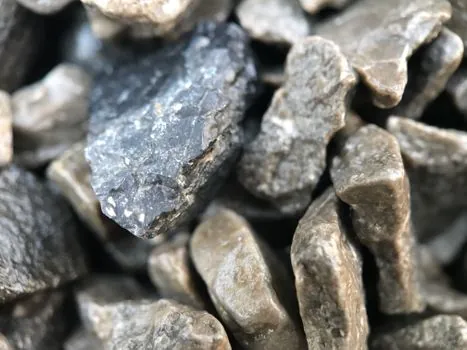
Slewing ring inner and outer rings are typically machined from medium-carbon alloy steel, most commonly 42CrMo4 or 50Mn, and the raceways are induction-hardened to combine a tough core with a wear-resistant surface [S7].
This material/hardening pairing is the baseline for general industrial and construction environments. For corrosive or wash-down material-handling settings (food, fertilizer, marine port cranes) stainless raceway options, sealed-for-life greasing, or external zinc-rich coatings become the differentiator, with sealing design alone often determining service interval in dusty bulk-handling terminals [S3][S8].
Seals protect the raceway against dust, water, and contaminant ingress while retaining lubricant, and on dust-exposed material-handling sites (cement terminals, grain elevators, bulk-ore yards) the seal design frequently decides whether the bearing reaches its calculated L10 life or fails early from grit ingestion [S1][S3].
Application Mapping: Cranes, Excavators, Wind, Solar, and Rotary Tables
Tower cranes and mobile cranes use slewing rings as the critical joint between the fixed base and the rotating upper works; for large port and shipyard cranes, three-row roller slewing rings are the dominant specification, with manufacturers such as Liebherr producing units exceeding 6 m in diameter for these duties [S2].
Hydraulic excavators rely on the slewing ring to connect the upper structure (house) to the undercarriage, supporting continuous 360° rotation under dynamic digging, boom, and machine-weight loads, which is why roller-type slewing rings dominate the excavator swing mechanism [S2]. In wind turbines, yaw bearings sit at the tower-to-nacelle connection and are typically specified in the 2,000–4,000 mm diameter range to support nacelle turning into the wind, while pitch bearings act on each blade root [S2].
Solar trackers, welding positioners, and packaging-line indexers use smaller four-point contact or crossed-roller rings, and a side-by-side view of similar slewing-ring selection logic for packaging and cement plants is captured in packaging-line slewing-ring selection and cement-plant slewing-ring selection. For background on the bearing category itself, see the slewing ring bearing reference and the slewing bearing overview.
Selection Pitfalls and a Decision Sequence
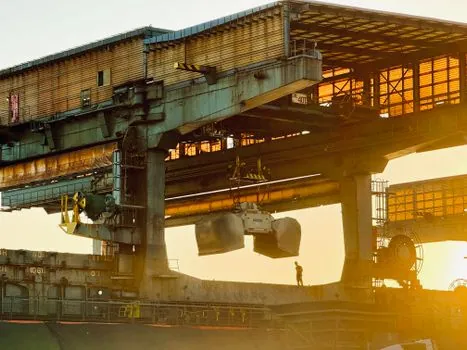
The most common early mistake is to size by bore diameter rather than by the equivalent dynamic load, and the second is to ignore service factor; LILY Bearing's 9-step selection flow runs load calculation, service factors, gear and mounting requirements, then bearing-series review [S1]. SKF, working with crane OEMs, similarly frames selection as a multidisciplinary decision across technical, reliability, and economic requirements rather than a single-parameter pick [S10].
A defensible sequence: (1) compute the combined axial, radial, and tilting-moment loads with worst-case dynamic factors; (2) apply a service factor of 1.0–1.5 for steady duty or 1.5–2.5 for impact and reversing duty; (3) choose structural type (four-point ball, crossed roller, three-row roller, double-row ball) against the dominant load and precision need; (4) confirm gear configuration, mounting-hole pattern, and seal/lubrication package; (5) verify raceway hardness (induction-hardened 42CrMo4 or 50Mn is the industry baseline) and the supplier's ISO 9001 / ABMA / DIN 628 quality documentation [S1][S3][S7].
Crossed roller slewing rings are NOT the cheapest path for a simple crane swing, and three-row roller rings are NOT justified for light turntables or indexing tables; mis-mating type to duty is the most expensive way to overspend on a slewing ring, and in the material handling context it is the most common reason for a premature overhaul.
Verification: Standards, Documentation, and Total-Cost Signals
Specifying engineers should require raceway hardness certification, material certificates for 42CrMo4 or 50Mn rings, and documented gear quality (typically DIN 3962 / ISO 1328 class 8 or better for external gear teeth on crane-duty rings) before releasing a purchase order [S1][S7].
Two trackable signals for the next purchasing cycle: (1) compare quoted L10 life at the calculated equivalent load, not just static load rating, and reject suppliers who only publish static capacity; (2) require a written service-factor assumption from the supplier so the warranty baseline matches the actual duty cycle. The storage and handling equipment overview and the related steel-mill slewing-ring spec map extend the same selection logic into adjacent high-duty environments.