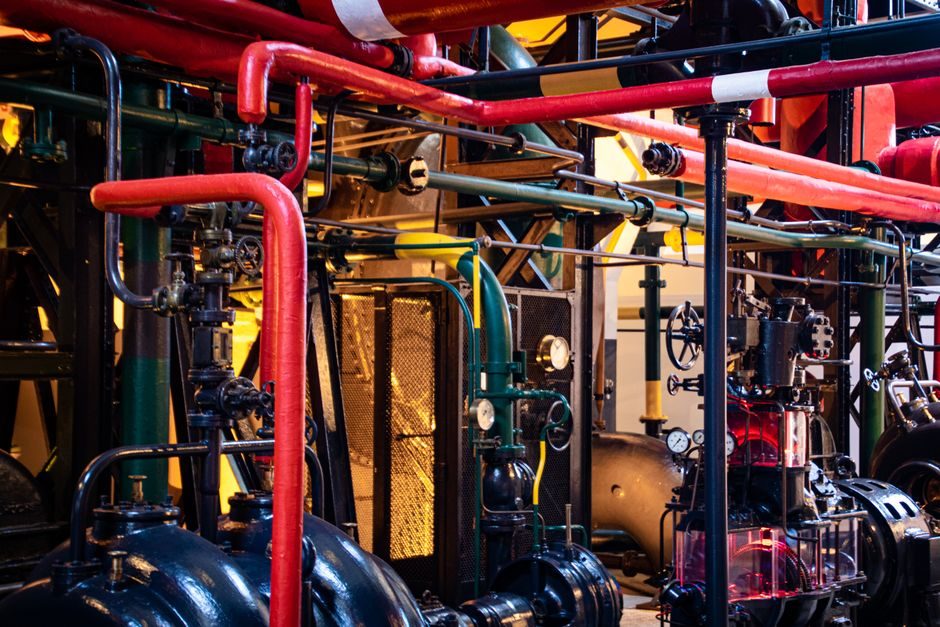
A Bran+Luebbe CEREX K double-diaphragm metering pump delivers 12–1,200 l/h (3.17–317 US gal/h) at 0–103 bar (1,493.9 psi), draws 0.75–1.5 kW, handles fluids from −10 °C to 50 °C, and is built to API 675 with a hydraulically actuated double PTFE diaphragm and 316L or plastic liquid-wetted material [S1].
A 47-ton XCMG HB52 concrete pump truck on a Volvo FM440 chassis moves 90–138 m³/h of structural concrete at 8.7–13 MPa, with a 51.5 m boom reach, 40 m depth, 360° slewing, and a 47000 kg GVWR — a complete different machine class aimed at placing, not metering [S3]. For readers comparing the two product families on a spec sheet, the concrete pump truck and the truck-mounted concrete pump pages lay out the chassis and boom geometry, while the diaphragm pump page documents the reciprocating positive-displacement architecture that defines low-flow precision pumping.
Flow Class: Liters-per-Hour vs Cubic-Meters-per-Hour
Diaphragm metering pumps live in the 12–1,200 l/h window for a single station; the Bran+Luebbe CEREX K covers 12 l/h on the low end and 1,200 l/h on the high end, with linear manual stroke adjustment from 0–100% [S1].
Concrete pump trucks live in the 70–138 m³/h theoretical-output band; the HB52 quotes 90 m³/h on the high-pressure setting and 138 m³/h on the low-pressure setting, while a separate 26 m boom model (ZLJ5331THB 43X-5Z) lists 70/120 m³/h [S3][S8]. That is a 1,000×–10,000× flow ratio between the two categories — not a close substitute.
The diaphragm pump is sized for chemical dosing lines, additive injection, and small-flow control loops, while the truck-mounted boom pump is sized for structural concrete placement in foundations, high-rises, and bridge decks.
Pressure Class: 103 Bar Metering vs 8.7–13 MPa Placement
The CEREX K operates up to 103 bar (1,493.9 psi) at 1,200 l/h, with 0 bar as the minimum — the head is built for back-pressure resistance in chemical skid piping, not for moving solids [S1].
The XCMG HB52 hydraulic concrete pump runs at 8.7 MPa (low-pressure mode) up to 13 MPa (high-pressure mode) [S3]. Pressure here drives aggregate-laden concrete through boom delivery pipes, where the line is DN125 twin-wall heat-treated wear-resistant steel [S4].
Pressure units look similar on paper (100 bar vs 130 bar), but the working fluids are completely different: clean or pigmented liquids with PTFE compatibility on the diaphragm side, vs abrasive 40 mm-aggregate concrete slurries on the placement side. Specifying one for the other duty is a procurement error, not a tolerance question.
Power, Drive, and Mobility
The CEREX K is stationary, manual-stroke, motor-driven at 0.75–1.5 kW (1.02–2.04 hp), with safe-area motor suiting and no onboard engine [S1].
The HB52 mobile pump truck carries a Volvo D13 inline 6-cylinder diesel, 12.8 L displacement, 324 kW at 1,400–1,800 rpm, 410 L fuel tank, and 50 L/100 km fuel consumption, all on a 14,665 × 2,500 × 3,990 mm chassis with 12.00R20 tyres [S3]. Total vehicle weight 47,000 kg; max speed 90 km/h; max gradeability 38%.
Mobility rules out the truck on any indoor skid duty; stationary mounting rules the diaphragm pump out of any placing-boom job. The two product families do not overlap on installation footprint, transport, or hookup.
Materials, Wetted Parts, and Wear Parts
CEREX K wetted materials are 316L stainless or plastic (PTFE diaphragms, NPT metallic or union-end plastic connections), with double ball or spring-loaded cone check valves; failure detection is built into the diaphragm monitoring with pressure gauge [S1].
Concrete pump wear parts are dominated by abrasive service: DN125 boom pipes, twin-wall heat-treated elbows, rubber delivery hoses, rubber pistons, clamp couplings, and S-valve distribution hardware, all of which are stocked as OEM spares for Putzmeister, Schwing, Zoomlion, XCMG, and SANY boom-pump lines [S4][S5]. A typical Chinese concrete-pump-pipe factory quotes US$29 per piece MOQ for a double-layer concrete-pump pipe aimed at large-scale projects [S4].
For comparison, the concrete mixer truck page documents the drum-and-augur side of the same ready-mix chain — transport, not placement — while the diaphragm valve page covers the elastomer-lined shutoff hardware that often sits downstream of a metering pump. Buyers chasing spare-parts kits for either side need to match the brand matrix (Putzmeister, Schwing, Zoomlion, XCMG, SANY), not the generic pump category.
Pumping Mechanism: Reciprocating Diaphragm vs S-Valve Piston
The Bran+Luebbe CEREX K uses a hydraulically actuated double PTFE diaphragm with linear stroke adjustment, which is sealed against leakage by design and supports condition monitoring via diaphragm-space pressure gauge [S1].
The XCMG HB52 uses an S-valve distribution system with 215 mm delivery-cylinder bore, φ230 × 2,100 mm concrete cylinder, 22 min⁻¹ pumping frequency, 550 L hopper, and 1,540 mm filling height on a close-type hydraulic system with air-cooled oil [S8]. Recommended concrete slump is 12–23 cm; max aggregate dimension is 40 mm; max theoretical pumping pressure is 11 MPa at 70 m³/h or 7 MPa at 120 m³/h [S8].
Mechanism-level, the diaphragm pump isolates drive fluid from process fluid (double diaphragm + monitoring); the concrete pump couples hydraulic oil directly to a piston that pushes abrasive slurry. The sealing strategy and the failure mode are unrelated.
Standards, Compliance, and Sourcing Bands
Diaphragm metering pumps in this class are built to API 675 (positive-displacement metering pump standard) with ATEX/IECEx-rated variants available for hazardous-area dosing skids; the CEREX K spec sheet explicitly cites API 675 compliance and double-PTFE diaphragm monitoring [S1].
Concrete pump trucks are not driven by API standards; they are governed by chassis-emission rules (Euro IV on the 26 m surplus-stock ISM11E4 345 engine [S6]; China GB III on the HB52 Volvo D13 [S3]), boom-stability load cases, and ISO 9001:2000 build quality per the HB52 product spec [S3]. Spare-part vendors like SANF list 15-year aftermarket coverage across Putzmeister, Schwing, Zoomlion, XCMG, and SANY boom-pump parts [S5].
For buyers mapping the global sourcing picture, the Concrete Vibrator vs Concrete Mixer Truck: Spec Bands, Use Case Split, Sourcing Map article breaks out the placement chain from vibration to drum transport, and an adjacent spec piece on O-Ring Seal Suppliers 2026: Vendor Map, Spec Bands, and Sourcing Tiers helps when sealing the chemical side of a metering skid. For hazardous-area drives, see [Explosion-Proof Motor Selection: A Spec-Driven Buyer's Map](/news/explosion-proof-motor-selection-a-spec-driven-buyers-map.html).
Decision Matrix: Which Pump Fits the Job
Use a diaphragm pump when the duty is precision chemical dosing, additive injection, paint or reagent metering, fluid temperature is −10–50 °C, flow is 12–1,200 l/h, pressure is up to 103 bar, and the installation is a fixed skid with a 0.75–1.5 kW safe-area motor. The CEREX K is API 675-compliant with double-PTFE diaphragm and 316L/plastic wetted options [S1].
Use a concrete pump truck when the duty is structural concrete placement, flow is 70–138 m³/h theoretical, pressure is 7–13 MPa, boom reach is 26–52 m, the fluid carries 40 mm aggregate, and the unit must self-propel on a multi-axle chassis. The XCMG HB52 on Volvo FM440 with 51.5 m reach, S-valve distribution, and 12.8 L diesel is representative [S3].
Do not cross-spec: a diaphragm pump cannot move aggregate concrete, and a concrete boom pump cannot dose reagent at 12 l/h. Buyers comparing both usually do so because they are sizing two unrelated lines of a single plant — chemical skid plus concrete placement — not because one is a substitute for the other.
Trackable Signals and Near-Term Verification
Two data points are worth re-checking before final spec freeze: (1) confirm the diaphragm pump's hazardous-area certification scope (ATEX zone vs IECEx vs Class I Div 2) on the OEM data sheet for the specific skid, since CEREX K lists "motor suiting safe area" and a hazardous-rated variant requires an explicit variant code [S1]; (2) verify the concrete pump truck's emission-tier and axle-load compliance for the destination country — Euro IV/GB III is current on the in-stock units [S3][S6], but buyers shipping into Euro VI or Stage V markets need an up-tier chassis.