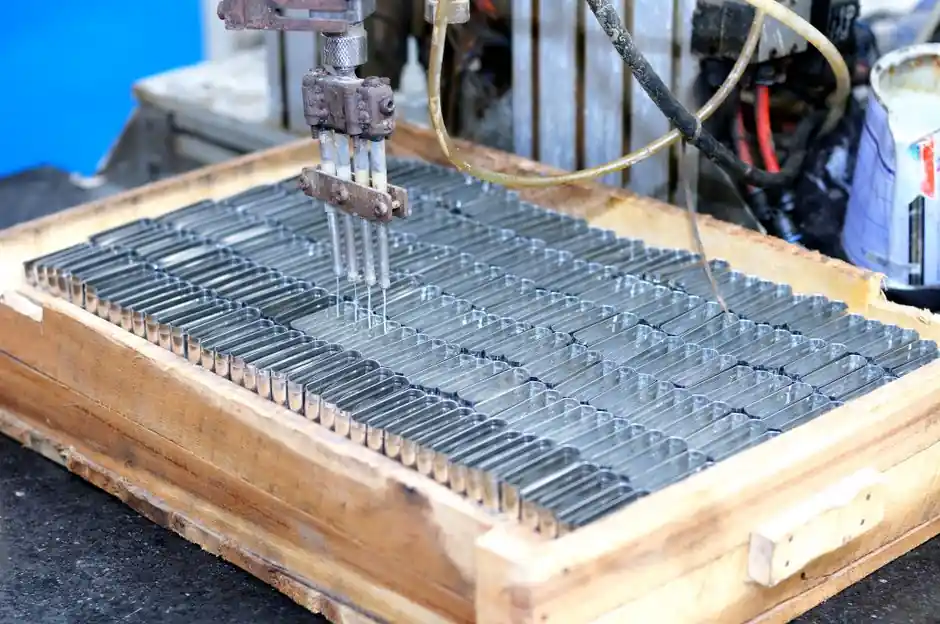
Two Chinese smart small-satellite production lines define the current design baseline: a CASIC subsidiary's Wuhan line rated for 240 small satellites per year, and Hunan Satellite Technology's Zhuzhou line rated for more than 150 commercial satellites annually in the 50–500 kg mass bracket [S1][S2].
Wuhan's 28.4-hectare aerospace industrial base bundles R&D, satellite internet work, micro-craft integration, space monitoring, and data processing under one perimeter, while Zhuzhou's site adds a dedicated space environment testing center and a space materials testing and evaluation center alongside the manufacturing hall [S1][S2].
Throughput targets and mass-class split
The Wuhan line targets 240 small satellites per year, a step change driven by replacing manual integration with machine-led cell assembly, with project designer Liu Feng reporting an average manufacturing efficiency improvement above 40 percent versus the prior manual baseline [S1]. Zhuzhou's commercial line, owned by private firm Hunan Satellite Technology Co., Ltd., is sized for more than 150 satellites per year, explicitly bounded to a 50–500 kg per-satellite mass envelope, which covers most LEO remote-sensing, IoT, and small SAR constellations now in deployment [S2]. The two mass-class choices diverge: Wuhan was framed as a general small-satellite industrial park inside a state-owned aerospace integrator, while Zhuzhou is commercial-only and was launched on 2024-10-25 during the 3rd International Summit on BDS Applications, with satellite orders already booked before commissioning [S2]. Buyers comparing similar lines should treat 240 units/year as a state-integrator reference throughput and 150+ units/year as a private-sector reference for the 50–500 kg class.
Factory layout and AIT flow
Both facilities follow a four-block factory layout: an R&D center, a satellite-manufacturing factory, a space environment testing center, and a space materials testing and evaluation center, which keeps assembly, integration, and test (AIT) on a single site and eliminates inter-building transport of flight hardware [S2]. Wuhan extends that pattern with a 28.4-hectare master plan that adds satellite internet R&D, micro-craft work, space monitoring, and data processing on the same site, so AIT output can be handed directly to a constellation operations team without leaving the perimeter [S1]. The 40 percent efficiency uplift claimed at Wuhan is consistent with replacing hand-torqued structural bonding, manual harness layup, and bench-top solar-array integration with fixtured robotic cells, a pattern readers cross-referencing the automatic molding line encyclopedia entry will recognise as a general-purpose discrete-assembly automation principle. Inside the AIT hall, clean-room class is typically ISO 7 or ISO 8 around the integration cells, with local ISO 5 laminar flow zones for thruster and propellant-handling operations, although specific ISO classifications for the Wuhan and Zhuzhou halls have not been published.
Machine-led integration versus manual baseline
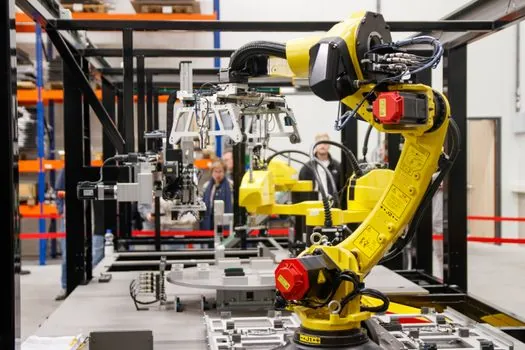
Liu Feng, one of the Wuhan project's designers, stated that the new line improves average manufacturing efficiency by more than 40 percent by carrying out many key satellite production steps with machines rather than manual labor, a delta that maps directly onto structural bonding, harness routing, fastener torque, and propellant-loading steps [S1]. Zhuzhou's commissioning data, released 2024-10-25, ties that same automation philosophy to a commercial throughput of over 150 satellites per year in the 50–500 kg class, with production beginning immediately on launch [S2]. For a peer doing a make-versus-buy study, the engineering signal is that 40 percent efficiency headroom is achievable when AIT is reorganized around fixtured cells, not when automation is bolted onto a hand-integration shop. A process engineer planning a greenfield line should also benchmark against the molding line reference, which documents the same fixture-and-cell logic applied to non-aerospace discrete assembly, and against the conveyor sorting line reference, which covers inter-station handoff and WIP buffering for high-mix flows.
On-site test cells and qualification gating
Zhuzhou's facility includes a space environment testing center and a space materials testing and evaluation center on the same site as the manufacturing hall, which means thermal-vacuum, vibration, EMC, and materials coupons can be qualified without shipping flight hardware off-perimeter [S2]. Wuhan's 28.4-hectare aerospace base bundles R&D, micro-craft work, and space monitoring onto the same campus, so a satellite can move from integration to test to operations handoff inside one secured perimeter [S1]. A buy-gate discipline that hardens between integration and launch typically includes: incoming materials coupon test, structural-fit check, thermal-vacuum cycle, sine and random vibration, EMC compatibility, and end-to-end payload functional test, each gated by a pass/fail traveler. Cost-side context for the same bus-and-payload stack these lines are designed to build is documented in the cost-breakdown analysis here, which is the natural cross-reference for any peer sizing capex versus per-satellite recurring cost.
Site-level enabling systems and supply chain

Wuhan's line sits inside a national aerospace industrial base in Hubei Province, with the 28.4-hectare industrial park intended to provide support for space monitoring, data processing, and operations once fully built out, so ground-segment and mission operations are co-located with AIT [S1]. Zhuzhou's site is a private-sector industrial park in Hunan Province owned by Hunan Satellite Technology Co., Ltd., launched during the 3rd International Summit on BDS Applications, with orders already secured and production starting immediately at line commissioning on 2024-10-25 [S2]. Both sites cluster their enabling systems: power conditioning with UPS-backed clean feeds for AIT cells, chilled water for thermal-vacuum chambers, and secure data links to constellation operations. The Wuhan site's R&D-plus-manufacturing-plus-operations co-location pattern is functionally similar to the line frequency furnace reference for process industries, where the heat source, the forming cell, and the QC station are sequenced along one continuous flow rather than split across buildings. Likewise, in-line optical inspection logic used in the line scan camera reference applies directly to harness and solar-array inspection cells on a satellite AIT line.
Limits of public data and what to track next
Public reporting on both lines gives throughput, mass-class, efficiency delta, and headline facility blocks, but does not disclose ISO clean-room class, thermal-vacuum chamber count, vibration shaker rating, or unit recurring cost, so any peer benchmarking off these two sites should treat the 240/year and 150+/year numbers as upper-bound capacity, not as typical-year output [S1][S2]. A 2025-2026 trend worth tracking is whether private-sector lines like Zhuzhou converge with state-integrator lines like Wuhan on cycle time, or whether the 50–500 kg mass bracket spawns dedicated sub-lines for 50–150 kg IoT-class birds versus 200–500 kg SAR and high-throughput optical birds. Adjacent context on the sensor-side supply constraint that gates any constellation build-out is in the MEMS sensor demand 2026–2030 reference, which sizes the inertial and pressure-sensor bottleneck against a US$80B base and US$150B ceiling demand case.