
Sodium-ion battery production is graduating from pilot lines to GWh-scale factories, with CATL and Hyperstrong signing a 60 GWh stationary-storage agreement over three years, the largest single sodium-ion order recorded to date [S3].
The bottleneck is no longer electrochemistry. Mid-to-small sodium-ion lines are running at roughly 70% production yield while mature lithium-ion lines exceed 95%, and process-control instrumentation (moisture analyzers, inline particle sizers, stack-pressure cells, swelling-force sensors, and EIS cyclers) is now the gating capability for closing that gap [S3].
Where Sodium-Ion Process Control Breaks Differently from Lithium-Ion
Layered oxide cathodes in sodium-ion cells are markedly more sensitive to moisture and CO2 degradation than LFP or NMC cathodes, which is why incoming-material screening at the powder stage (powder resistivity plus compaction density) is the first line of defence rather than an optional QA step [S3].
Hard carbon anodes introduce a separate failure mode. Their disordered turbostratic structure needs interlayer spacing and surface defect sites to host sodium ions, and that same structure makes the carbonised powder (treated at 1,000-1,400 degrees C) exceptionally sensitive to grinding conditions, surface area, and PSD control [S5]. A 4-level characterisation hierarchy (particle, powder, electrode, cell) is now the accepted framework for closing the loop on these issues [S3].
Polyanionic Cathode Dry Grinding and Contamination Budgets
Wet bead milling of polyanionic cathodes can reach the required nano-scale PSD, but grinding-media wear introduces iron and zirconium contamination at the ppm level, and the downstream spray drying step consumes 30-40% of total process energy while risking agglomerate formation [S5].
Dry grinding (jet milling and high-energy mechanical milling) eliminates dissolution of metallic ions from the media and removes the drying step entirely, which matters for a chemistry whose commercial proposition is low cost [S5]. The trade-off is tighter PSD and surface-area control, so the specification on classifier cut point and mill residence time is now a primary instrumented variable, not a mechanical afterthought. Cross-referencing the layered cathode sub-flow against the broader battery pack process-control spec map clarifies which transmitters and analyzers can be reused from a lithium-ion line versus which need sodium-specific calibration.
Hard Carbon Anode: PSD, Surface Area, and Carbonisation Uniformity
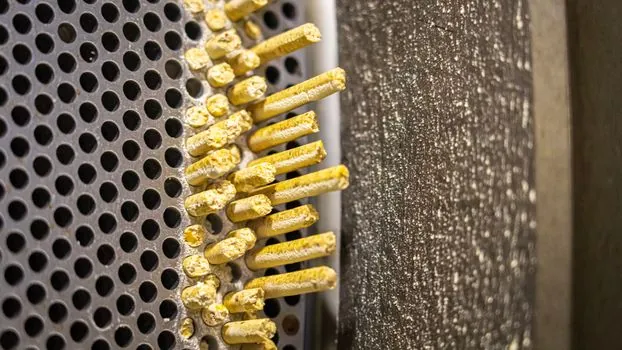
Hard carbon precursors become brittle after carbonisation at 1,000-1,400 degrees C, which simplifies size reduction, but the harder control problem is outcome consistency: PSD, BET surface area, and tap density must be held inside tight bands or sodium uptake at the anode becomes cell-to-cell variable [S3][S5].
Wet grinding of hard carbon causes swelling that disrupts the disordered structure, so manufacturers are migrating to dry routes paired with inline laser-diffraction PSD meters, and with powder-resistivity probes that flag under- or over-carbonised batches before coating [S3]. The single-particle crushing strength test, measured at the particle level, is the upstream gate that determines whether the powder will survive slurry mixing and calendering without fracturing [S3].
Electrode-Level Instrumentation: BER, EIC, and BEF
At the coated-electrode stage, three measurements now define release-to-next-step: bulk electronic resistivity (BER), effective ionic conductivity and tortuosity (EIC), and electrode flexibility (BEF) [S3]. Each one maps to a discrete upstream defect: BER catches conductive-additive dispersion problems, EIC flags calendering density drift, and BEF detects binder migration or coating cracks before cells are assembled.
This is a different sensor stack than a lithium-ion electrode line because the ionic radii and the electrolyte-salt chemistry are not the same, so tortuosity targets and conductivity baselines have to be re-baselined cell-by-cell. A practical battery pack production line design needs to reserve floor space and utility drops for these inline electrode-test stations from day one, not retrofit them after first-article failure review.
Cell-Level Dynamics: Operando Swelling, Stack Pressure, and Gassing

Operando swelling-force measurements on sodium-ion stacks reveal a bimodal swelling behaviour that is specific to this chemistry, and that response drives stack-pressure setpoint selection during formation cycling and during the early-life cycle window [S4].
In-situ gassing characterisation (GVM for gas-volume measurement, MSG for mass-of-gas species identification) plus EIS, CV, and GITT at the cell level capture the dynamic electrochemical and mechanical responses that ultimately determine cycle life, rate capability, and safety [S3]. For a tabless-format commercial cell from Hina Battery, postmortem teardown plus electrochemical testing has become the reference workflow for validating that the formation protocol matches the actual failure modes inside the cell [S6]. Process-control loops in modern battery management system procurement increasingly consume these cell-level signals directly, so the instrumentation boundary between cell finishing and pack assembly is shifting upstream.
Process Calibration Loop and Standards Posture
Because each measurement (PSD, moisture, CO2, stack pressure, EIS impedance, gas volume) drives a downstream yield decision, sodium-ion lines need traceable calibration on every inline analyser, and the calibration cadence for moisture and CO2 probes is shorter than for LFP lines because the cathode degradation kinetics are faster at ambient exposure [S3].
The practical fallback is to anchor calibration cycles to process calibration routines tied to material lot release, and to validate the full cell-level measurement chain with a multifunction process calibrator before each new SKU runs. Closed-loop control across the 4-level hierarchy (particle to cell) is the engineering pattern that will move sodium-ion yield from 70% toward the lithium-ion benchmark, and process control system architectures for these lines are being specified now around that premise.
Selection Criteria: What to Specify versus What to Reuse from a Lithium-Ion Line
For a sodium-ion greenfield, the controllable variables fall into four decision groups: (1) incoming-material screening (powder resistivity, compaction density, moisture/CO2), (2) powder processing (inline PSD via laser diffraction, BET surface area, contamination monitoring), (3) electrode QA (BER, EIC, BEF), and (4) cell-level dynamics (operando swelling, stack pressure, GVM/MSG, EIS/CV/GITT) [S3][S4].
Reuse from an existing lithium-ion line is feasible for solvent handling, dry rooms, and most slurry mixing skids; reuse is risky for cathode-side PSD and moisture control, for formation cycling profiles, and for stack-pressure fixture design, because the failure modes are chemistry-specific [S3][S4]. Procurement teams should treat sodium-ion instrumentation as a separate bill of materials even where the lighting equipment and electric lamps inside dry-room inspection stations and the lamps and light fittings on the coating line are identical, and they should budget for higher analyser density per megawatt of cell capacity than a comparable LFP line.
Trackable signals over the next two quarters: published yield disclosures from CATL and Hina Battery on the 60 GWh program, revision of any China New Energy Storage Technology Development Roadmap 2025-2035 milestones on sodium-ion QA thresholds, and the first third-party multi-level characterisation datasets on polyanionic versus layered-oxide production lines.