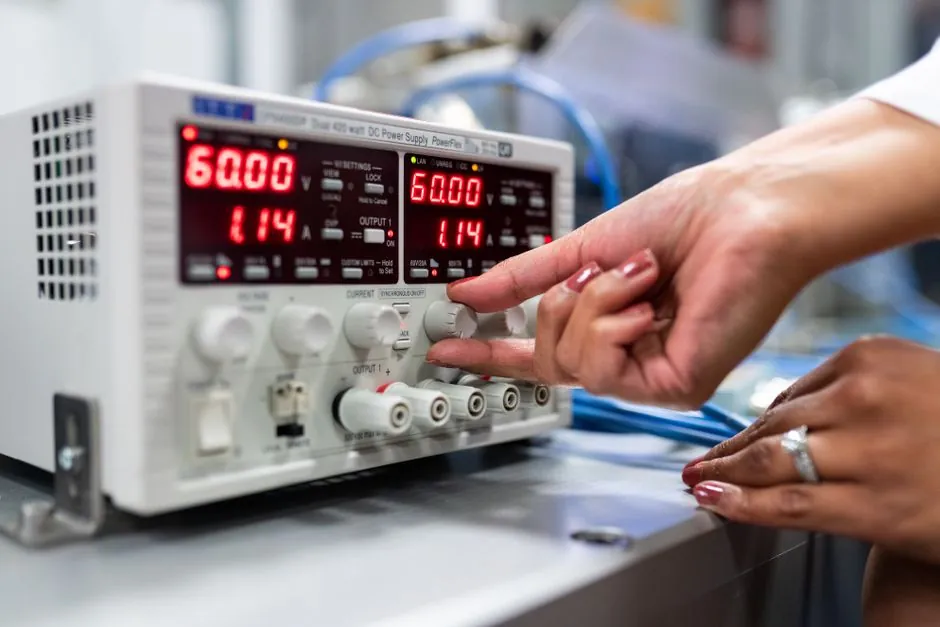
Pack-line process control centers on a PLC/SCADA backbone with ISA-style HART/4-20 mA field devices, dew points of -40 to -60 °C in the dry room, and formation-cabinet voltage and current accuracies of ±1 mV and ±0.1% of full scale, per a 2026-07 spec map for cell and pack lines [S4].
The scope spans electrode coating through pack assembly, with the dry room treated as the first control loop, O₂ held below 1,000 ppm in formation purge, and cell-to-pack measurement stations resolving voltage to 0.001 V and internal resistance to 0.001 mΩ, drawing on 2024-2026 vendor data and a U.S. pilot-plant I&C design posting [S1][S3][S4].
Dry-Room Moisture and Electrolyte Filling Control
Li-ion dry rooms are commonly specified at -40 to -60 °C dew point, which corresponds to 10-60 ppm moisture by volume and below 1% RH at 20 °C, with cell-area electrolyte water content capped below 20 ppm to prevent LiPF₆ hydrolysis and HF attack on the SEI [S4]. Capacitive probes handle continuous monitoring while chilled-mirror hygrometers serve as the periodic reference because capacitive drift is the more common field failure mode [S4]. On the filling line, per-cell weighing systems resolve to 0.01 g, vacuum levels reach ≤10 Pa on prismatic turnkey lines, and inline leak testers flag pressure-decay rates below 10⁻⁶ mbar·L/s, the same acceptance threshold used in hermetic helium-snug testing of chemical-service control valves [S4][S5]. Filling accuracy on commercial prismatic turnkey equipment is held to ±0.01 g under ≤10 Pa vacuum, with soaking shelves running 8-24 h at ±2 °C temperature uniformity [S5]. Engineers selecting these loops lean on a multifunction process calibrator for loop commissioning because the dry-room dew-point, vacuum transducer, and load-cell chains are validated against one transfer standard.
Electrode Coating Grammage and Calendaring Closed-Loop
Coating grammage is held within ±1.5 to ±2.0% of target areal weight, fed back from a beta-gauge or X-ray fluorescence head upstream of the drying oven into a PLC setpoint that adjusts slot-die flow in real time [S4]. Calendaring compresses dried electrodes to 30-35% porosity for graphite anodes and 25-30% for NMC/LFP cathodes, with load cell resolution of 0.1 kN and a closed-loop tolerance of ±2 µm on the final coating thickness [S4]. On prismatic turnkey lines, coating accuracy is ±1 µm at 80 m/min, drying-oven temperature uniformity is ±2 °C across up to six heating zones, and calendaring pressure control is ±0.5 t with ±1 µm thickness accuracy [S5]. In-line defect cameras flag pinholes, agglomerates, and edge cracks at 60-100 m/min, with reject targets below 0.5% by area, and electrode inspection systems resolve defects to ≤50 µm [S4][S5]. Slitting follows with burr ≤5 µm at 100 m/min, the mechanical spec that the control loop has to keep stable before cells move to stacking [S5].
Cell Assembly: Stacking, Welding, and Module Fixturing
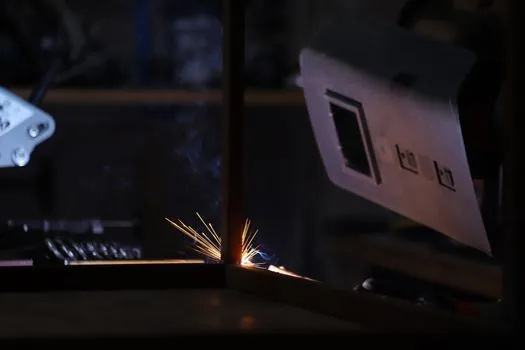
Z-folding and core-insertion stations on prismatic lines hold separator/electrode alignment to ±0.1 mm at 0.2 s per layer and core-insertion accuracy of ±0.2 mm into aluminum prismatic cases, with notching precision of ±0.05 mm at 100 pcs/min [S5]. Ultrasonic or laser tab welding is qualified at weld strength ≥90% and ±0.1 mm positional accuracy, while bus-bar welding on cylindrical pack lines requires pull force above 1,400 N and a pole-to-busbar gap below 0.2 mm [S3][S5]. Cylindrical module fixturing clamps cells at 300-500 N per cell, with total clamp force capped at ≤8,000 N per side, a module length of ≤1,200 mm, and overall length error of ±0.5 mm [S3]. After stacking, the maximum stacking number of modules is 16 cells, and post-stack pole height difference must stay under 0.05 mm; robot repeatability is specified at ±1 mm moving and 0.5 mm static [S3]. Cell-thickness measurement stations apply a controlled force of ≤4,000 N with the thickness value displayed on the HMI, feeding the laser coder that prints the module code to a ±1 mm positional tolerance at 100% coding accuracy [S3]. process calibration of the load cells, displacement transducers, and laser coder is what keeps those ±0.5 mm and 0.05 mm numbers from drifting in production. Companion context on the upstream design choices is in Battery Cell Production Line Design: Stages, Cell Formats, and 2026 Spec Levers.
Formation, Aging, and End-of-Line Grading as One Long Control Loop
Formation is the longest single control step: a fresh cell is charged at 0.05-0.2 C to formation voltage, held, then cycled 2-5 times at 0.2-0.5 C to grow the SEI layer, with each formation-cabinet channel logging voltage to ±1 mV and current to ±0.1% of full scale [S4]. Aging follows for 7-21 days at 25-45 °C with intermediate OCV and DCIR screening, and cells outside the population's 3-sigma IR envelope are binned for second-grade use [S4]. The formation cabinet behaves like a two-hand safety interlock: charging cannot start unless the door interlock, contactor feedback, and BMS hardware trip are all HIGH, and the mass-flow-controlled N₂ or Ar purge keeps O₂ below 1,000 ppm to suppress fire risk [S4]. End-of-line grading cabinets cover 0.1-300 Ah with ±1 mAh classification accuracy, while OCV/IR testers resolve voltage to ±1 mV and internal resistance to ±0.1 mΩ [S5]. Pack-level OCV/IR stations on cylindrical lines extend the same envelope: voltage range 3-5 V at 0.001 V accuracy, internal resistance 0.1-0.5 mΩ at 0.001 mΩ accuracy, with NG cells auto-routed and recovered manually [S3].
Selection Criteria: Cylindrical vs Pouch vs Prismatic Pack Lines

The three form factors drive different control-loop emphases, and the differences are best read off the instrumentation rather than the marketing. Cylindrical pack lines emphasize cell sorting and mechanical fixturing, with the cylindrical spec at voltage 0.001 V / IR 0.001 mΩ / clamp force 300-500 N per cell / bus-bar pull force ≥1,400 N [S3]. Pouch cell assembly pushes dry-room and inline leak-test performance, with pressure-decay acceptance below 10⁻⁶ mbar·L/s and electrolyte water content below 20 ppm [S4]. Prismatic turnkey lines emphasize turnkey integration and turnkey-equipment metrics: 99.8% equipment yield, coating ±1 µm, calendaring ±1 µm, vacuum filling ±0.01 g at ≤10 Pa, and formation-cabinet voltage accuracy ±0.05% with current accuracy ±0.1% [S5]. For BMS integration, the BMS monitors voltage, current, temperature, and pack-level state-of-health across the same parameters the formation cabinet logs, and cells are graded by capacity, voltage, and IR before any pack is built [S2]. Primary lithium (Li-SOCl₂ and Li-MnO₂) lines run similar loops but at lower SEI-management demand, with cell sizes spanning ER14250 to ER341245 and CR2 through CR26500 [S4]. Engineers running mixed-format plants stage the process control architecture so the same PLC/SCADA backbone covers all three formats with format-specific HMI recipes.
Standards, Sourcing, and Pilot-Plant Postings
Industrial I&C scopes for battery pilot plants are explicit: PLC programming, control-panel design, instrumentation, electrical documentation, system commissioning, and ongoing process improvements, with deliverables including I/O lists, loop diagrams, network diagrams, instrument lists, and equipment layouts [S1]. The 2026-07 American Battery Technology Company posting in Reno, Nevada covers a multi-step processing train for mechanical processing, physical separation, chemical extraction, and commercial-scale battery metals, with a mid-senior Controls & Electrical Design Engineer responsible for PLC hardware selection, HMI/SCADA development, and integration of PLCs, remote I/O, VFDs, instrumentation, safety systems, and plant network devices [S1]. Pack-line sourcing decisions are increasingly tied to chemistry compliance and quality standards, and a 2026 spec map on Battery Pack Manufacturing Quality Standards lines up against the same loop accuracies described above. Cross-reference is useful on adjacent power-side instrumentation, and the same 4-20 mA / HART field-device discipline is documented in the Pressure Sensor Suppliers and Manufacturers: 2026 Spec Map and Selection Guide for dry-room and formation-cabinet pressure loops.
Next nodes to track: ABTC Reno pilot-plant commissioning milestones and any expansion of formation-cabinet ±0.05% voltage accuracy beyond current prismatic turnkey offerings, plus adoption of inline X-ray fluorescence grammage gauges on cylindrical pack lines where beta gauges still dominate.