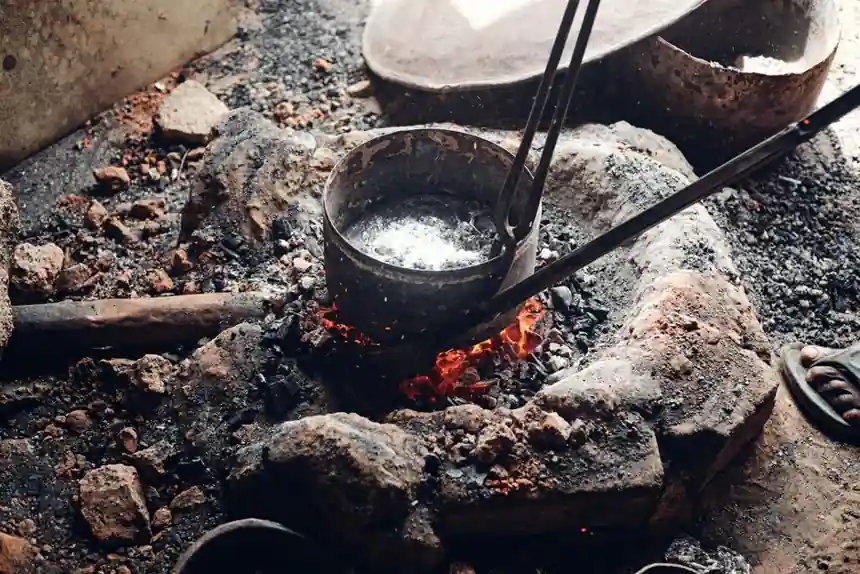
Induction hardening heats a local surface zone in seconds using electromagnetic induction, while furnace heat treatment heats an entire part or batch slowly in a controlled atmosphere.
For localized treatment, compare induction with furnace hardening on treatment depth, distortion, throughput, part size, and inspection requirements rather than treating them as interchangeable processes.
Choose the Process by Heating Scope and Production Volume
Choose induction hardening when only a defined surface zone needs a hard, wear-resistant layer and the core must remain relatively tough. Induction heat treatment is particularly useful for applications requiring controlled case depth, repeatable results, and integration into high-volume production [S4].
Choose furnace heat treatment when the section must be heated through the core, the load contains varied geometries, or the required result is through-hardening. Furnace heat treatment heats the whole part or load in a controlled atmosphere before quenching and, where applicable, subsequent tempering [S3][S4]. A heat treatment furnace is the better process platform when load uniformity, atmosphere control, and batch flexibility dominate the decision.
The choice between induction and furnace treatment depends on factors such as case depth, production volume, throughput, part size, and geometry [S3][S4]. Induction can scan a long component section by section, with either the part moving through the coil or the coil moving along the part, while furnace treatment processes complete loads in chamber cycles [S1].
Compare Heating Depth, Speed, and Distortion Control
Induction heating creates eddy currents within the workpiece, and electrical resistance generates heat internally through Joule heating. At higher frequencies, eddy currents concentrate closer to the surface, producing a shallower initial heating zone; lower frequencies support deeper heating [S3][S4].
Final case depth is not controlled by frequency alone. Heating time, power density, coil geometry, material properties, heat conduction into the core, and quenching conditions all affect the resulting hardness profile [S4]. Treat any proposed case depth as a process-development result requiring hardness and metallurgical verification, not as a direct reading from the power supply frequency.
Furnace treatment heats the complete section and therefore supports more uniform core properties, but it also introduces broader thermal gradients during heating and quenching. Furnace treatment heats and quenches the whole load, so warpage and residual stress are higher than with localized induction hardening [S3]. The trade-off is clear: induction is faster and more selective, while the furnace is slower and more comprehensive.
Match the Process to the Part and Application
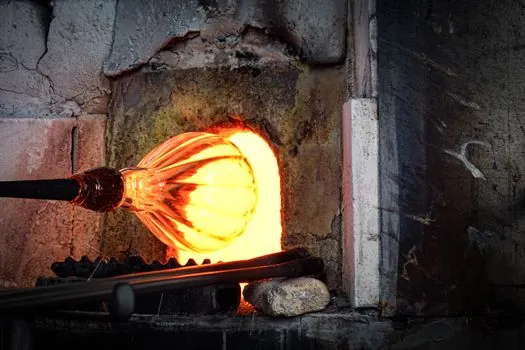
Use induction hardening for localized surface enhancement when the component is electrically conductive, the target area can be reached by a suitable coil, and repeat production justifies coil and quench-system development. Induction supports surface hardening, tempering, annealing, stress relief, and other localized operations [S4].
Use a furnace for through-hardening, large or variable batches, and applications where the entire section must reach the heat-treatment temperature. Furnace treatment is also the more logical starting point when part geometry prevents effective coupling or when a broad load must receive a uniform thermal history [S3].
For local spring treatment, induction can preserve a tough core while producing a hard martensitic surface layer. Furnace treatment is preferred when the spring design calls for through-hardening or when the production mix changes too often to justify a dedicated coil and scanning arrangement [S3]. This is a process-fit distinction, not a quality ranking.
Evaluate Cycle Time, Energy, and Capital
Induction cycle times can be measured in seconds per part, while furnace cycles are measured in hours per batch [S3]. That difference makes induction attractive for high-volume production, automated cells, and parts that pass repeatedly through the same coil geometry. Furnaces remain attractive for mixed batches, large loads, and work requiring broad thermal processing.
Energy use depends on the treatment objective, part mass, coil coupling, furnace construction, atmosphere, and thermal losses. Localized induction avoids heating untreated portions of the workpiece and can be more energy-efficient for that reason, while furnace systems carry the energy required to heat chamber, fixtures, and the complete load [S2][S5].
Do not compare only equipment purchase price. Include coil design, power supply, cooling or quench media, controls, tooling, fixturing, maintenance, and the cost of distortion or rejected parts. The induction furnace category provides a useful equipment reference for induction systems, but a hardening line still requires the correct coil, frequency, power, and quench arrangement for the component.
Control Distortion, Quenching, and Part Acceptance
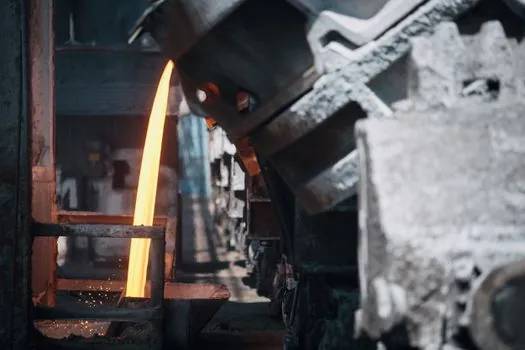
Quench intensity and uniformity are critical in both routes. Quench system selection must be based on the steel grade, geometry, section, distortion limit, and required hardness profile rather than on cycle-time alone.
Specify surface hardness, a hardness profile, case depth, and a microstructure check as acceptance criteria [S3]. Add straightness, runout, dimensional inspection, and tensile or fatigue validation where those properties control service life. For induction, record frequency, power, heating time, coil position, travel speed, quench conditions, and part temperature at the end of heating. For furnace treatment, record load pattern, temperature, soak time, atmosphere, quench medium, quench delay, and tempering conditions.
Both processes have failure modes. Induction can develop uneven or shallow cases when coil clearance, coupling, frequency, power, or travel is poorly controlled. Furnace treatment can show excessive distortion, inadequate core properties, oxidation, or nonuniform load results when temperature uniformity, atmosphere, soak time, or quench handling is not controlled.
Set Standards, Evidence, and Process Qualification
The 2014 ASM International preview on principles of induction hardening and inspection identifies induction heating applications including annealing, normalizing, surface or case hardening, through-hardening, and tempering [S6]. This supports treating induction as a family of thermal processes rather than a single hardening recipe.
For steel selection, distinguish induction hardening from carburizing or nitriding case hardening. Induction heating creates a hardened layer by controlled heating and quenching, whereas diffusion-based case hardening depends on slower carbon or nitrogen movement to produce a deeper case [S8]. A case-depth specification alone is therefore insufficient to identify the process.
Qualify the selected route with the actual material grade, geometry, coil or load arrangement, production power supply, and quench system. Record sample results for surface hardness, effective case depth, microstructure, distortion, and the relevant mechanical property. For furnace route selection, batch versus continuous conveyor furnace considerations provide additional context when material movement and lot size affect the decision.
The practical recommendation is straightforward: specify induction for repeatable, localized surface zones in high-volume production, and specify furnace treatment for through-sections, variable loads, or mixed part families. Validate case depth, hardness, distortion, and service-relevant mechanical properties before committing the production route.