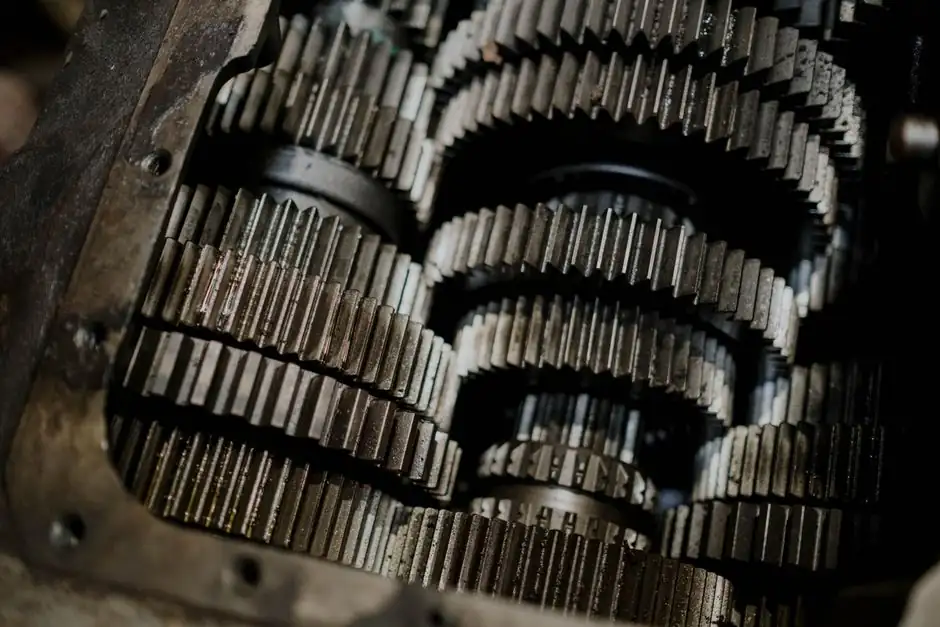
Industrial gearbox buyers importing from China in 2026 should treat the RFQ stage as a technical-qualification gate, not a price exercise: confirm ISO 9001:2015 certification, DIN 6 gear accuracy, 20CrMnTi case-hardened alloy, and a documented 58-62 HRC surface-hardness window before negotiating unit cost [S1].
China remains the largest manufacturing node in the industrial transmission supply chain, exporting $59.1 billion in motor vehicles, parts, and accessories during 2025, with over 10,000 parts suppliers and a typical 30-50% cost advantage versus Western factories [S3]. Power-transmission specialists like LiuDrive report 39+ years of accumulated factory relationships and a curated network built since 1987, which is the depth most one-off importers lack [S5].
Gear Type Selection: Helical, Planetary, Worm, and Cycloidal Trade-Offs
Helical, planetary, worm, and cycloidal reducers are the four dominant gearbox families sourced from Chinese factories, each covering a distinct operating envelope. Helical units (DIN 6 tooth accuracy, 20CrMnTi gears, 58-62 HRC surface) reach above 95% mechanical efficiency and are the default for continuous-duty conveyors and mixers [S1]. Planetary gearheads offer higher torque density per kilogram and lower backlash (often under 10 arc-min for precision grades), but cost rises sharply for ground-internal-cycloid stages [S2].
Cycloidal pin-gear reducers (the RV-style architecture) carry shock-load tolerance as their main selling point and are widely specified for mining, crane, and agitator duty. For a deeper comparison against the RV/crossed-roller class, see this RV reducer sourcing spec band analysis, which breaks down the same vendor-tier logic applied to gearboxes.
Mandatory Certification and Material Verification
ISO 9001:2015 is the floor, not the differentiator; CE marking (Machinery Directive 2006/42/EC) is required for European import, and ATEX 2014/34/EU certification gates any gearbox destined for Zone 1 or Zone 21 hazardous areas [S2]. Buyers should also request the mill certificate (EN 10204 3.1) for each heat of 20CrMnTi or 42CrMo alloy steel, confirming chemistry and hardenability before cutting starts [S1].
For North American shipments, UL-listed explosion-proof enclosures (NEC Class I, Division 1) and CSA equivalents are non-negotiable for oil-and-gas duty. Power-transmission sourcing partners note that a single missed certification can detain a 40-foot container at port, which is why supplier vetting covers documentation, not just sample parts [S5]. Material verification beyond the certificate: insist on a spectrographic test report for every batch, since surface hardness (58-62 HRC) can read correct on a finished gear but hide a low-alloy core that fails under shock load [S1].
Quality Control Gates: DIN 6 Accuracy and Factory Acceptance Testing
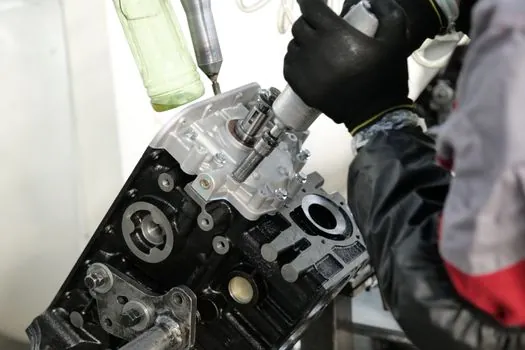
DIN 6 gear accuracy (DIN 3962-3964) is the most common spec quoted for industrial helical gears, equivalent to AGMA 2001 quality 9 for fine-pitch gearing, and it is the threshold at which noise stays below roughly 75 dB(A) at 1 m on a typical 4-pole motor input [S1]. Chinese factories that run imported CNC gear grinders (Reishauer, Liebherr, or Kapp class machines) can hold DIN 6, while shops with only hobbing capacity typically settle at DIN 8-9. Buyers should ask which machine brands are on the shop floor, not just which standard is claimed.
Factory acceptance testing (FAT) should cover no-load current draw, full-load temperature rise (typically below 90 K over ambient for helical units with synthetic PAO oil), vibration velocity (ISO 10816-3 limits for rigid mount), and a 4-hour loaded run-in. Independent third-party inspection (SGS, BV, TUV) adds roughly 1-3% to the order value but catches roughly 80% of the defects that would otherwise surface at commissioning. For a process engineer, the QC punch list is the single most enforceable artifact in the contract, and it should be attached as Annex B before the purchase order is released.
Customization Scope: Ratios, Mounting, Voltage, and Shaft Geometry
Chinese gear-motor suppliers typically support gear ratios from 3:1 up to 10000:1 (compound helical or planetary-helical combinations), with B5 flange, B14 face, B3 foot, or combinations available on the same housing family [S2]. Input voltages cover 220V/380V/400V/440V/480V at 50 or 60 Hz, with single-phase, three-phase, brake-motor, and inverter-duty winding variants. Shaft output can be solid, hollow, or shrink-disc, and custom bore tolerances down to H7 are routine for any factory running a proper CNC lathe cell.
For OEM buyers, the most expensive customization is usually a non-standard reduction ratio combined with a non-standard output flange; expect a tooling/setup surcharge of $2000-5000 and a 4-6 week lead-time adder for first articles. Sticking to a catalog ratio on a standard foot or flange mount usually keeps sample lead time at 2-3 weeks and mass-production at 30-45 days, depending on capacity booking. The lesson: standardize your spec sheet before talking price, because every "small" deviation multiplies tooling, inspection, and documentation work.
Lead Time, MOQ, and Total Landed Cost
Standard helical and worm-gear units carry no formal MOQ in most Chinese factories, but custom color, custom nameplate, or custom ratio orders typically start at 50-100 units to justify the line changeover. Lead time for catalog items is 15-30 days ex-works, plus roughly 28-35 days door-to-door for a 20-foot container moving via Shanghai or Ningbo to a U.S. East Coast port under FOB terms. [S3]
Total landed cost typically lands 30-50% below a comparable Western quote, but the gap narrows for low-volume orders once tooling amortization, third-party inspection, and customs brokerage are layered in [S3]. Incoterms choice matters: CIF locks the freight rate, DDP hands the entire customs risk to the supplier, and FOB leaves it with the buyer, which is the cleanest structure for experienced importers.
Common Failure Modes and Specification Traps to Avoid
Three failure patterns show up repeatedly in low-cost gearbox imports: (1) case-hardened gears that pass 58-62 HRC surface hardness but fail the core-impact test, indicating shallow case depth, typically under 0.6 mm, where AGMA duty calls for 1.0-1.5 mm on a 4-module gear; (2) bearings specified by Chinese part number only, making replacement impossible without the original factory cross-reference; (3) oil-seal lip material rated for -20 to +120 C but installed in an ambient above 50 C without external cooling [S1].
Another trap is the "DIN equivalent" claim without a documented test certificate; a verbal statement of DIN 6 accuracy is not the same as a coordinate-measuring-machine report run against DIN 3962.
Sourcing Channels: Direct Factory vs. Trading Company vs. Sourcing Agent

Direct factory engagement cuts out the 8-15% trading-company markup and gives access to engineering staff for design changes, but it also pushes the buyer into managing documentation, quality, and logistics across multiple vendors. Trading companies consolidate purchasing, accept lower MOQs, and handle export paperwork, but they cannot influence the production line when a spec slips. A technical sourcing partner sits between the two, charging 5-10% but providing engineering-level review, consolidated purchasing, and one point of contact across multiple factories [S5].
Established Chinese transmission manufacturers with verifiable export histories, like Hangzhou Advance Gearbox Group (founded 1960, gear transmission and powder metallurgy), offer a higher baseline but trade at a 10-20% premium to the long-tail of small and mid-sized factories [S6]. For a first-time buyer, the right starting point is a sourcing partner that will do a 2-3 day factory audit (process, metrology, documentation) before any purchase order is signed.
Next trackable signals: watch for 2026 GB/T national-standard revisions covering gearbox efficiency classes (a pending IE4-equivalent banding for industrial gear reducers), and monitor ISO 6336-2 update drafts for surface-hardened gear load-capacity factors, both of which will reset the minimum spec floor for European-bound shipments through 2027.
Detailed specification references: gearbox, linear guide, and crossed roller guide.