
Specifying commercial flooring in 2026 means picking a material class first, then a brand second: LVT and SPC rigid core dominate retail and office, polished concrete and epoxy handle 10,000+ daily-footfall industrial zones, and carpet tile remains the acoustic baseline for open-plan offices, per distributor linecards aggregating Armstrong, Mannington, Tarkett, Shaw and Karndean SKUs across commercial channels [S1].
Decision-making starts with four axes, traffic load, moisture/chemical exposure, slip coefficient, and lifecycle cost in dollars per square foot per year, before any colour board is opened; the same source linecard lists commercial wear layers from 6 mil to 30 mil, with 20 mil being the typical commercial-grade minimum on glue-down LVT [S1][S4].
Material Classes and What They Actually Cost Over Time
Six material classes cover roughly 90% of commercial specifications: LVT, vinyl composition tile (VCT), commercial laminate, porcelain/ceramic tile, carpet tile, and resin systems (epoxy, polyurethane cement), with relative cost bands, maintenance burden, and service life tabulated in a side-by-side comparison drawn from contractor guidance published in May 2025 [S4].
Commercial epoxy leads service life at 10-20+ years, porcelain/ceramic reaches 15-50+ years, LVT and VCT both sit at 10-20 years, while commercial laminate and carpet tile cluster at 5-15 years; relative cost ranks epoxy high, porcelain/ceramic medium-to-high, LVT medium, VCT low, and laminate and carpet tile low-to-medium [S4]. The 50-year top end on porcelain is the longest in the table and the only one worth considering for transit hubs and hospital cores, where re-tile shutdown costs dwarf material savings.
Slip, Fire and Wear Layer: the Three Numbers That Gate Acceptance
Three numbers decide whether a product gets stamped: ASTM D2047 coefficient of friction (COF) for slip resistance, ASTM E648 or ASTM E84 flame spread for corridors, and the wear-layer thickness in mils printed on the technical data sheet, with 6 mil, 8 mil, 10 mil, 12 mil, 20 mil, 22 mil, 28 mil and 30 mil options visible across the major brand linecards [S1]. For healthcare and food service the floor must also clear OSHA walk-surface rules plus facility-specific sanitation schedules, with slip data usually quoted as a wet COF above 0.42 and a static coefficient above 0.50 [S4].
Specify 20 mil or higher for main entrances, queue lanes, and any area with rolling-load carts; 12 mil is acceptable for private offices and back-of-house corridors under 500 daily crossings, while anything below 12 mil is residential-grade and should be rejected on commercial submittals, a rule visible in the wear-layer filter on a current distributor catalog [S1]. For wet zones, the industrial flooring reference category should be read alongside product data sheets because slip ratings and chemical resistance interact with cleaning chemistry.
Where Each Material Wins and Where It Fails
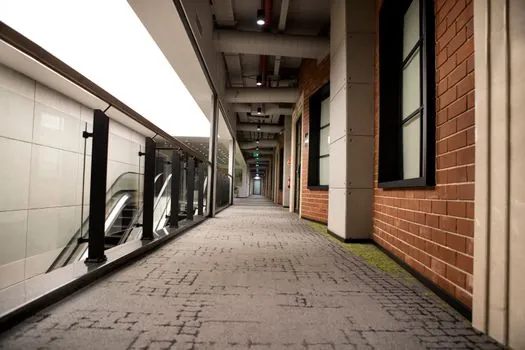
LVT suits retail, offices, restaurants and healthcare because the PVC core, photographic design layer and urethane wear layer together block water, scratches, and most commercial stains, and a damaged plank can be replaced in minutes without touching adjacent tiles [S4]. LVT's failure mode is gouging from sharp metal casters and telegraphing through from uneven subfloor; a 6 mm plywood or fibre-cement underlayment plus a roll-on moisture barrier cures the second failure, while specifying polyurethane casters on all rolling stock cures the first.
Carpet tile wins open-plan offices and hospitality corridors on acoustic performance, with a damaged square liftable and replaceable in under a minute; its failure mode is staining and compression in high-spill or rolling-load zones, where it must be paired with entry walk-off matting or it is uneconomic. Resin flooring, including epoxy and polyurethane cement, dominates manufacturing and pharmaceutical plants because it is seamless, chemical-resistant, and cleanroom-compatible, with polyurethane cement specifically chosen for thermal-shock zones such as wash-down and cold-storage areas [S6]. Porcelain tile handles lobbies, commercial kitchens, restrooms and exterior entries for the same reason it handles a 50-year service life: it does not absorb water, it does not burn, and it tolerates aggressive daily cleaning.
2026 Procurement Reality: Lead Time, Stock and Substrate
Glue-down LVT lead time on common 6" x 48" planks from Philadelphia, Armstrong and Shaw in the 2-3 mm thickness range with 12-20 mil wear layer was running 2-4 weeks on US distributor stock in September 2026, with 20 mil commercial SKUs the most heavily stocked thickness across the catalog at 1,237 line items [S1]. SPC rigid core, a stone-plastic composite click system, is now the fastest-growing entry in the same catalog because the click profile removes adhesive cure time and lets a 1,000 sq ft retail fit-out go down over a weekend, with the SPC flooring reference page documenting the calcium-carbonate core that gives it higher dimensional stability than glue-down LVT.
Substrate prep is where commercial jobs bleed money: concrete moisture vapor emissions above 3.0 lb/1,000 sq ft/24 h per ASTM F1869 calcium chloride test will blister any vinyl, and the fix is a two-coat epoxy moisture barrier plus a cementitious underlayment; budget 2-4 dollars per square foot for this layer on any retrofit over 20-year-old slab. Adhesive choice should be cross-checked against the substrate and the industrial adhesive reference, because pressure-sensitive acrylic, two-part polyurethane and water-based contact adhesives each have a different open time, tack profile and slab-moisture tolerance.
Decision Matrix for the Five Common Building Types

Retail strip mall under 5,000 sq ft: 20 mil glue-down LVT, 2-3 mm thickness, polyurethane finish, slip rating above ASTM D2047 0.5. Office tenant fit-out: 12 mil LVT in private zones, carpet tile in conference and open-plan zones, transition strips at thresholds. Restaurant or healthcare: 20 mil LVT with heat-welded seams in dining and exam rooms, quarry or porcelain tile in kitchens and wet zones, epoxy cove base at 4-6 inch upturn. Manufacturing or warehouse: 6-9 mm polyurethane cement or 3-5 mm epoxy with quartz broadcast for slip, sealed at 100% solids. School or municipal corridor: 20 mil LVT or rubber sheet with ASTM E648 Class I flame spread above 0.45 W/cm2. [S1]
This matrix is a starting point, not a substitute for an ASTM D2047 and ASTM F1700 submittal review on the actual product, and the same contractor guidance referenced earlier puts OSHA walk-surface compliance, healthcare sanitation and food-service slip resistance in the hard-requirements column rather than the nice-to-have one [S4]. For a residential build that is being asked to perform commercially, the industrial flooring specified for residential builds selection map extends the same matrix with thinner wear layers and click-lock profiles; for plants that need more than a floor covering, the suspended ceiling selection for prefab modular construction map is a useful parallel for finish-trade spec writing.
Verifiable Next Nodes for Spec Writing in Q4 2026
Track the ASTM F1700 solid vinyl tile standard revision balloting cycle, the OSHA 29 CFR 1910.22 walking-working surfaces enforcement actions, and the manufacturer wear-layer disclosures on 2026 production runs; the published distributor linecards aggregating Armstrong, Mannington and Shaw SKUs from September 2026 are the cleanest public snapshot of which thicknesses and which collections are in stock across commercial channels [S1]. Confirm the slip coefficient, flame spread and substrate prep clause on every submittal before signing, because the same source flags that a 20 mil wear layer, a 0.5+ COF, and a subfloor moisture barrier together are the three clauses that consistently survive an OSHA or healthcare audit.