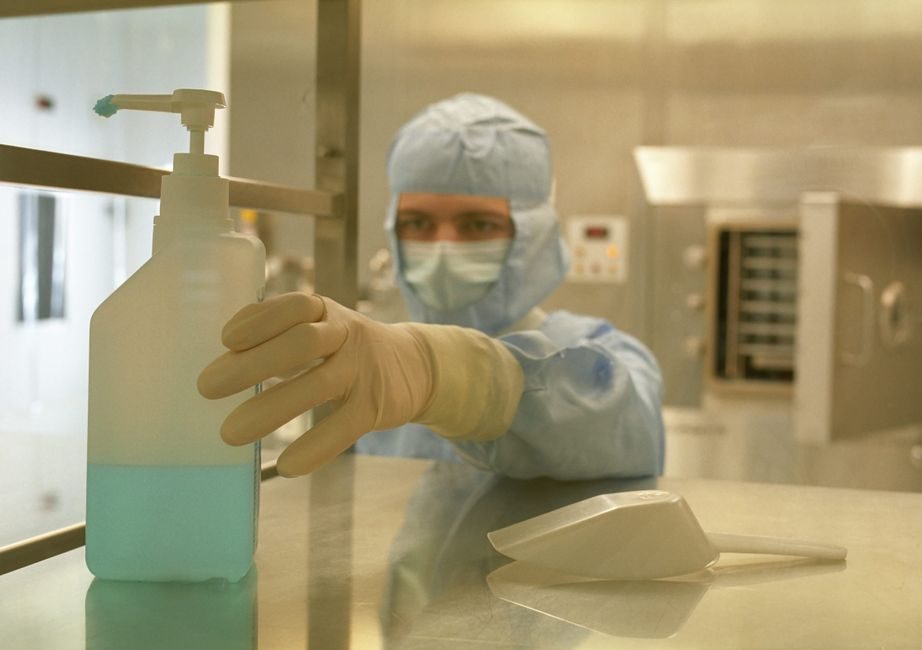
Cleanroom construction specifies special cements — defined here as low-alkali, low-dust, sulfate-resistant, polymer-modified, or self-leveling binders — to control particulate and ionic contamination at the slab and wall interface, with the binder chosen against the target ISO 14644 cleanliness class rather than structural load alone.
Unlike ordinary Portland cement (OPC), which can shed measurable dust during placement and continues to leach calcium hydroxide during curing, cleanroom-grade binders are formulated to minimize particle release, alkali-silica reaction (ASR) potential, and moisture-vapor transmission that drives sub-slab contamination. The reference standard for cleanroom garment and material particulate behavior is documented in IEST-RP-CC003.4 (2011), which defines a particle as matter between 1 nm and 1 mm — the exact size band that cleanroom cement specifications target for reduction [S1].
Why OPC Fails Cleanroom Particle Budgets
Ordinary Portland cement liberates airborne PM10 and PM2.5 fines during dry-bag handling, and freshly cured OPC surfaces generate calcium-rich laitance that abrades into the airstream under foot traffic, degrading ISO Class 5 (formerly Class 100) and tighter environments. Per IEST-RP-CC003.4, particle control spans 1 nm to 1 mm — a band wide enough that even subvisible cement fines fall inside the cleanroom monitoring window [S1].
Special cements combat this through three mechanisms: reduced free lime (Ca(OH)₂) content, finer and more uniform particle packing that closes surface porosity, and polymer or pozzolanic additions (silica fume, fly ash, ground granulated blast-furnace slag) that consume residual portlandite. For pharmaceutical and semiconductor suites, this typically pairs with a sealed epoxy or polyurethane topcoat applied to a laitance-free, moisture-tolerant substrate.
Cleanroom Cement Type Comparison on Four Decision Criteria
For ISO 14644-1 Class 5–8 cleanroom builds, four special-cement families dominate the specification table. The comparison below covers the four criteria an engineer weighs at the desk: dust/particle emission, alkali and chloride resistance, moisture-vapor emission rate (MVER), and installed cost relative to OPC. [S1]
Sulfate-resistant Portland cement (ASTM C150 Type V or EN 197-1 CEM I SR) drops chloride ingress to under 0.05% by mass of cementitious material and limits alkali content to 0.6% Na₂Oeq maximum, making it the baseline for ISO 7–8 back-of-house slabs. Low-alkali, low-heat-of-hydration binder (Type IV or equivalent) is preferred for thick pours where thermal gradient cracking would otherwise generate secondary particulates. Self-leveling, polymer-modified underlayment cements with built-in vapor retarders hit MVER below 1.36 kg/100 m²/24 h (3.0 lb/1000 ft²/24 h), the threshold below which most conductive and static-dissipative floor systems can be direct-applied without a separate membrane.
Epoxy-resin and urethane-mortar screeds represent the highest-spec choice for ISO 5 and tighter, since they contain zero portlandite, are cast to a non-porous surface, and tolerate aggressive CIP chemistries (pH 1–13). Cost-wise, expect a roughly 3–8x multiplier over OPC for the cementitious layer alone, with epoxy mortar systems running higher; the delta is normally recovered through reduced filter loading, lower cleanroom down-time for floor re-sealing, and longer recoat cycles documented in the OEM technical data sheet.
Specifying the Substrate: MVER, Surface Profile, and Moisture Tolerance

The single most common cleanroom floor failure is moisture-vapor-driven blistering of the topcoat, traced to insufficient MVER testing before resin application. Calcium chloride moisture-vapor emission testing per ASTM F1869 or in-situ relative humidity testing per ASTM F2170 is the standard site gate. The 1.36 kg/100 m²/24 h ceiling matches the bond-strength window most epoxy and MMA flooring manufacturers publish as their minimum substrate condition. [S1]
For wall systems, glass-fiber-reinforced gypsum panels on metal studs, finished with a seamless epoxy or PVDF coating, dominate ISO 7 pharmaceutical and biotech builds because they eliminate the wet-trades particulate that a cement-plaster wall would shed during the first 90 days of operation. Cementitious wall finishes are reserved for ISO 8 back-of-house corridors or where impact and wash-down resistance outweighs particle control.
The underlying slab is still concrete — typically a 30–35 MPa (4,350–5,075 psi) mix with Type V or low-alkali binder, water/cement ratio below 0.45, and densified with a penetrating silicate or lithium hardener to close the capillary network. The hardener densifies the top 3–5 mm of the slab, reducing dusting under pallet jacks and ISO 7 foot-traffic loads.
Standards, Source Material, and Sourcing Constraints
The governing material standards for cleanroom cement selection are typically ASTM C150 (Portland cement types), EN 197-1 (common cements), and ASTM F1869 / F2170 for moisture testing before resin overlays. ISO 14644-1 sets the airborne particulate classification; ISO 14644-9 sets surface particle cleanliness — the metric the cement substrate directly influences. [S1]
Suppliers of specialty and low-alkali cements in China include established manufacturers such as Guangxi Yunyan Special Cement Building Materials Co., Ltd., a state-owned producer founded in 1992 focused on specialty cement and construction materials R&D and production [S3]. On the buyer side, the procurement logic mirrors the broader special cement selection for industrial facilities workflow, with the cleanroom variant tightening two specific criteria: MVER and surface particulate.
What the Cement Specification Cannot Fix
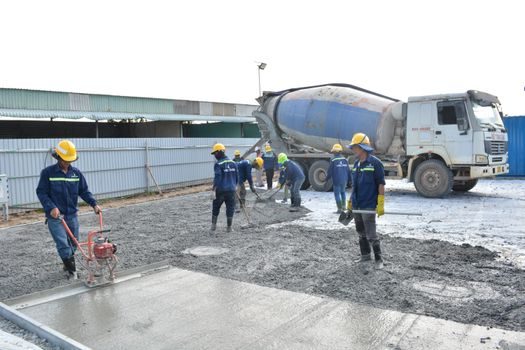
Even a flawless substrate will not bring a space into ISO 5 if the air-handling system, garment system, and operational discipline are not co-specified. The IEST-RP-CC003.4 framework explicitly notes that cleanroom garment systems must address donning, doffing, reprocessing, and the interaction of garments with equipment, fixtures, and facilities [S1] — meaning the floor is one input to a system, not a stand-alone fix.
Specifying engineers should also flag two failure modes that no special cement can prevent: (1) construction-phase contamination when a cement floor is walked on before the topcoat cures, and (2) substrate cracking from shrinkage in wide pours, which breaks the vapor barrier and reopens the contamination path. Both are managed by sequencing, joint layout, and curing-compound selection rather than binder chemistry alone.
Selection Checklist for Engineers
Final specification should pin down four numbers: target ISO 14644-1 class and ISO 14644-9 surface cleanliness; MVER measured within 72 h of topcoat application; alkali content cap (typically 0.6% Na₂Oeq for ASR-sensitive sites); and water/cement ratio for the structural slab (0.45 max for cleanroom-adjacent pours). Each of these traces to a defined test method (ASTM F1869, F2170, C150, EN 197-1) and a documented acceptance threshold. [S1]
Where the project is a brownfield retrofit rather than greenfield, a third data point matters: residual moisture from the existing slab, which can be 3–10x higher than a new pour and forces either a moisture-tolerant topcoat chemistry or a vapor-mitigation primer. Skipping the moisture survey at this stage is the most expensive mistake in the spec chain.
For engineers sourcing adjacent equipment, the pressure transmitter used to monitor the cleanroom differential-pressure cascade and the flow meter on the makeup-air handler are the two field instruments most often co-specified with the floor system, since their calibration drifts if the slab is outgassing solvents at installation.
For the relevant spec sheets and selection criteria, see special cement.