
A ground-level gantry crane rail foundation must support repeated wheel loads along a straight runway while maintaining rail geometry over the crane’s operating area [S2][S3].
The foundation serves a full gantry crane whose two ground-level legs travel on embedded rails, rather than an overhead bridge crane supported by building columns [S3][S4].
What the Rail Foundation Must Carry
A gantry crane consists of a horizontal load-bearing girder supported by two or more freestanding legs, with those legs transferring vertical reactions into the ground runway [S1][S4]. Rail-mounted systems are intended for permanent work in a straight line, while their larger installations normally use rails embedded in the ground [S2].
The runway foundation is not merely a recess for the rail. It must carry the crane’s dead load, live lifting reactions, dynamic effects from travel, and local wheel loads, while also limiting differential settlement that could distort the rail line [S3]. A patent describing this application identifies the foundation beam as the element that supports the crane and permits its controlled movement along the track [S5].
Two structural arrangements illustrate the design choice. A continuous cast-in-place concrete strip can provide longitudinal continuity but uses substantial material and can develop cracking after prolonged service. A discontinuous system of reinforced-concrete columns, embedded plates and paired I-beams can reduce material use, but uneven reaction distribution between individual supports can create safety concerns [S5].
Continuous Beam Versus Segmented Foundation
A continuous concrete strip and a segmented beam-and-slab foundation differ across four decision criteria: longitudinal continuity, staged installation, reuse and tolerance control. Most existing gantry-crane foundations are constructed in situ by casting an entire concrete strip foundation, which uses substantial material, has an excessively long structural length, is prone to cracking after long use, and consequently has a short service life.
Continuous construction distributes foundation behavior along the rail line, but its monolithic form is difficult to dismantle and usually cannot be reused. The segmented patent route uses multiple standard concrete beam sections, each with a top support plate, through-hoisting openings and a side fixing plate; the rails are fixed above the support plates [S5].
The decision cannot be made from concrete volume alone. Joint location, drainage, settlement behavior, lifting access, rail fastening and the crane’s wheel configuration determine whether a segmented system creates a practical advantage.
Rail Alignment and Foundation Geometry
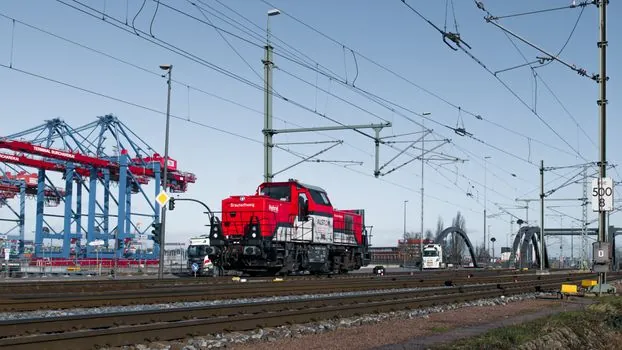
The rail line must maintain a consistent gauge, level and straight running direction because the crane travels along the fixed track during positioning [S2][S4]. Full gantry systems use two ground rails embedded flush with the finished floor or operating surface, allowing forklifts, carts, scissor lifts and trucks to cross the runway where the installation permits [S2].
Concrete rail beams or embedded rail foundations are required to handle the static crane weight and the moving wheel reactions generated during operation [S3]. In a ground-mounted installation, the foundation top, embedded support plates, rail, fastening system and wheel flange form one continuous load path. Any loss of level or gauge in that path can increase side forces, disturb wheel tracking and transmit shock loads into the concrete.
The foundation arrangement must also match the crane configuration. Full gantries place both legs on ground rails, while semi-gantries combine one ground-running leg with an elevated runway attached to a wall or building structure [S2][S4]. The ground beam should not be detailed as a symmetric two-rail foundation if only one side of the crane reaches the ground.
Subgrade, Drainage and Construction Sequence
A rail foundation distributes concentrated wheel reactions over prepared ground, so subgrade preparation is part of the foundation design rather than an informal site assumption. Large systems are deployed outdoors in cargo yards, stockyards, rail yards and precast areas, where rainfall, settlement and repeated traffic can affect both the concrete and the rail alignment [S2][S5].
Construction sequence has a direct schedule effect. Where early rail access is necessary, prefabricated or segmented concrete elements offer a different path, provided joints, support plates and connections are detailed to preserve line and level [S5].
Drainage must be coordinated with surrounding paving. Water trapped beside or beneath a rail beam can promote deterioration, washout around poorly drained joints and contribute to settlement. Pavement transitions should therefore be treated as part of the runway interface, not as an unrelated finishing layer. A flush crossing arrangement may support vehicle traffic, but only if the rail, fastening and cover or paving system remain compatible with repeated wheel loads.
Where a Ground Rail Foundation Is the Right Choice
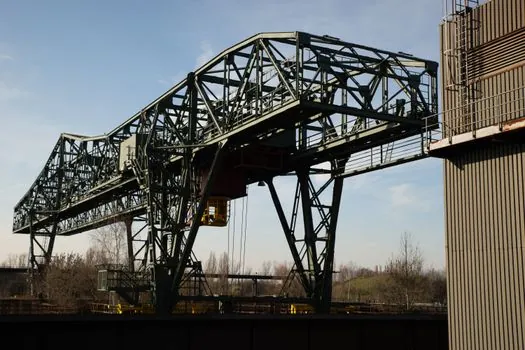
A ground rail foundation is appropriate when the crane must repeatedly serve a fixed straight work area, handles heavy loads and benefits from a permanent runway that does not depend on a building [S1][S2]. It suits outdoor cargo handling, rail terminals, steel or scrap yards, precast production and heavy fabrication areas where the operating path remains predictable [S2].
It is not the best fit for small maintenance lifts that must move among multiple locations. Portable gantries use casters or wheels and can be relocated between work areas, while rail-mounted systems remain constrained to their installed line [S2][S3]. A facility with an existing overhead runway may also be better served by a bridge crane because its load path uses building-supported runway beams rather than a ground foundation [S3].
The procurement boundary is equally important. The civil foundation, rail assembly and crane supplier may have different design duties. A defensible specification separates supplied crane components from owner-provided civil works, then defines who verifies the completed rail geometry, drainage interfaces, embedded components and foundation acceptance criteria. This prevents a prefabricated rail from being installed over an incompatible concrete beam.
Acceptance Criteria Before Crane Delivery
Acceptance should verify the interface that the crane will actually use: rail gauge, rail level, straightness, joint condition, embedded plate position, wheel-path clearance and drainage performance. The research establishes the need for embedded ground rails and engineered foundation beams, but it does not provide a universal numerical tolerance, so the project specification must set tolerances appropriate to the crane geometry, travel speed and duty cycle [S2][S3].
At minimum, the inspection and test plan should record concrete strength before loading, foundation dimensions, rail fastener completeness, rail alignment along the straight line, deviations at joints and the absence of standing water or damaged concrete. For cast-in-place construction, the documented 28-day wait before major loading is a useful schedule milestone and should not be shortened without an approved engineering basis [S5].
The gantry crane specification should then state the lifted load, crane span, lift height, travel path and required ground support conditions. For buyers comparing capacity, the separate gantry crane price per ton calculation is useful only after that operating envelope is defined, because foundation reactions cannot be scaled from a nominal capacity figure alone.