A cut-off machine used continuously should have an S1 continuous-duty motor unless its load, starts, braking, or cooling pattern requires S3 through S9.
The duty marking must match the real load cycle, including load duration, rest periods, starting frequency, braking, acceleration, and ambient conditions under IEC 60034-1.
S1 duty defines continuous production
S1 duty applies when the motor runs at constant load long enough to reach thermal equilibrium [S2][S4]. It is the appropriate base rating for a cut-off machine that remains loaded through an uninterrupted production shift, provided the motor is also sized for the actual cutting load.
S2 short-time duty covers a defined operating period followed by a rest long enough to return the motor to ambient temperature, and the nameplate carries the permitted duration, for example S2 30 minutes [S2][S4]. That designation is not an acceptable substitute for S1 when the cutter remains loaded continuously. If the machine is actually run nonstop, the continuous-duty rating must cover the resulting temperature rise [S4].
Power alone is not enough to establish the rating. A continuous motor also has to match the cutter’s torque, acceleration, load magnitude, frequency of starts, and required cooling. IEC 60034-1 defines duty as the load cycle, including starting, electric braking, no-load operation, and de-energized rest periods, together with their durations and sequence [S3].
S3 to S9 cover recurring cutting loads
S3 is intermittent periodic duty with load and rest periods that do not permit the motor to reach thermal equilibrium [S4]. S4 includes starting, S5 includes electric braking without a specified number of starts, S6 is continuous periodic duty, S7 includes electric braking together with a specified number of starts, and S8 incorporates load or speed changes [S3][S4]. S9 describes non-periodic duty with irregular load and speed variation [S4].
The cyclic duration factor is the ratio of loading time to total cycle time [S1][S3]. A 50% cyclic duration factor does not by itself identify the correct motor. The purchaser must declare the duty, because starts, braking, inertia, and load changes can add thermal load that a simple on-time percentage does not capture [S3].
For a cut-off machine, use S3 for a repeatable run-rest cycle without notable starting or braking effects, S4 when every cut cycle includes starting, and S5 where electric braking is part of the cycle. S9 is more appropriate when load and speed vary irregularly rather than following a stable cycle [S3][S4].
Compare ratings by production pattern
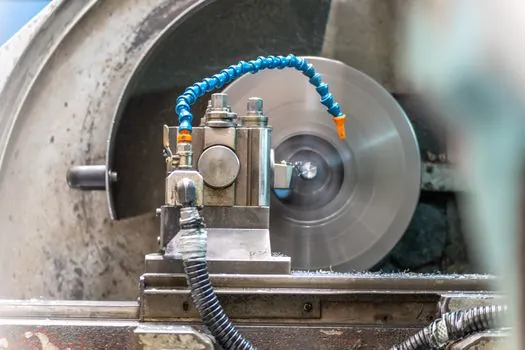
S1 is strongest when the machine holds one load for a complete shift, while S3 offers a defined intermittent alternative that depends on permitted cooling time. S4 through S8 apply where starting, braking, speed, or load variation materially increases heating, and S9 addresses irregular service that cannot be represented as a fixed periodic cycle [S2][S3][S4].
This comparison prevents a common purchasing error: selecting a short-burst motor by peak power and then operating it continuously. A motor rated for intermittent duty depends on rest periods to dissipate heat; continuous operation removes that allowance and can overheat the machine [S4].
Continuous use is suitable for selected machines
An S1-rated motor fits a cut-off machine whose load remains stable during long production periods, such as a fixed abrasive or wheel-cutting station operating without scheduled shutdown [S2]. Continuous-duty machines are also used where reliability and simple control are priorities, and the motor can operate near its rated capacity after thermal equilibrium is reached [S2].
Continuous duty does not automatically make the machine suitable. If the cutter jams, the wheel decelerates rapidly, or the drive experiences repeated starts, those events alter the thermal and mechanical requirements. The selected motor must still handle the cutting load, acceleration, and any braking without exceeding its allowable winding temperature [S3].
A cut-off machine designed for short production runs is better served by an explicitly documented intermittent rating, or by a continuous motor if operating margin justifies it. Larger ratings cost more and may operate below their efficient load point, while an undersized intermittent rating creates a thermal-failure risk [S1][S4].
Record the duty before ordering
The purchaser should declare the duty, including applicable operations and their durations and sequence [S3]. Nameplate duty markings identify the load and rest pattern for which the motor is rated, while IEC 60034-1 provides the classification framework [S3][S4].
For a genuinely continuous cut-off application, request S1 and verify that the motor reaches thermal equilibrium without exceeding its insulation-class limit. For repeated cutting, record the cyclic duration factor and specify S3, S4, S5, or another applicable class according to the actual sequence. If no duty is declared, continuous running duty is the applicable default under IEC 60034-1 [S3].
Guard against thermal and starting failures
The main failure mode is heat accumulation from continuous operation of an S2 or S3 motor. Continuous-duty motors are sized so their steady running temperature remains within the insulation class, while intermittent motors rely on rest periods to shed heat [S4]. If the application cannot provide those rest periods, the correct remedy is an S1-rated motor or a revised operating cycle.
Starting is the second failure mode. The manufacturer’s start rating must cover the cutter, wheel, chuck or arbor, and driven components as one inertia train. High starting frequency can make a motor that passes a simple power calculation unsuitable because starting adds heat not represented by steady-load output [S3][S4].
For a 50% cyclic duration factor, the motor is loaded for half of the stated cycle and rests for the other half, but the maximum permitted loaded duration and total cycle still need to be identified [S3]. Do not derive the rating from a production tonnage figure alone, because material, section thickness, abrasive type, wheel diameter, and cutting speed determine the actual load.
Track production evidence after commissioning
Validate the installed motor against at least 3 operating variables: winding temperature, motor current, and actual cycle duration. Record starts per hour and confirm that stop periods provide the cooling assumed by the rating. If the machine runs continuously but the purchase specification was S3, correct the mismatch before insulation damage develops. [S2]
The verifiable procurement record should show the motor nameplate rating, declared production cycle, calculated cyclic duration factor, measured current under representative cuts, and temperature trend during the longest planned run. For variable-load cutting, retain the motor nameplate, load profile, and cycle calculation together so the rating can be rechecked when wheel or material changes extend the duty cycle.